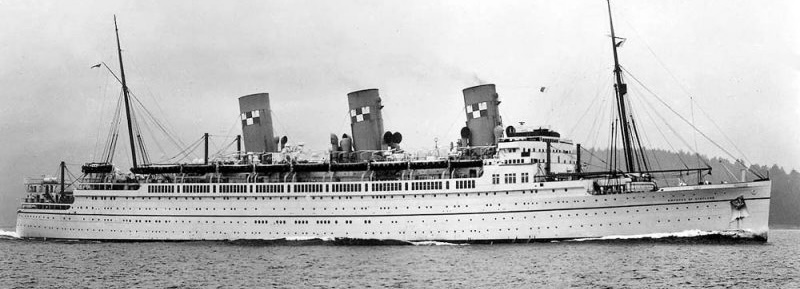
RMS Empress of Japan (1929)
Canadian Pacific · entered service 1930 · Ship Guide
Overview
RMS Empress of Japan (launched in 1929 and completed in 1930) was Canadian Pacific’s purpose-built trans-Pacific flagship—an “Empress” intended to plug into CP’s sea-and-rail “through route” concept: ship to Canada, CP rail across the continent, then a fast liner from Vancouver to Asia. In practice she became a defining Pacific presence of the 1930s, operating the Vancouver–Japan–China–Hong Kong circuit and projecting an “ocean-liner” standard of comfort on a route shaped as much by schedule reliability as by prestige.
Her name is also a built-in collecting trap—in 1942 she was renamed RMS Empress of Scotland, and in 1957–1958 she was sold and rebuilt again as TS Hanseatic. Many authentic artifacts exist across these phases, but the strongest cataloging keeps the identity ladder explicit and does not retro-label later pieces as “Empress of Japan” for romance.
Evidence-first note: Canadian Pacific also operated an earlier Empress of Japan (1890/1891 era). This page covers the 1929/1930-built liner that later became Empress of Scotland and Hanseatic.
Key Facts
Design & Construction (Context)
Built at Govan for Canadian Pacific, Empress of Japan was engineered to reduce overall “Europe-to-Far-East” journey times in the CP system and to carry a high-grade passenger experience on the Pacific equivalent of a prestige route. In collecting terms, this matters because CP material often presents the voyage as a seamless itinerary: rail-and-steamship brochures, port-of-call programs, and printed ephemera that treats Vancouver as the hinge between two oceans.
The ship also sits in a visual family with other Canadian Pacific “Empresses,” which is helpful for style recognition but hazardous for attribution. Treat any “looks like an Empress” claim as secondary; a printed ship name + date/ports line is the stronger anchor.
Service History (Summary)
1930–1942: Pacific flagship as Empress of Japan. Delivered to Vancouver in 1930, she operated CP’s trans-Pacific route through the decade, commonly summarized as Vancouver–Yokohama–Kobe–Shanghai–Hong Kong. Contemporary accounts often emphasize her speed and the nine-day crossing as a prestige marker. This is the core “Empress of Japan” collecting era: passenger lists, menus, sailing cards, brochures, deck plans, and port programs—often crisply branded.
1942–1957: Wartime identity and postwar Atlantic work as Empress of Scotland. Renamed in 1942, she was refitted for wartime needs, and after WWII she was rebuilt again to suit harsher North Atlantic conditions, returning to civilian passenger service. If your item says Empress of Scotland, catalog it that way—even if the seller markets it as “Empress of Japan.”
1957–1966: Rebuilt as TS Hanseatic. Sold and transformed for the Hamburg–New York trade, she emerged in the late 1950s as a modernized liner with altered superstructure. The ship suffered a catastrophic fire in New York harbor in September 1966 and was then scrapped at Hamburg.
Interpretive Notes
The ship is an evidence-first joy precisely because she changed names and markets: each phase has a distinct printed “identity ecosystem.” The most common problems you’ll see in listings are name collapse (everything labeled “Empress of Japan”) and era drift (1930s Pacific nostalgia used to sell later Atlantic or German-service material).
Practical checks:
1) Name as printed: Empress of Japan vs Empress of Scotland vs Hanseatic should be preserved in cataloging.
2) Ports line: Vancouver + Far East ports strongly supports the 1930s Pacific phase.
3) Operator branding: CP house style differs from Hamburg Atlantic; don’t “back-date” later items.
4) Disambiguation guard: confirm you’re not dealing with the earlier CP Empress of Japan of the 1890s/early 1900s.
Three names, three contexts: the 1929 Empress of Japan later became Empress of Scotland and ultimately Hanseatic. Those names mark genuine shifts in political, corporate, and route context rather than decorative renamings. A photograph or passenger document should therefore be cataloged under the contemporary identity first, with hull continuity explained second.
Her Pacific career is especially important because it places the ship in Canadian Pacific’s trans-Pacific system rather than the better-known North Atlantic world. Wartime service and later European operation belong to separate phases that generated different markings, interiors, routes, and documentary records.
The renamings also create a practical attribution hazard: later photographs of Empress of Scotland or Hanseatic should not be back-labeled as Empress of Japan without noting the date and configuration shown.
Evidence-first ship guide