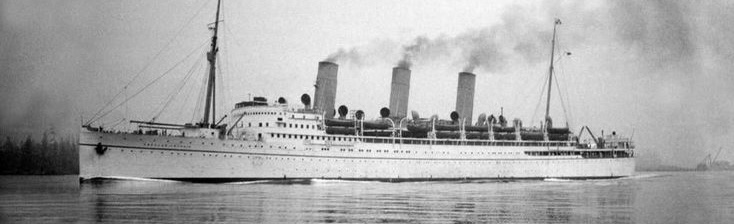
RMS Empress of Russia
Canadian Pacific · entered service 1913 · Ship Guide
Overview
RMS Empress of Russia was a Canadian Pacific trans-Pacific turbine liner built by Fairfield Shipbuilding & Engineering at Govan as yard no. 484. Launched on 28 August 1912 and completed in March 1913, she and sister Empress of Asia represented a new level of speed, scale, and prestige on Canadian Pacific's Vancouver–East Asia route.
Her importance lies in a distinctly Pacific history. She connected western Canada with Japan, China, and Hong Kong through a rail-and-sea network every bit as strategic to Canadian Pacific as its Atlantic service. Her long career also crossed several different documentary worlds: scheduled passenger service, armed-merchant-cruiser duty, postwar Pacific travel, and disaster relief after the 1923 Great Kanto earthquake.
Key Facts
A Pacific Empress
Empress of Russia should not be interpreted through a North Atlantic template. The Pacific route had its own ports, passenger markets, mail system, imperial geography, and commercial rhythms. Canadian Pacific linked ship and railway into one transportation network stretching from East Asia across Canada.
This integrated identity shaped the ship's material culture. Passenger lists, route brochures, baggage documents, and company advertising often emphasize not simply the ocean crossing but onward rail travel and the larger Pacific–Canada corridor.
Design and Prestige
With three funnels, two masts, turbine machinery, and four screws, the ship presented a modern profile distinct from earlier Pacific liners. Her size and speed demonstrated that Canadian Pacific did not treat the trans-Pacific trade as a secondary service.
The sister relationship with Empress of Asia is important for image attribution. Broadside photographs can be difficult to distinguish without captions, dates, or small structural clues, so published identification should be cross-checked where possible.
Speed on the Pacific
GG Archives credits Empress of Russia with a Yokohama-to-Race Rocks passage of 8 days, 18 hours, 31 minutes at an average of 19.86 knots. The record is route-specific, but it shows that Pacific passenger shipping had its own competitive culture of speed and prestige.
This should not be converted into a generic “fastest liner” label. The historical value lies in the exact route and context, just as Atlantic record claims require direction and date.
Passenger Service Before the War
After positioning from Britain, Empress of Russia joined the Vancouver–East Asia service. Passengers moved through ports including Yokohama, Kobe, Nagasaki, Shanghai, and Hong Kong, with Vancouver linking the ocean voyage to Canadian Pacific rail connections.
The class structure deserves contextual reading. First and second class served prestige and business travel, while lower-cost accommodation reflected very different migration and labor patterns from Atlantic steerage.
First World War
The Admiralty requisitioned Empress of Russia as an armed merchant cruiser. Her operating identity changed sharply: armament, naval orders, patrol work, and military administration replaced ordinary passenger scheduling.
Wartime photographs and documents therefore belong to a naval provenance category rather than simply to Canadian Pacific passenger service.
Emden Survivors
After the Battle of Cocos in November 1914, the ship became involved in transporting survivors from the German cruiser Emden. The episode connected a Canadian Pacific liner directly to one of the best-known naval actions of the early Pacific and Indian Ocean war.
It is an important wartime chapter, but it should remain proportionate within the longer armed-merchant-cruiser career.
Return to Passenger Service
After wartime duty, Empress of Russia resumed Pacific passenger work. The interwar years restored the ship to Canadian Pacific's travel network at a time when international tourism and business travel were expanding again across the Pacific.
Commercial material from this phase—brochures, deck plans, menus, passenger lists, and postcards—belongs to a distinctly interwar service context and should not be mixed with wartime configuration.
The 1923 Great Kanto Earthquake
The ship was at Yokohama during the Great Kanto earthquake and became involved in rescue and relief activity. This episode gives her an important disaster-response history beyond normal transportation.
The earthquake association can easily dominate later retellings, but it should not erase the much longer routine passenger career. Exceptional events are most meaningful when placed inside the ordinary service they interrupted.
Late Career and Loss
Empress of Russia remained in Canadian Pacific service for decades. In September 1945, while undergoing refit, she was severely damaged by fire. The hulk was later broken up in 1946.
The end came after more than thirty years of service spanning prewar prestige travel, two world-war eras, and major changes in the Pacific passenger business.
Passenger Markets Across the Pacific
The passenger mix on a Canadian Pacific trans-Pacific liner should not be interpreted as a direct equivalent of Atlantic migration traffic. Business travelers, colonial and diplomatic personnel, tourists, families, workers, and migrants moved through a route system connecting several East Asian ports with western Canada. The meanings of first, second, and lower-cost accommodation therefore depended on a different social geography.
Surviving passenger lists and route brochures can illuminate those patterns, especially when read alongside port calls and onward Canadian rail connections. The ship's significance is not simply that she crossed the Pacific quickly, but that she formed part of a durable network linking multiple regions.
Collecting and Attribution
Canadian Pacific's strong “Empress” branding creates a recurring attribution problem. A company crest, menu style, or luggage label may be authentic without proving use aboard Empress of Russia. Ship-specific naming, date, voyage, or passenger provenance remains the stronger standard.
Wartime material adds another layer: photographs of an armed merchant cruiser and peacetime passenger ephemera document different configurations and institutions. They should be described separately even though the hull is the same.
Interpretive Notes
Pacific route context is essential. The ship belongs to the history of Canadian rail-and-sea connections with East Asia, not merely to a generic global liner category.
Passenger, naval, earthquake-relief, and late-career materials should be separated by phase. The same hull served several very different institutional and human purposes over time.
Evidence-first ship guide