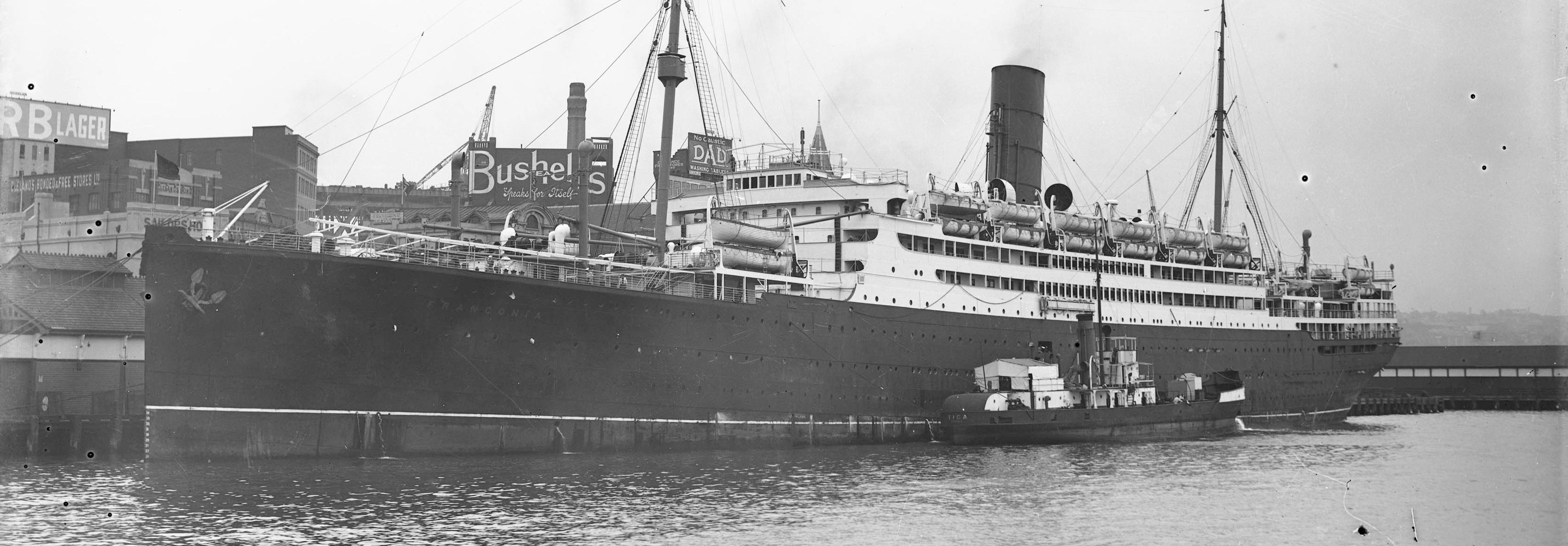
RMS Franconia
Cunard Line · 1923 · Ship Guide
Overview
RMS Franconia was a Cunard liner built by John Brown & Co. at Clydebank, launched in 1922, and placed in service in 1923. She belongs to the important interwar Cunard generation built for dependable transatlantic work rather than extreme speed, while also being well suited to the long world cruises that became a major part of her identity.
In collecting and interpretation, Franconia is especially interesting because her surviving material can fall into several distinct contexts: summer Liverpool–New York service, winter cruising ephemera, wartime troopship documentation, and postwar Canada-route material. Those contexts should be kept separate rather than blended into one generic “Cunard liner” label.
Key Facts
Passenger-capacity figures and route shorthand can vary slightly between summaries and brochures, especially when seasonal cruising arrangements are involved. For catalog precision, it is useful to preserve the figures exactly as printed on the source being cited.
Design & Construction Context
Franconia was part of Cunard’s large interwar rebuilding and renewal effort in the early 1920s. She was not intended as an all-out speed champion in the mold of the great express Atlantic liners, but rather as a spacious and commercially adaptable ship with respectable performance, broad passenger utility, and strong suitability for long-distance cruising.
That combination matters interpretively. Many liners are remembered mainly through a single route identity, but Franconia gained much of her character from dual service patterns: transatlantic crossings in one season and world or warm-climate cruises in another. As a result, her paper trail is often richer and more varied than that of a liner tied to one corridor alone.
Service History (Summary)
1923–1939: Entered Cunard service on the Liverpool–New York route, generally in the summer season. In winter she became closely associated with cruising, including extended world voyages and warm-weather itineraries.
1925 onward: Her cruise identity became especially prominent. Franconia is therefore a ship for which cruise brochures, cruise luggage labels, and voyage programs can be as historically characteristic as standard transatlantic passenger lists.
1926 and 1929 incidents: She ran aground at San Juan in late 1926 and was later involved in a collision at Shanghai in 1929. These events belong to the ship’s operational story, but do not define her broader service career.
1939–1948: Requisitioned by the British government as a troopship at the outbreak of the Second World War. She later took part in major wartime movements, including the Norwegian campaign, Operation Aerial, Mediterranean and Indian Ocean troop movements, amphibious landings, and service connected with the Yalta Conference.
End of war and aftermath: She carried troops, refugees, and repatriated personnel across the Atlantic and from India, giving her a significant but often under-emphasized humanitarian and postwar transport role.
1949–1956: Returned to Cunard after refit and resumed civilian service on the Canadian run from Liverpool to Quebec and Halifax. This late-career phase matters especially for immigration-related collecting, since she carried many postwar immigrants and displaced persons to Canada.
Interpretive Notes
Do not collapse cruise and liner identities: Franconia was both a North Atlantic liner and a major cruise ship in the interwar sense. A world-cruise brochure should not be interpreted in the same way as a routine Liverpool–New York passenger list.
Wartime and peacetime material require strict separation: troopship photographs, military transport documents, and postwar repatriation references belong to a wholly different interpretive frame than luxury cruising or standard Cunard passenger ephemera.
Postwar Canadian material is historically important: later Franconia items are not merely a lesser epilogue. They connect the ship to immigration, resettlement, and postwar Atlantic movement in a way that deserves independent attention.
Name ambiguity should be handled carefully: Cunard had multiple ships named Franconia. For cataloging, this vessel should be distinguished clearly as the 1922-launched / 1923-entered-service RMS Franconia.
Evidence-first ship guideSources (Selected)
- Ocean Liner Curator — Sources (master bibliography)
- RMS Franconia (1922) — overview and chronology
- Clydeships — Franconia builder and specification summary
- Cruise Line History — Franconia world-cruise context
- Norway Heritage — Franconia voyage chronology (research aid)
- GG Archives — Franconia archival and brochure material (research aid)