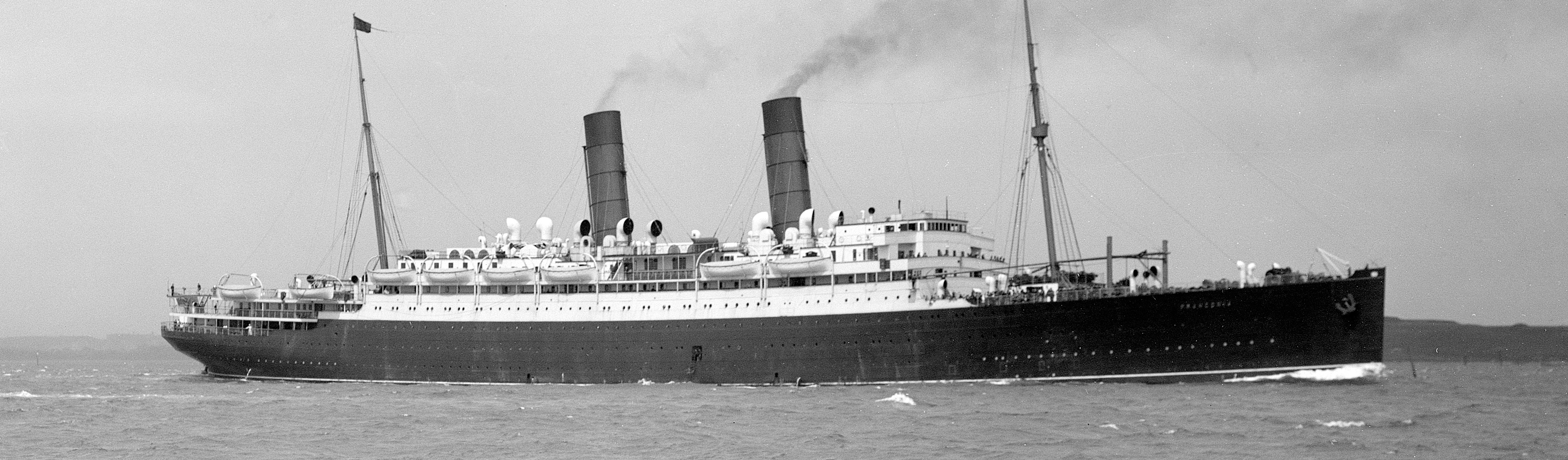
RMS Franconia (1910)
Cunard Line · entered service 1911 · Ship Guide
Overview
RMS Franconia was a large Cunard intermediate liner built by Swan, Hunter & Wigham Richardson for the Boston trade. Launched on 23 July 1910, completed in January 1911, and entering service the following month, she illustrates the important world of Cunard ships that combined immigrant-heavy transatlantic work with better-class travel and seasonal cruising rather than competing primarily for speed records.
Her surviving documentary trail can belong to several sharply different contexts: Liverpool–Boston service, Liverpool–New York service, Mediterranean work, migration traffic, hospital-ship duty, troop transport, and wartime loss. Those contexts should be separated rather than collapsed into one generic “Cunard” identity.
Key Facts
Designed for Commercial Flexibility
Franconia belonged to a generation of Cunard ships intended to earn their keep across several markets. She was large and comfortable enough to attract better-class passengers, but she also carried substantial numbers of emigrants and general travelers. Her speed was respectable rather than record-breaking, which suited a role where capacity and reliability mattered more than prestige.
Boston was especially important. Contemporary reporting on her first arrivals emphasized her size and passenger facilities, and the ship became closely associated with Cunard's Boston service. That route should not be treated as a minor footnote to New York; it was central to the ship's original commercial purpose.
Boston, New York, and Mediterranean Work
Before the war, Franconia worked Liverpool–Boston and Liverpool–New York sailings while also taking part in winter Mediterranean cruising. Some summaries additionally place her in emigrant-route service connected with Mediterranean ports. The result is a documentary history richer than that of a ship tied to only one route.
A winter cruise brochure, a Boston passenger list, and an emigrant sailing record all concern the same vessel, but they reflect different passenger markets and commercial intentions. Dates and port chains are therefore essential in interpreting surviving material.
Passenger Life
With accommodation spread across several classes, Franconia represented the mixed social world of the prewar Atlantic. First-class passengers experienced a more formal onboard environment, while the much larger lower-class complement reflected the continuing importance of migration and affordable passage.
This is precisely why ships like Franconia deserve fuller treatment. The historical significance lies not only in architecture or machinery, but in the thousands of ordinary journeys made aboard them.
War Service
After the outbreak of the First World War, the ship's documentary identity changed sharply. She entered British government service, serving first in a hospital-ship role and later as a troop transport. Wartime photographs, military records, and official correspondence belong to a different administrative system from civilian Cunard ephemera.
That separation matters because the same hull could be physically altered, differently staffed, and employed on routes dictated by military necessity rather than commerce.
Loss in 1916
On 4 October 1916, while in troop transport service and bound toward Salonika, Franconia was torpedoed by the German submarine UB-47. Twelve of her crew died, and survivors were taken aboard by Dover Castle.
Older secondary summaries sometimes identify the attacker imprecisely as “U-47.” The more specific attribution to UB-47 is retained here to avoid conflating two different German submarine designations.
Why Boston Matters
Boston was not merely an alternate port in Franconia's career. The route connected Cunard to a distinct New England passenger market and to large flows of migrants whose journeys continued inland after arrival. Local reporting treated the ship's arrival as a significant addition to the port, and that reception forms part of the historical record.
For researchers, Boston-linked material can therefore reveal a different network of agents, rail connections, port facilities, and immigrant communities from material associated with New York. Treating every Cunard artifact as part of one homogeneous Atlantic system would erase those regional differences.
Interpretive Notes
Name discipline is essential because Cunard reused the name Franconia. This page concerns the 1910-launched ship, not later vessels of the same name. Boston service deserves particular emphasis, as does the distinction between civilian liner, seasonal cruise, hospital ship, and troopship contexts.
For cataloging, route, date, class, and administrative setting should accompany the ship name whenever possible. Those details often determine the historical meaning of an object more clearly than the name alone.
Evidence-first ship guide