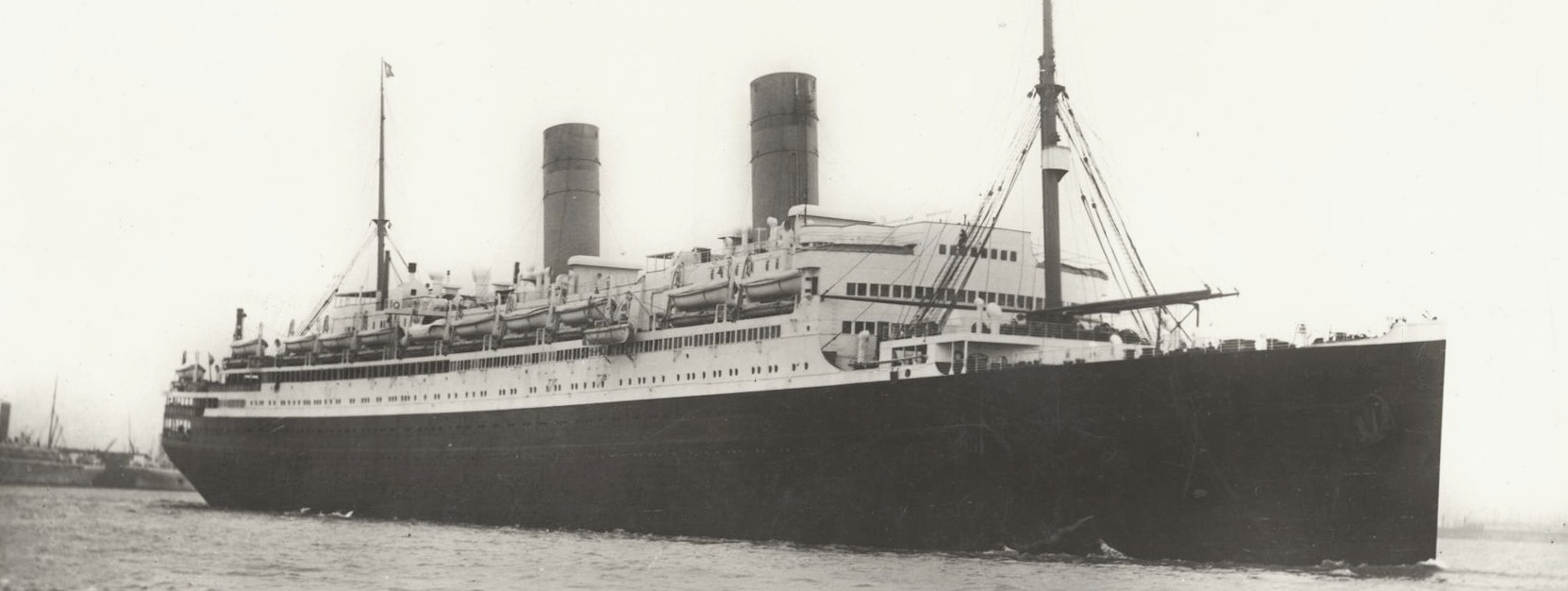
RMS Homeric (1913)
White Star Line · entered service 1922 · launched 1913 · Ship Guide
Overview
RMS Homeric is one of White Star Line’s most revealing “bridge ships” between eras: conceived as a German liner before World War I, completed in the war’s aftermath, and then reintroduced to the public under British ownership as part of the reparations settlement. Launched in 1913 as Norddeutscher Lloyd’s SS Columbus, her completion was interrupted by the war and resumed only after the conflict, culminating in her 1922 entry into White Star service as Homeric.
In the early 1920s, White Star needed a suitable running mate for Olympic. Homeric helped fill that gap until the arrival of the much larger Majestic (ex-Bismarck), forming the famous postwar trio. She was popular with passengers for comfort and space, but her relatively modest speed complicated strict “express” scheduling—an operational reality that shaped how she was deployed.
Evidence-first note: you’ll encounter this ship under two names (Columbus and Homeric) and two “systems” of documentation (German prewar intent vs. British/White Star operation). Date, company imprint, and route block usually solve attribution faster than ship photos.
Key Facts
Design & Construction (Context)
Homeric carries a “war-imprint” that collectors often sense before they can name it: her conception and launch belong to the pre-1914 world, while much of what passengers experienced (interiors, services, onboard routines) reflects the 1920s. That split is why her paper trail is so useful. The same hull can generate artifacts that feel stylistically “German prewar,” “British postwar,” and “White Star modern” depending on the date and department.
Operationally, the ship’s Achilles heel was speed. In a weekly express pattern, being a few knots slower matters—so her schedules, port calls, and seasonal deployment tell you as much about the interwar Atlantic market as the ship’s décor does.
Service History (Summary)
1912–1914: Ordered and launched as SS Columbus. Laid down in 1912 and launched 17 December 1913 for Norddeutscher Lloyd, intended for North Atlantic service from Germany to New York.
1914–1921: War interruption and delayed completion. Work halted after the outbreak of World War I; the ship remained unfinished until postwar settlement and completion in 1921.
1922–1923: White Star debut and “gap-filler” role. Renamed Homeric and introduced on the Southampton–New York run, joining Olympic and later Majestic as part of White Star’s postwar trio.
1923–1927: Efficiency changes and modernization. Converted from coal to oil firing (a major operational shift that also changes what you see in engineering/crew documentation) and later refitted, reflecting White Star’s attempt to keep the ship commercially attractive despite speed limitations.
1934–1935: Cunard-White Star transition and withdrawal. Following the merger era, she passed into the combined fleet, but was soon laid up, with her final year marked by ceremonial appearances rather than commercial resurgence.
1936–1938: Scrapping at Inverkeithing. Sold and broken up in Scotland, with demolition commencing in 1936 and finishing by 1938.
Interpretive Notes
Homeric is a high-value ship for “evidence-first collecting” because she produces clean, teachable contrasts: German-origin construction context vs. White Star’s interwar branding; coal-era vs. oil-era operational paperwork; and “express-liner marketing” vs. the realities of speed and schedule management.
Collector guidance: when evaluating ephemera (menus, passenger lists, deck plans, baggage labels, letterheads), prioritize: company imprint, route block, port agent lines, and dated onboard department headings. For ship-name confirmation, “Homeric” alone is usually enough—but “Columbus” requires extra caution due to reuse of the name across ships and contexts.
A ship shaped by wartime interruption: Homeric began as the German Columbus, but the First World War and the postwar settlement transformed both her ownership and career before she entered White Star service. That makes her a particularly clear example of how political events could redirect an unfinished or incomplete liner into an entirely different national fleet.
Her later White Star role should therefore be separated from the design context in which the ship was conceived. The same hull can be documented through German construction records, postwar transfer material, White Star passenger service, and later cruise-era use, each with its own evidentiary context.
Evidence-first ship guide