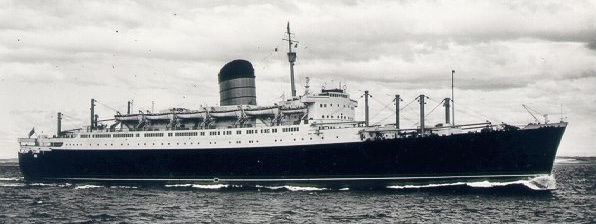
RMS Ivernia (1955)
Cunard Line · entered service 1955 · Ship Guide
Overview
RMS Ivernia was the second of Cunard's four postwar Canadian-service sisters. Launched by John Brown & Co. at Clydebank on 14 December 1954 and entering service on 1 July 1955, she was designed for the Britain–Canada trade at a moment when the liner business was shifting toward tourist-class volume, seasonal flexibility, and increasingly cruise-oriented winter deployment.
Like her sisters, Ivernia belonged to a practical middle tier of the Cunard fleet. She was neither an express-ship rival to Queen Mary nor a small coastal vessel, but a purpose-built Atlantic liner intended to serve Quebec and Montreal reliably while adapting to changing traffic outside the St. Lawrence season.
Key Facts
A Postwar Canadian Liner
Ivernia embodied Cunard's decision to renew the Canadian route with ships sized for the St. Lawrence rather than for maximum North Atlantic prestige. Her large tourist-class accommodation is particularly revealing. By the mid-1950s, broad middle-market travel was no longer secondary to the liner business; it was becoming central to the economics of ships like this.
The Canadian route also imposed a seasonal rhythm. Summer service centered on Quebec and Montreal, while winter closure of the St. Lawrence pushed ships into other Atlantic assignments and increasingly into cruising. That rhythm shaped everything from timetables to marketing and helps explain why the class proved so adaptable later.
Service with the Canadian Quartet
Ivernia joined Saxonia in 1955 and was followed by Carinthia and Sylvania. By the late 1950s the quartet had become a recognizable postwar Cunard family. They lacked the public glamour of the Queens, but they formed an important practical backbone of the company's scheduled passenger system.
Industrial action affected the planned departure point of Ivernia's maiden voyage, which began from Greenock rather than Liverpool. Such details matter because they remind us that liner history is not only about ships and routes but also about the operating realities of ports, labor, and seasonal traffic.
From Ivernia to Franconia
As jet aircraft eroded the economics of scheduled crossings, Cunard rebuilt the ship and renamed her Franconia in 1963. The new identity reflected more than branding. Accommodation, appearance, tonnage, and commercial emphasis shifted as cruising became more important.
For curatorial work, the conversion creates a clear boundary. Material labeled Ivernia documents the original Canadian-service liner; material labeled Franconia belongs to a later hybrid liner-cruise phase. Combining their specifications without date can produce misleading descriptions.
Fedor Shalyapin
Sold in 1973, the vessel became Fedor Shalyapin and continued in Soviet and post-Soviet service for many years. The remarkable longevity of the hull adds historical interest, but that later phase belongs to a different operator, market, and visual identity from the Cunard ship launched in 1954.
Passenger Market and Seasonal Work
The ship's first- and tourist-class division is more than a capacity statistic. It illustrates Cunard's response to the postwar expansion of middle-income international travel. Tourist-class passengers formed the great majority aboard, and the printed culture of the ship—menus, sailing lists, cabin plans, and promotional brochures—documents a social environment quite different from both prewar steerage and the luxury image of the Queens.
Seasonal redeployment also became part of Ivernia's identity. Summer Canadian sailings were the core business, but winter use could shift toward New York and cruising as the St. Lawrence closed and demand changed. This made the ship a flexible commercial instrument rather than a vessel tied permanently to one timetable.
Why the Rebuild Matters
The 1963 transformation into Franconia came as Cunard was trying to preserve value in ships whose original market was shrinking. The rebuilt vessel was marketed differently, used differently, and physically altered. For historians, this is precisely the kind of change that can make an undated interior photograph or brochure misleading if the two identities are casually merged.
Interpretive Notes
Name discipline matters throughout the career: Ivernia, Franconia, and Fedor Shalyapin are connected physically but should remain separate documentary identities. Canadian-route context is equally central; describing the ship merely as a generic mid-century Cunarder obscures the reason she was built.
Tourist-class material deserves particular attention because it documents the democratization of postwar Atlantic travel. Menus, brochures, deck plans, and cabin ephemera from this ship can reveal a social world very different from the prestige-first culture associated with earlier liner history.
Evidence-first ship guide