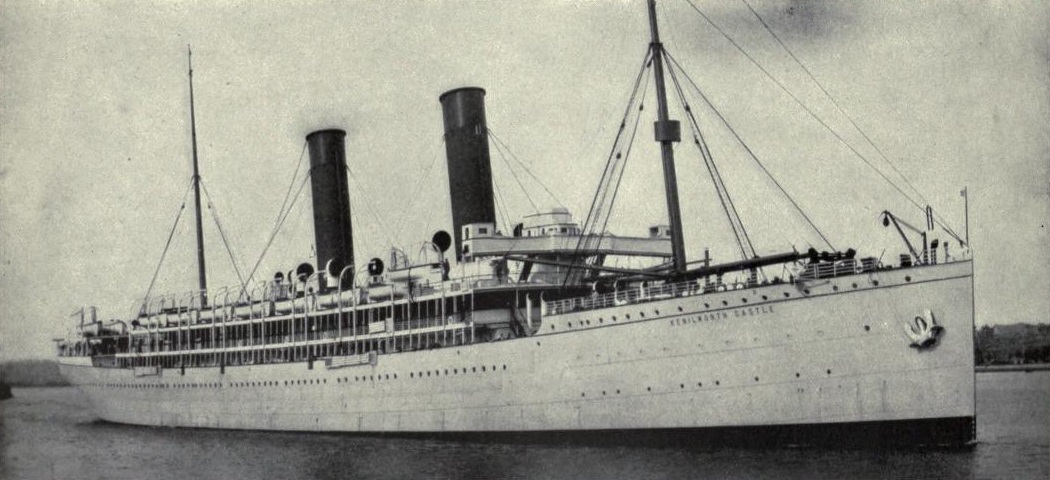
RMS Kenilworth Castle
Union-Castle Line · 1904 · Ship Guide
Overview
RMS Kenilworth Castle was a Union-Castle Royal Mail steamer built by Harland & Wolff for the Southampton–Cape Town service. The previous page at this filename incorrectly contained a guide to Armadale Castle; this revision restores the correct ship.
Launched at Belfast in December 1903 and entering service in May 1904, Kenilworth Castle spent most of her career on the South African mail route. Her First World War service included troop transport and a dramatic 1918 collision with the destroyer HMS Rival, after which depth charges exploded beneath the liner’s stern and fifteen of her crew were lost.
Key Facts
Built for the Cape Mail Route
Kenilworth Castle belonged to the first generation of large Union-Castle mail ships ordered after the 1900 amalgamation. Her commercial purpose was dependable long-distance service: passengers, mail, officials, emigrants, refrigerated cargo, and general freight moving between Britain and South Africa on a regulated schedule.
She was closely related to Armadale Castle, which helps explain how the two became confused in the previous guide. They were sister ships, but not interchangeable vessels: different builders, yard numbers, launch dates, and wartime histories distinguish them.
Passenger and Mail Service
After entering service in 1904, Kenilworth Castle settled into Union-Castle’s Southampton–Cape route. Typical voyages could include Madeira and several South African ports beyond Cape Town. Passenger lists therefore document a wide range of travelers: officials, military personnel, settlers, tourists, families, and returning residents.
For curatorial work, route and voyage date are stronger identifiers than the generic “Castle” naming pattern. Many Union-Castle ships shared similar profiles and branding, so a ship-specific passenger list or timetable is especially valuable.
First World War Troopship Service
The Admiralty requisitioned Kenilworth Castle in August 1914. She took part in the well-known six-ship Union-Castle convoy that carried roughly 4,000 troops to Europe and remained in troop service into early 1915 before returning to mail work.
Photographs preserved by Royal Museums Greenwich show her again as a troopship in 1917. Wartime use altered the meaning of the ship even when the name remained unchanged: naval escort records, troop manifests, temporary fittings, and operational photographs belong to a distinct evidentiary phase from normal passenger service.
The 4 June 1918 Collision
Shortly after midnight on 4 June 1918, while proceeding without lights in convoy near the Eddystone area, Kenilworth Castle maneuvered to avoid HMS Kent and collided with the destroyer HMS Rival. The impact severed or damaged Rival’s stern and dislodged live depth charges, which exploded beneath Kenilworth Castle’s stern.
The liner remained afloat and ultimately reached Plymouth, but the casualty was severe. Fifteen members of her crew died after evacuation boats were swamped during the confusion. The ship required extensive repair and did not return to normal service until 1919.
Postwar Return and Refit
After repair, Kenilworth Castle resumed the Cape mail service. She was held in quarantine at Table Bay during the influenza crisis in 1919 and underwent further refit work in 1928. By the mid-1930s, accommodation had been simplified as the passenger market and fleet structure changed.
These later alterations mean that deck plans and passenger totals should be dated. An early Edwardian arrangement should not be assumed to describe the ship in her final years.
1934 Accommodation Change
Union-Castle records indicate that second-class accommodation was removed in 1934. That late-career change is a useful provenance boundary: passenger totals and class arrangements from the Edwardian ship should not be carried forward unchanged into her final two seasons.
Disposal-Date Caution
The final disposal date is reported differently in otherwise useful fleet summaries. Union-Castle specialist material describes Kenilworth Castle at Newport awaiting Cashmore’s breakers in 1936, while other compiled references date the completed scrapping to 1937. The safest wording is therefore withdrawal in May 1936 followed by demolition across the 1936–37 period.
Withdrawal and Disposal
Kenilworth Castle was withdrawn from service in May 1936. She was sold for demolition and broken up in 1937, ending more than three decades associated with Union-Castle’s South African route.
Why Kenilworth Castle Matters
The ship matters for two reasons. First, she was a long-serving Cape mail liner whose history belongs to the everyday infrastructure of Britain–South Africa travel. Second, the 1918 collision is an unusually well-documented wartime casualty in which a passenger liner, convoy maneuvering, a destroyer, and live depth charges combined in one event.
For attribution, use the builder, yard no. 356, official number 118433, 1904–36 service span, and the Rival collision. Those anchors also prevent confusion with sister Armadale Castle or later ships carrying the Kenilworth Castle name.
Sources (Selected)
- Ocean Liner Curator — Sources (master bibliography)
- British & Commonwealth Staff Register — Kenilworth Castle (2)
- Royal Museums Greenwich — Kenilworth Castle as a troopship, 1917
- South African Military History Society — the 1918 Kenilworth Castle incident
- RMS Kenilworth Castle — chronology and published bibliography
- British & Commonwealth Staff Register — Kenilworth Castle service chronology
Sources (Selected)
Use these as a starting index and corroborate publish-ready details with contemporary registers, Admiralty records, passenger lists, company timetables, and archival material where possible.
- Ocean Liner Curator — Sources (master bibliography)
- Clydeships — Armadale Castle builder and registry particulars
- British & Commonwealth Staff Register — Armadale Castle
- British & Commonwealth Staff Register — HMS Armadale Castle
- GG Archives — RMS Armadale Castle archival collection
- Wikipedia — SS Armadale Castle (starting index; corroborate key facts)