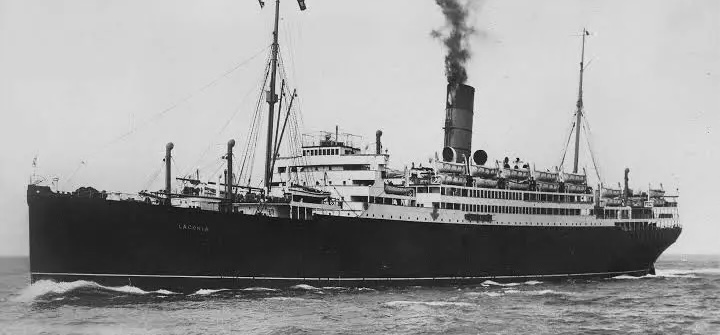
RMS Laconia (1921)
Cunard Line · launched 1921 · entered service 1922 · Ship Guide
Overview
RMS Laconia was a large Cunard passenger-and-cargo liner built at Wallsend on the River Tyne in the difficult aftermath of the First World War. Launched on 9 April 1921 and completed in January 1922, she was intended for regular Atlantic work rather than outright speed competition. At about 19,680 gross tons, with twin screws and a service speed of roughly 16½ knots, she represented a practical new generation for a company rebuilding a fleet that had suffered heavy wartime losses.
Yet Laconia became historically significant for reasons far beyond ordinary line service. In 1922–23 she made the voyage Cunard identifies as its first world voyage, returning to New York after a 130-day circumnavigation. Two decades later she was serving as a troop transport when U-156 torpedoed her in the South Atlantic on 12 September 1942. The rescue effort that followed—undertaken by German and Italian submarines and Vichy French warships, interrupted by American air attack—became the “Laconia incident” and helped produce the German order restricting U-boat rescue of survivors.
Key Facts
A Postwar Cunarder
The first Laconia had been sunk by a German submarine in 1917. Cunard reused the name for the new postwar ship, which emerged from Swan Hunter's Wallsend yard at a moment when British liner companies were reconstructing both fleets and route networks. Her design did not pursue the extreme speed associated with prewar express liners such as Lusitania and Mauretania. Instead, she combined substantial passenger accommodation with refrigerated cargo capacity and moderate, economical speed.
Tyne Built Ships records accommodation for roughly 350 first-class, 350 second-class, and 1,500 third-class passengers, underlining how broad a market the vessel was intended to serve. She was built for Liverpool–Boston and New York work, placing her firmly within Cunard's practical North Atlantic network rather than its fastest prestige tier.
The 1922–23 World Voyage
Laconia's most important peacetime distinction came almost immediately. Cunard records that she departed on the company's first world voyage in 1922 and completed the circumnavigation 130 days later. In the company's centenary account of the voyage, Laconia called at 22 ports before returning to New York in March 1923.
This voyage matters because it shows the ocean liner being used for something more than point-to-point transportation. A scheduled Atlantic liner could also become a vehicle for extended destination travel, linking a sequence of ports into a single marketed experience. Later “world cruises” would develop the concept far beyond the conditions of the early 1920s, but Laconia's voyage became a foundational reference point in Cunard's own history of that trade.
Interwar Service
After the world voyage, Laconia continued in Cunard service through the interwar years. Her career overlapped with a fleet that ranged from older prewar vessels to the former German Berengaria and, eventually, the new Queen Mary. She therefore belonged to the less glamorous but essential middle of the fleet: large enough for major passenger work, versatile enough for changing assignments, and never dependent on record-breaking speed for her identity.
When Cunard and White Star were combined operationally in 1934, ownership and fleet presentation changed, but Laconia remained useful. By the end of the decade, however, European war transformed the role of the ship completely.
Armed Merchant Cruiser
The Admiralty requisitioned Laconia in September 1939. After conversion she entered service on 6 January 1940 as the armed merchant cruiser HMS Laconia, pennant F 42. Uboat.net records an armament of eight 6-inch guns and two 3-inch guns and places her successively with the Halifax, Bermuda and Halifax, and North Atlantic escort forces.
Armed merchant cruisers were a wartime compromise: large commercial hulls could be made available quickly for patrol and escort duties, but they lacked the protection and fighting qualities of purpose-built warships. Laconia's period in this role ended in October 1941, when she was transferred for troop-transport work under the Ministry of War Transport.
The Final Voyage
In September 1942 Laconia was sailing from the Middle East toward the Atlantic via South Africa. Her human cargo was unusually complex: British military personnel and civilians, crew, Polish guards, and approximately 1,800 Italian prisoners of war were aboard. Late on 12 September, U-156 under Werner Hartenstein fired two torpedoes at the unescorted ship.
Uboat.net places the attack at 22:07 and the sinking at 23:23, at approximately 5°05′ south, 11°38′ west. Conditions during abandonment were chaotic, and the presence of the Italian prisoners—many confined below before the torpedoing—contributed to the scale of the disaster.
The Laconia Incident
After surfacing, Hartenstein's crew heard Italian voices among the survivors and realized that the ship had been carrying Axis prisoners. U-156 began rescue work, taking survivors aboard and towing lifeboats. Hartenstein transmitted messages seeking assistance, and other German U-boats, the Italian submarine Cappellini, and Vichy French ships were directed toward the area.
The rescue then entered one of the most controversial episodes of the Atlantic war. A U.S. Army Air Forces B-24 from Ascension Island located U-156 while the submarine was carrying and towing survivors. According to the U.S. Naval History and Heritage Command, the aircraft accurately reported the rescue situation but was ordered to attack. The submarine was forced to abandon the exposed rescue operation and dive.
Rescue efforts nevertheless continued elsewhere. Uboat.net records 1,083 survivors eventually saved, including hundreds picked up by the Vichy French cruiser Gloire and the sloops Dumont d'Urville and Annamite. The episode became closely associated with the subsequent “Laconia Order,” by which Karl Dönitz directed German submarines not to undertake rescue measures for survivors of ships they had sunk.
Counting the Dead
The casualty figures deserve caution. Uboat.net gives a complement of 2,741, with 1,658 dead and 1,083 survivors. A modern Naval History and Heritage Command summary gives 2,732 people aboard. Other historical accounts use still different totals because manifests, military personnel, prisoners, guards, and last-minute movements were not always counted in the same way.
For that reason, this guide does not force all sources into a single supposedly exact embarkation total. The most defensible conclusion is that roughly 2,700 people were aboard and that well over 1,600 died. Where a precise figure is quoted, the source should travel with it.
Why Laconia Matters
Laconia connects three very different histories. She was part of Cunard's reconstruction after the First World War; she became an early instrument of long-form leisure travel through the 1922–23 circumnavigation; and she ended as the center of a wartime disaster whose rescue effort affected submarine doctrine.
That breadth is precisely why the ship should not be remembered only through the circumstances of her sinking. The 1942 incident is enormously important, but it came after two decades in which Laconia had already helped demonstrate how flexible the interwar ocean liner could be—as transport, cargo carrier, cruise vessel, and eventually wartime auxiliary.
Interpretive Notes
Do not confuse the two Cunard ships named Laconia: the earlier 1912-built Laconia was sunk in 1917. This guide concerns the second ship, launched in 1921 and completed in 1922.
World-voyage terminology: Cunard describes the 1922–23 voyage as the first continuous passenger-liner circumnavigation and the beginning of its world-cruise tradition. “First world cruise” is therefore best understood in the context of Cunard's documented claim and the later development of the cruise concept.
Casualty totals vary: published figures differ slightly even among serious sources. The variation should be retained rather than concealed behind false precision.
Evidence-first ship guide