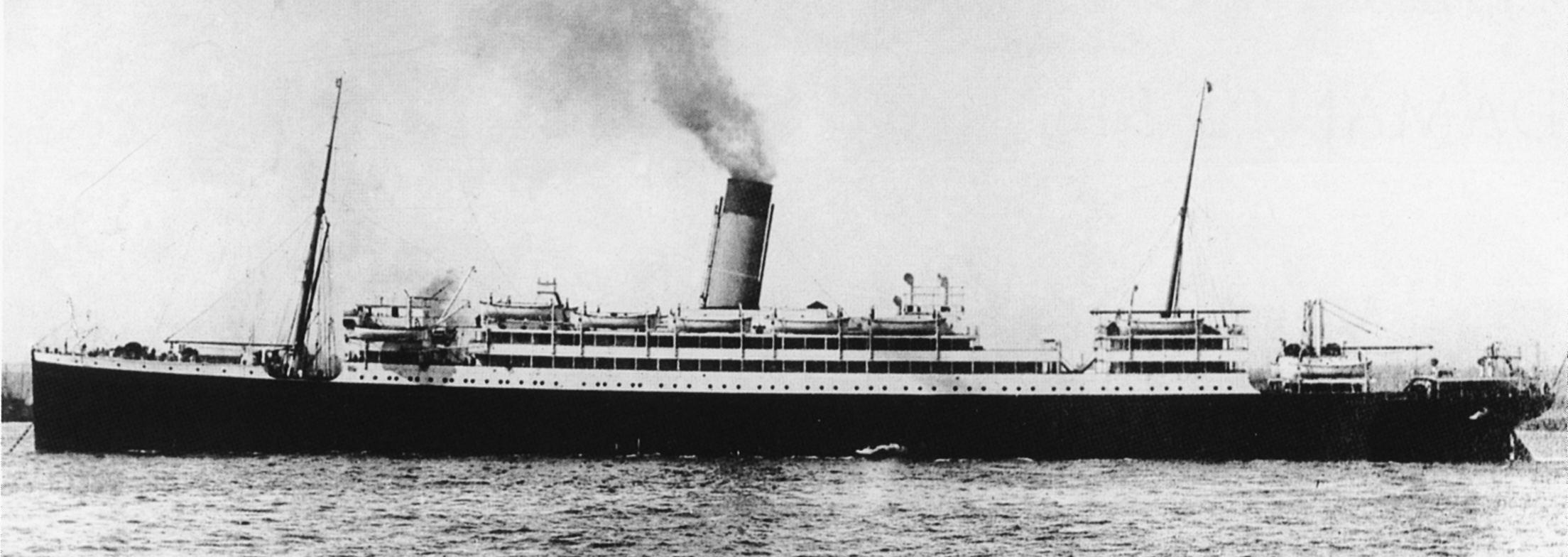
RMS Laurentic
White Star Line · 1909 · Ship Guide
Overview
RMS Laurentic (White Star Line) entered service in 1909 on the North Atlantic—best known for Canadian trade sailings connecting Liverpool with Québec and Montréal in season. She became historically prominent for her wartime loss in January 1917 off Lough Swilly, Ireland, while carrying a large shipment of gold bullion—an episode that generated extensive postwar salvage work and lasting collector interest.
Name caution: White Star also operated a later Laurentic launched in 1927. This guide covers the earlier ship launched in 1908 and placed in service in 1909 (often styled “Laurentic (I)” in reference works).
Key Facts
Many secondary sources summarize Laurentic quickly; for collector-grade precision, prioritize period passenger lists, sailing circulars, company brochures, and official archival records tied to a specific date.
Design & Construction Context
Laurentic originated as a Dominion Line order within the International Mercantile Marine (IMM) orbit and was transferred to White Star before completion—useful context when you encounter early printed matter that blends “Canadian service” framing with White Star branding. In the market she was not an express record-breaker; she was a robust, revenue-earning route ship built for sustained North Atlantic work.
Service History (Summary)
1909–1914: Regular passenger service on the Liverpool–Canada route, with Québec and Montréal as key terminals during the St. Lawrence season. Period reporting and later summaries often mention winter redeployment patterns when the river was closed.
1914–1917: Requisitioned for wartime service. In January 1917 she departed on a voyage connected with high-value bullion carriage. On January 25, 1917 she struck mines and sank off the north coast of Ireland.
1917–1920s: The wreck became the focus of sustained salvage activity. The “Laurentic gold” story—both the reality of official recovery efforts and the later mythology—helped keep the ship in public memory long after the war.
Interpretive Notes
How “Laurentic” shows up in collections: passenger lists, agent brochures, luggage labels, postcards, and menus are the most common categories. Items tied to Canadian ports (Québec / Montréal) tend to be more informative than generic “Atlantic crossing” ephemera.
Gold-bullion claims: material advertised as “from the gold ship” is often story-forward. Curator practice: treat “gold ship” language as interpretive context unless the object can be anchored to the 1916–1917 window by date, imprint, or traceable provenance.
Disambiguation discipline: because there is a later Laurentic (launched 1927), always verify by date and visual details. If your artifact references the late-1920s Canadian service and looks “interwar modern,” it may belong to the later ship.
Evidence-first ship guideSources (Selected)
- Ocean Liner Curator — Sources (master bibliography)
- SS Laurentic (1908) (overview; cross-check recommended)
- Titanic & Co. — White Star Line: Laurentic (build dates & basic particulars)
- Bank of England Archive — “HMS Laurentic: salvage operations” (catalog record)
- Western Front Association — Laurentic loss and bullion narrative (context)
- SS Laurentic (1927) (for disambiguation; cross-check recommended)