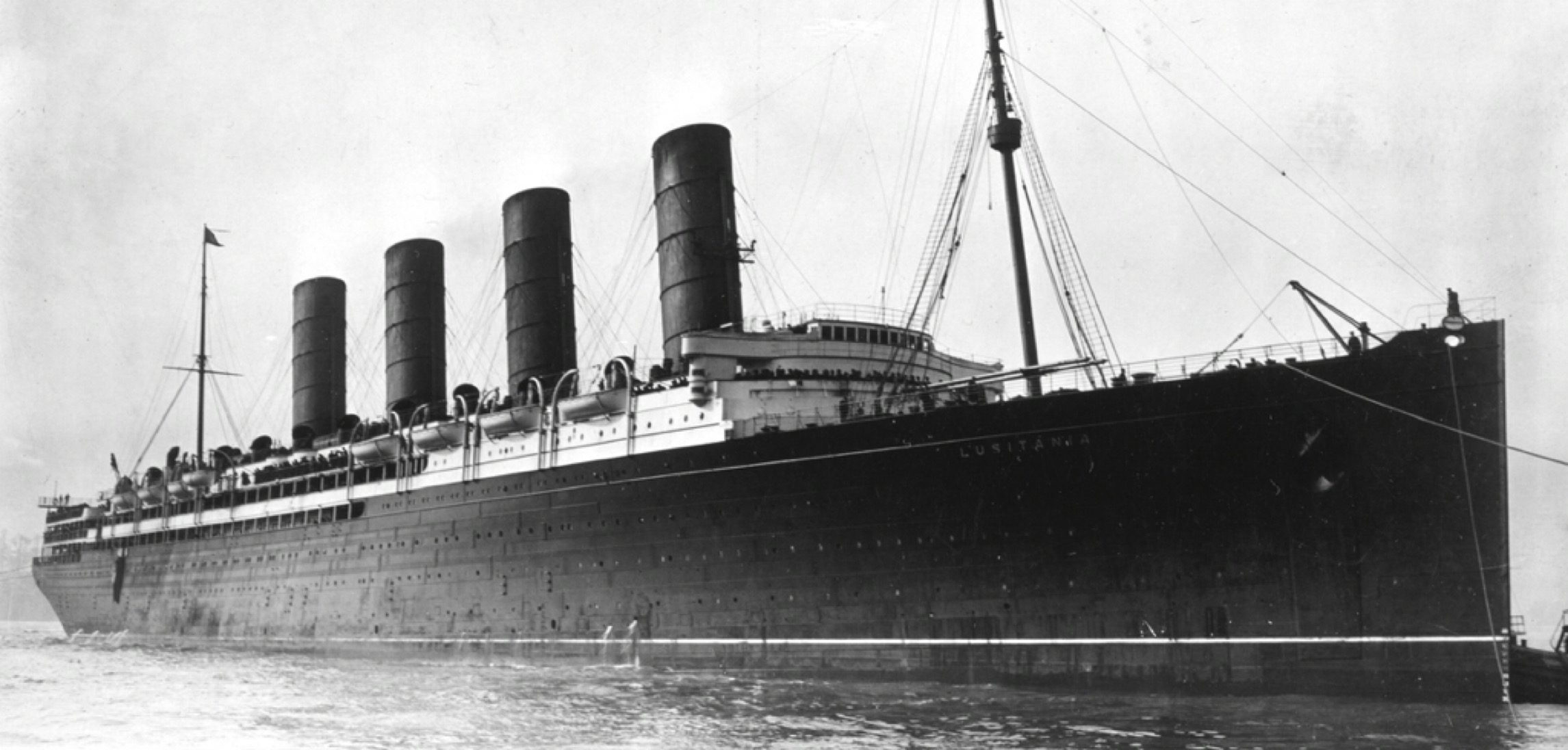
RMS Lusitania
Cunard Line · 1907 · Ship Guide
Overview
RMS Lusitania was a British transatlantic express liner built for the Cunard Line and placed into service in 1907. Designed for speed, prestige, and dependable North Atlantic schedules, she became one of the best-known liners of her era—both for her prewar reputation and for the circumstances of her loss during the First World War.
This page is written as a reference doorway: it summarizes widely documented facts, flags uncertainty where it exists, and avoids turning repeated anecdotes into “record” without evidence.
Key Facts
Note on figures: published totals differ because passenger manifests, stowaways, post-rescue deaths, and contemporary recordkeeping do not always align cleanly across official investigations and later reconciliations.
Design & Construction (Context)
Lusitania was conceived during a period when North Atlantic competition rewarded speed, regularity, and a convincing public image of modernity. In practice, that “modernity” shows up in design choices that matter to collectors: branded Cunard fittings, printed material that signals class structure, and interior style that sits between late-Victorian comfort and early-Edwardian restraint.
For collecting and attribution, the most useful approach is to think in “eras” rather than in one timeless ship identity: prewar Cunard material (1907–1914) tends to differ in typography, ticketing language, menu styling, and onboard ephemera from wartime context (1914–1915), where routing, security practices, and public messaging changed.
Service History (Summary)
After entering service in 1907, Lusitania operated as a high-profile Cunard express liner on the Liverpool–New York run. Like her near-contemporary rivals, she functioned as both transportation and public theater—an engineered promise of schedule reliability and status.
With the outbreak of World War I, transatlantic passenger travel continued but carried new risk. Public warnings, changing naval strategy, and the collision of civilian shipping with wartime policy created a context where even “regular service” voyages could become politically explosive events.
Sinking (Evidence-First Summary)
On May 7, 1915, Lusitania was torpedoed off the south coast of Ireland by German submarine U-20 and sank rapidly—often summarized as about 18 minutes from impact to loss. The disaster produced heavy casualties and significant international backlash.
Many accounts describe a second explosion after the torpedo strike. The cause of that second explosion has been debated for over a century, and the literature ranges from cautious technical discussion to internet-native certainty. Ocean Liner Curator treats the “second explosion” as a documented observation in many sources, while keeping causal claims (what exactly exploded, and why) in the “contested / evidentiary” category unless supported by primary technical documentation.
Later History & Collecting Implications
Because Lusitania was lost at sea, the “fittings dispersal” pattern you see with scrapped liners (architectural salvage, hotel installs, auctions) is limited and uneven here. That matters in the market: claims of “from Lusitania” can attract strong prices despite weak chains of custody, especially for items that resemble general Cunard-era material.
As a rule: the more a claimed object would matter financially or historically, the more it should be anchored to documentation you would cite publicly: institutional holdings, contemporary purchase records, excavation / recovery context, or a traceable chain of custody. Where that chain isn’t present, the responsible label is often “attributed” or “unverified.”
Interpretive Notes
Lusitania sits at the center of several recurring narratives: the legality and ethics of the attack, the meaning of passenger warnings, the nature of cargo aboard, the second explosion, and claims about deliberate provocation or “secret intentions.” Some questions are well-treated in mainstream scholarship and official documentation; others persist because they offer a dramatic, single-cause story.
Ocean Liner Curator’s stance is simple: keep facts and inference separated. When a claim materially changes identification, historical meaning, or market value, it should be held to a higher standard than repetition. If the best available record remains ambiguous, “unknown” can be the most responsible conclusion.
Evidence-first ship guideSources (Selected)
This list is intentionally conservative.
- Ocean Liner Curator — Sources (master bibliography)
- Encyclopaedia Britannica — “Lusitania” (overview)
- Imperial War Museums — “18 Minutes That Shocked the World” (context and artifacts)
- Library of Congress — “The Lusitania Disaster” (WWI collection essay)
- National Museums Liverpool — RMS Lusitania archive sheet (launch and local context)
- The Lusitania Resource (rmslusitania.info) — reference hub (cross-check against primary documentation)