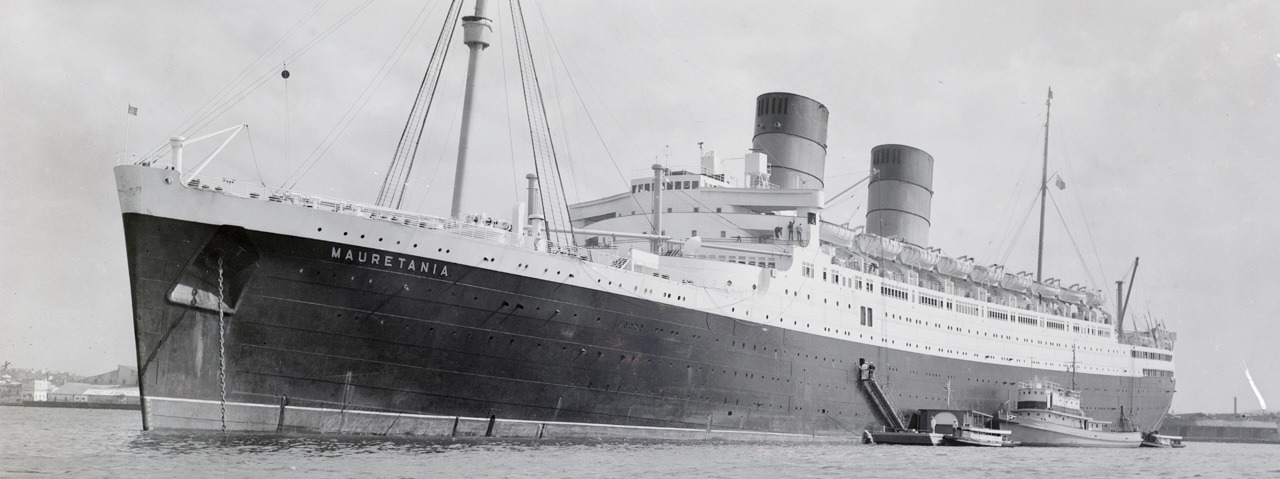
Cunard-White Star Line (later Cunard Line) · 1939 · Ship Guide
Overview
RMS Mauretania (II) was Cunard-White Star’s prewar “workhorse modern”: a large, handsome British liner launched in 1938 and placed on the North
Atlantic in 1939—just in time for the route to be transformed by World War II. She never had a long, uninterrupted prewar career; instead her story is
dominated by wartime requisition and troopship service, followed by a long postwar second life carrying Atlantic passengers and, later, cruise traffic.
For collectors and researchers, Mauretania (II) is useful because her material culture spans distinct markets: late-1930s “new liner” branding,
wartime austerity and government service, then postwar Cunard passenger operations (with repeated refits and class redefinitions). Dating is everything.
Evidence-first note: published tonnage figures and passenger capacities can differ slightly across references and can change after refits.
If you publish a single number, anchor it to a dated source or to a specific configuration.
Key Facts
Operator
Cunard-White Star Line (later Cunard Line)
Name
RMS Mauretania (II)
Builder
Cammell Laird (Birkenhead, England)
Laid down
24 May 1937 (commonly cited)
Launched
28 July 1938 (often cited; some sources give 27 July)
Maiden voyage
17 June 1939 (Liverpool → New York)
Primary route (prewar / postwar)
North Atlantic service (ports varied by period and scheduling)
Tonnage
Commonly cited ~35,738–35,739 GRT (varies slightly by reference)
Service speed (typical)
About 23 knots (commonly cited)
Wartime role
Requisitioned and used as an armed merchant cruiser / troopship (timeline varies by source)
Postwar service
Returned to civilian service; later used extensively for cruising
Fate
Withdrawn 1965; scrapped 1965–66 (commonly cited: Thos. W. Ward)
Design & Construction (Context)
Designed for a modernized Cunard-White Star era, Mauretania (II) carried a sleek, late-1930s profile—balanced proportions, twin funnels, and
a “contemporary” interior program intended to read as modern rather than Edwardian. In research terms, she’s a reminder that “ocean liner style”
isn’t one look: the interwar period produced its own design language, and it shows up clearly in printed material, onboard graphics, and cabin ephemera.
A practical research takeaway: because she served through multiple eras and underwent repeated refits, avoid treating any single deck plan or postcard
as definitive for the whole career. Date the depiction first; interpret second.
Cut-away View & General Arrangement
This illustration provides a visual guide to RMS Mauretania (II)’s internal arrangement.
Select the image to open a larger, viewport-aware view.
General arrangement
Passenger spaces and machinery layout
A sectional view helps relate passenger decks, public rooms, cabins, service spaces, and machinery within the ship’s
late-1930s arrangement. Because Mauretania underwent wartime conversion and later refits, the drawing should be
interpreted as a record of a particular configuration rather than her entire career.
Curatorial note: Published deck plans and sectional drawings may reflect a specific service period or refit.
Treat room names, capacities, and internal arrangements as era-specific unless the illustration clearly identifies its date.
Service History (Summary)
1939: Brief peacetime introduction.Mauretania (II) entered service in 1939 and made a small number of Atlantic crossings before
the outbreak of war reshaped civilian operations.
1939–1946: Requisition and troopship service. Like many large liners, she was taken up for government use, armed and repurposed, and then
employed as a troopship. Her movements in this period intersect with the wider machinery of convoy routing and long-distance transport—an area where primary
documentation (movement cards, convoy records, official logs) matters more than later summaries.
1947–1965: Postwar Atlantic work and cruising. After the war she returned to civilian service, operating transatlantic routes in the postwar
passenger market and, as the decades progressed, pivoting increasingly toward cruising. By the 1960s, the changing economics of the Atlantic and the rise of
jet travel made older liners difficult to operate profitably without heavy modernization. Mauretania (II) was withdrawn in 1965 and scrapped shortly after.
A Prewar Career Cut Short
Mauretania entered service only weeks before the outbreak of the Second World War. That timing meant her intended peacetime role was never allowed to settle into a normal prewar pattern; the ship moved almost immediately from new-liner publicity into wartime government service.
This is crucial when dating photographs and printed material. The glamorous launch-and-maiden-voyage image belongs to a very narrow 1938–1939 window, while most of the ship's early operational history is wartime.
Troop Transport at Global Scale
After requisition, Mauretania was adapted for military transport and operated over long-distance Allied routes. Her size, speed, and relatively modern machinery made her valuable for carrying large numbers of personnel over ocean distances that had little resemblance to her intended North Atlantic schedule.
The wartime phase also altered her material identity: accommodation, fittings, and passenger spaces were adapted for military use, so surviving wartime images and plans should not be interpreted as representative of civilian Cunard service.
From Atlantic Liner to Cruise Ship
Returned to civilian service after the war, Mauretania resumed North Atlantic work but increasingly moved toward cruising as air travel eroded the liner market. Repeated refits changed passenger capacity and onboard presentation during this later phase.
Her final years therefore illustrate a broader industry transition. A ship conceived as a modern transatlantic liner in the 1930s ended her career participating in the cruise economy that would ultimately replace much of traditional scheduled passenger shipping.
Interpretive Notes
Mauretania (II) rewards a “date-first” approach. Many artifacts—menus, souvenir booklets, stationery, baggage labels—look broadly similar across years,
but small design cues (company name, address lines, crest styles, class terminology, route wording, even paper stock) can narrow an item’s timeframe dramatically.
If you collect or catalog Mauretania (II) material, resist the temptation to let the famous name do the attribution work. “Mauretania” is a legacy brand,
reused intentionally; a careful description should clarify which ship (and which era) your item belongs to.
Fleet context:Cunard’s Postwar Fleet Strategy places this ship within the company’s changing postwar mix of express service, cruising, Canadian routes, and jet-age adaptation.
Evidence-first ship guide
Sources (Selected)
These are useful starting points for dates and broad career outlines. Corroborate publish-ready specifics (especially wartime chronology and technical figures) with primary or institutional sources.