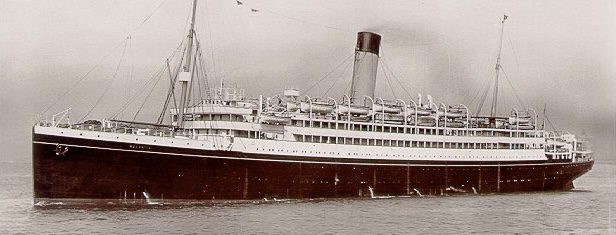
RMS Megantic
White Star Line · entered service 1909 · Ship Guide
Overview
RMS Megantic was a large White Star Line passenger liner built by Harland & Wolff for the Canadian trade. Originally laid down as Albany for the Dominion Line, she was acquired while still under construction by White Star’s Oceanic Steam Navigation Company, launched on 10 December 1908, completed on 3 June 1909, and entered service from Liverpool to Quebec and Montreal that June.
Her historical importance is unusually technical. Megantic and her near-identical sister Laurentic were deliberately fitted with different propulsion systems so their performance could be compared in service. Megantic used conventional twin screws driven by quadruple-expansion reciprocating engines; Laurentic combined reciprocating engines with a low-pressure turbine driving a third screw. The hybrid arrangement proved more economical and helped inform the machinery chosen for White Star’s Olympic-class liners.
The comparison is significant because the hulls were closely matched. That made the pair a practical full-scale experiment rather than a comparison between unrelated ships.
Key Facts
The Megantic–Laurentic Experiment
When the two sisters entered service, Harland & Wolff and the International Mercantile Marine organization gained an unusually controlled opportunity to compare two approaches to marine propulsion. Megantic represented the mature reciprocating-engine solution. Laurentic used two reciprocating engines exhausting into a low-pressure turbine that drove a center propeller.
Published engineering accounts reported a meaningful efficiency advantage for Laurentic: for comparable power, her coal consumption was about 12–15 percent lower, while other contemporary summaries described greater output for similar fuel use. The result mattered beyond the pair. A related combination system was selected for Olympic, Titanic, and Britannic, making Megantic part of the engineering prehistory of White Star’s best-known class.
Service History
1909–1914: Megantic served the Canadian route between Liverpool, Quebec, and Montreal, working in the joint White Star–Dominion service. Her large third-class capacity reflects the importance of migration traffic alongside cabin passengers and cargo.
1914–1917: wartime conditions altered routes and risk. White Star briefly used her on Liverpool–New York service, and on 30 May 1915 she was chased by a German submarine off southern Ireland while bound westward; she escaped by speed.
6 April 1917: Megantic entered the British liner requisition scheme for government service. She subsequently carried Canadian and American troops and, after the Armistice, helped repatriate servicemen.
Postwar: she returned to civilian sailing in December 1918 and later resumed Canadian service. As newer tonnage entered the fleet, she was increasingly a veteran of the prewar generation.
1933: after more than two decades of service, Megantic was sold to Japanese shipbreakers and dismantled.
Interpretive Notes
Not merely “Laurentic’s conventional sister”: the propulsion comparison gives Megantic an independent technical importance. The less efficient system is still part of the evidence that made the later decision possible.
Canadian identity: her core peacetime story belongs to the Liverpool–St. Lawrence route. Quebec and Montreal references on passenger lists, postcards, advertisements, and schedules are therefore important attribution clues.
Wartime chronology: wartime activity began before formal liner requisition in April 1917. Describing the entire period simply as “requisitioned in 1914” collapses distinct phases and should be avoided.
Evidence-first ship guide