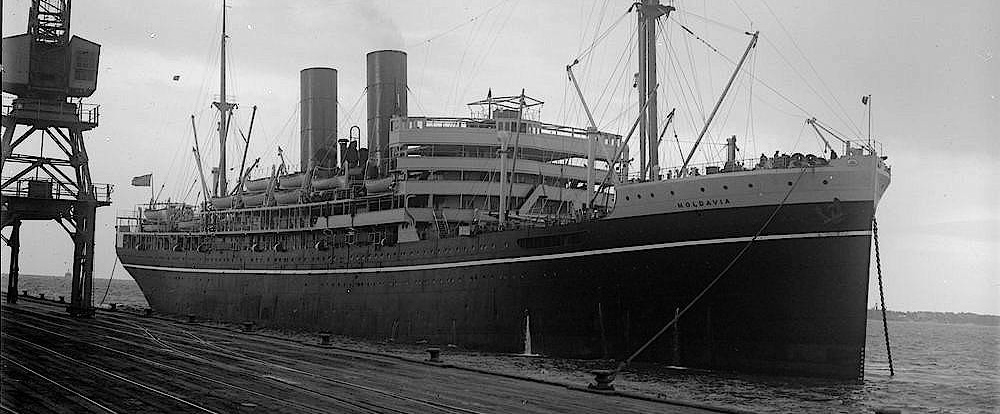
RMS Moldavia
P&O · 1903 · Ship Guide
Overview
RMS Moldavia was the first of P&O’s early-twentieth-century M-class passenger liners, built by Caird & Company at Greenock for the Britain–Australia route via Suez. Launched on 28 March 1903, she spent more than a decade in civilian imperial-route service before being requisitioned late in 1915 and converted into the armed merchant cruiser HMS Moldavia.
Her wartime chronology can now be stated more precisely: she was hired for naval use on 27 November 1915, commissioned on 1 February 1916, served with the Northern Patrol, later carried troops, and was torpedoed by UB-57 off the south coast of England on 23 May 1918.
Key Facts
P&O’s Australia Service
Moldavia was built for a commercial world fundamentally different from the Liverpool–New York express trade. The voyage to Australia via Suez demanded endurance, cargo capability, reliable mail and passenger schedules, and comfortable accommodation over a far longer route.
Her civilian significance therefore lies in imperial communications and long-haul mobility. Passenger lists, menus, route brochures, and company stationery should be interpreted within that Britain–Suez–Australia network rather than through North Atlantic assumptions.
From Passenger Liner to Armed Merchant Cruiser
P&O kept Moldavia in civilian Australia service after war began, but the Admiralty hired her on 27 November 1915. Following conversion, she commissioned as HMS Moldavia on 1 February 1916 under Acting Captain Adrian Holt Smyth.
Armed with 6-inch guns, she joined the 10th Cruiser Squadron’s Northern Patrol, examining and intercepting merchant shipping as part of the blockade system. This naval phase should be kept distinct from her earlier RMS identity in both language and artifact description.
Troop Transport and the Final Voyage
By 1918 Moldavia was carrying American troops and military stores. On 11 May she left Halifax as part of convoy HC.1. In the early hours of 23 May, UB-57 under Johannes Lohs torpedoed the ship in the English Channel off the Sussex coast.
Loss figures vary depending on whether a source counts men missing immediately, bodies recovered, or a later hospital death. Contemporary reporting spoke of roughly 56 missing Americans; later summaries commonly give 54 killed aboard plus one who died later, while heritage records preserve other totals. The safest curatorial practice is to name the source whenever a precise casualty number is used.
Imperial Route and Passenger Evidence
Moldavia’s long civilian career produced a different kind of archive from the better-known Atlantic express liners. Route books, P&O advertisements, passenger lists, menus, and mail-service material often emphasize Suez, India, and Australia rather than short Atlantic crossing times. That geography should remain visible in any interpretation of the ship.
The vessel also carried substantial cargo alongside passengers, reinforcing the mixed commercial logic of the Australia service. Even where surviving ephemera appears luxurious, the ship belonged to a network sustained by mail, freight, government connections, and long-distance passenger movement together.
Casualty Figures and Source Discipline
The 1918 loss illustrates why casualty totals need explicit sourcing. Contemporary cable reports used figures such as 56 missing Americans, while later reference works distinguish between men killed in the sinking and one who died afterward in hospital. Heritage databases sometimes preserve still another total depending on what category is counted.
Rather than selecting a single number and presenting it as universally agreed, the guide now keeps the range visible and explains why it exists. For exhibit labels, the source and counting method should accompany any precise total.
Why Moldavia Matters
Moldavia demonstrates how an imperial-route liner could pass from civilian passenger service into blockade duty and troop transport without ever belonging to the better-known North Atlantic prestige world.
Her evidence divides naturally into RMS Moldavia passenger material, HMS Moldavia armed-merchant-cruiser records, and the 1918 casualty archive. Keeping those phases explicit prevents wartime loss from erasing twelve years of civilian service.
Evidence-first ship guideSources (Selected)