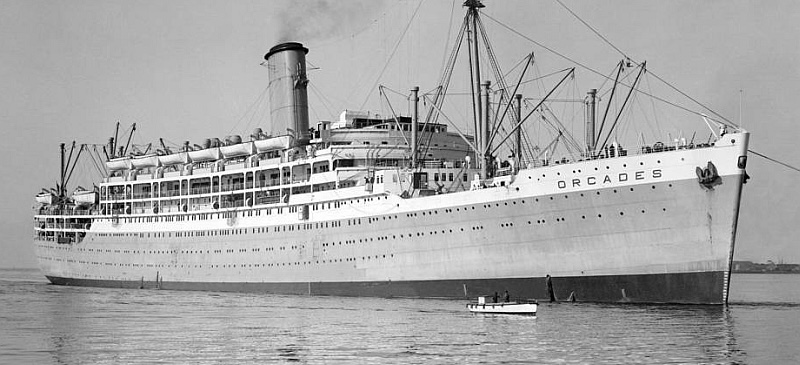
RMS Orcades (1937)
Orient Line · entered service 1937 · Ship Guide
Overview
RMS Orcades was one of the most advanced British passenger liners placed on the England–Australia route immediately before the Second World War. Built by Vickers-Armstrongs at Barrow-in-Furness for the Orient Line, she followed the successful Orion and carried the same broad modernist design philosophy into a larger and more technically ambitious ship.
Her peacetime career was brief. From 1937 she worked the long route between Britain and Australia via the Mediterranean and Suez, while also undertaking cruises. Requisitioned in 1939, she became a troop transport. On 10 October 1942, while sailing independently southwest of Cape Town, she was attacked by U-172. The ship remained afloat for roughly two and a half hours under repeated torpedo attack, allowing the great majority of those aboard to survive.
Key Facts
Tonnage note: contemporary and later sources differ slightly in the reported gross tonnage. The variation is small and does not indicate a different ship; this guide preserves the range rather than forcing a false precision.
Orion’s Sister and the New Orient Line
Orcades belonged to the same modernizing program that had produced Orion. The two ships are commonly treated as sisters, although Orcades incorporated refinements and was completed later. Together they represented a decisive break from the heavier decorative traditions of earlier British liners.
The Orient Line again placed overall interior direction in the hands of New Zealand-born architect Brian O’Rorke. His approach emphasized coordinated architecture, furniture, textiles, murals, lighting, and circulation rather than treating each public room as a separate exercise in ornament. The result was a ship intended to feel unmistakably contemporary.
Modern Interiors and Air Conditioning
Air conditioning was one of Orcades’ most important technical advances. A 1937 engineering account noted that the installation went substantially beyond that in Orion: conditioned air served the first-class dining saloon, library, hairdressing saloon, and selected special cabins. The same source described her as the first British liner to apply air conditioning to staterooms.
That mattered especially on the Suez route. A ship travelling between northern Europe, the Mediterranean, the Red Sea, the Indian Ocean, and Australia exposed passengers to dramatic changes in heat and humidity. Mechanical control of the indoor environment was therefore not merely a luxury flourish; it directly addressed one of the route’s recurring discomforts.
Contemporary architectural coverage also emphasized broad promenade spaces and less obstructed sea views. The ship’s interiors included modern art and custom-designed furnishings, extending the Orient Line’s effort to make modern British design part of the travel experience itself.
Britain to Australia
Orcades entered the established Orient Line service from Britain through the Mediterranean and Suez to ports in the Indian Ocean and Australia. Her route linked a chain of ports rather than functioning as an express point-to-point Atlantic liner, and the ship’s accommodation had to support a voyage measured in weeks rather than days.
Her commercial career lasted only about two years before war intervened. This brevity is part of what makes the ship historically significant: much of the design effort invested in a new generation of civilian travel was almost immediately redirected toward military transport.
Conversion to Troop Transport
After the outbreak of the Second World War in 1939, Orcades was requisitioned and converted for troop-carrying duties. Like many large liners, her speed, range, internal volume, and existing hotel services made her valuable for moving large numbers of personnel over long distances.
The troopship years placed her in a very different operational world from peacetime line voyages. Passenger comfort gave way to carrying capacity, wartime routing, defensive armament, blackout procedures, convoy discipline, and the constant risk of submarine attack.
10 October 1942
On 9 October 1942 Orcades left Cape Town for Liverpool carrying 741 passengers, about 3,000 tons of general cargo, and roughly 2,000 bags of mail. The next morning, while about 220 nautical miles southwest of Cape Town and steaming independently on a zigzag course, she was attacked by the German submarine U-172.
The first torpedoes caused severe damage, but the ship did not sink immediately. Passengers were put into boats while a reduced party remained aboard trying to preserve the vessel and maintain communications. U-172 continued the attack, expending seven torpedoes according to the later U.S. Navy interrogation report of the submarine’s survivors.
The prolonged sinking is one of the defining episodes in Orcades’ history. It gave time for an orderly abandonment, but it also required officers, engineers, gunners, radio personnel, and volunteers to remain exposed aboard a crippled ship while the submarine continued its attack.
Rescue and Losses
Orcades finally sank on 10 October. Forty-five people were killed, while 1,022 survived. The Polish merchant ship Narwik reached the boats and rescued survivors despite the continuing danger of submarine attack. Allied warships later joined the rescue and escort effort.
Captain Charles Fox’s leadership during the sinking was formally recognized after the loss. The episode is notable not because the ship proved unusually invulnerable, but because damage control, communications, boat handling, and discipline converted a potentially much larger disaster into a loss from which most of those aboard escaped.
Why Orcades Matters
Orcades connects two very different histories of the late 1930s and early 1940s. In peacetime she embodied confidence in modern design, climate control, long-distance travel, and the continuing importance of the Britain–Australia sea route. In war she became transport infrastructure, and her final voyage demonstrated how quickly the purpose of a liner could change.
Her short life also preserves a sharp historical contrast. The same ship celebrated in 1937 for air-conditioned rooms, modern interiors, and passenger comfort was destroyed only five years later in a sustained submarine attack. That compressed arc makes Orcades one of the clearest examples of how the Second World War interrupted the technological and aesthetic evolution of the interwar passenger liner.
Related Liners
Sources
- Nature, “The S.S. Orcades; the Latest Orient Liner,” 18 September 1937.
- The Engineer, 3 September 1937, technical coverage of RMS Orcades and her air-conditioning installation.
- The Architects’ Journal, 7 October 1937, coverage of Brian O’Rorke’s interior design for Orcades.
- Royal Museums Greenwich, Orient Steam Navigation Co. archive catalogue, “Sinking of ORCADES, c.13 Oct 1942,” OSN/31/4.
- uboat.net, “Orcades — British Troop transport,” attack and casualty record for 10 October 1942.
- U-boat Archive, U.S. Office of Naval Intelligence interrogation report for U-172.
- Cooper Hewitt, Smithsonian Design Museum, Orient Line to Australia, Ships and Services, ca. 1937.