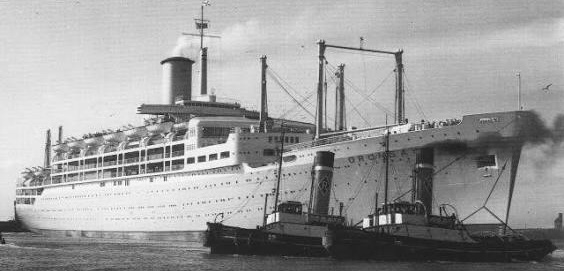
RMS Oronsay (1951)
Orient Line · entered service 1951 · Ship Guide
Overview
The 1951 Oronsay was one of the key postwar Orient Line passenger ships built for the Britain–Australia route. Constructed by Vickers-Armstrongs at Barrow-in-Furness, she followed the new Orcades into service and helped restore a modern, fast passenger connection between Britain and Australia after the Second World War.
Her career quickly expanded beyond the traditional Suez route. By the mid-1950s she was operating Pacific voyages, and cruising became increasingly important as long-distance air travel eroded the old liner market. She remained in service through the Orient Line–P&O transition and was not withdrawn until 1975.
Key Facts
Naming note: contemporary and later records commonly refer to the vessel simply as Oronsay or as SS Oronsay. This guide uses “RMS Oronsay” in its archive title to distinguish the 1951 ship from the earlier 1924 Oronsay already documented here.
A Postwar Successor to Orcades
Oronsay formed part of the Orient Line’s postwar rebuilding program and followed the 1948 Orcades into the Australia trade. Both were large, fast passenger liners built by Vickers-Armstrongs at Barrow and designed for regular long-distance service rather than record-breaking Atlantic crossings.
The relationship between the ships is best understood as a close postwar family rather than as perfectly identical sisters. Their machinery, speed, route purpose, and general scale were closely aligned, but their construction and accommodation details reflected continuing development.
Launch, Fire, and Completion
Oronsay was launched on 30 June 1950. During fitting out, a serious fire delayed completion, and she did not enter service until May 1951. The delay is an important reminder that even large, mature shipyards remained vulnerable to the disruption that could accompany fitting-out work on a complex passenger liner.
Royal Museums Greenwich preserves Orient Line records for her launch, trials, entertainment arrangements, and early Pacific service, reflecting how closely the company documented the introduction of a major new liner.
Britain to Australia
Her maiden voyage left Tilbury on 16 May 1951 for Australia by way of the Suez Canal. Museums Victoria records her arrival at Fremantle on 8 June. The route placed her within the postwar migration and passenger system connecting Britain, the Mediterranean, the Indian Ocean, and Australia.
Unlike the faster North Atlantic express service, this was a long-distance route in which accommodation, cargo capacity, and sustained reliability mattered as much as outright speed. First- and tourist-class passengers could remain aboard for weeks, making the ship a temporary community as well as transportation.
From Line Voyage to Cruise
Oronsay made her first cruise on 14 February 1953. In 1954 her service expanded more decisively into the Pacific, an evolution documented in the surviving Orient Line archive. Pacific itineraries and later round-the-world patterns allowed the company to combine scheduled transportation with leisure travel.
This changing employment made Oronsay representative of the broader postwar liner transition. Ships originally justified by regular passenger traffic increasingly had to attract travelers for whom the voyage itself—not merely arrival at the destination—was part of the product.
Modernization
Like other ships on hot-weather routes, Oronsay was progressively modernized as passenger expectations changed. Later refits included stabilizers and expanded air conditioning, improvements that addressed both comfort at sea and competition from newer passenger ships.
Her passenger configuration also changed during her career as the distinction between traditional first and tourist classes became less useful in a cruise-oriented market. By the early 1970s she was being marketed increasingly as a one-class passenger ship.
The P&O Transition
In 1960 Orient Line operations were integrated with P&O as P&O-Orient Lines. Oronsay continued under the combined organization and later under P&O itself. The change was part of a broader consolidation of British long-distance passenger shipping at exactly the moment when jet aviation was removing much of the commercial foundation on which those services had been built.
A 1969 P&O sailing-and-fares brochure still listed Oronsay alongside Arcadia, Canberra, Chusan, Himalaya, Iberia, Orcades, Oriana, and Orsova for Australia and New Zealand service. The list captures the extraordinary concentration of classic liners still operating only a few years before many of them disappeared.
Final Years
Oronsay outlived several ships of the immediate postwar generation. She remained in service until September 1975, by which time the economics of the old Britain–Australia liner trade had changed beyond recognition.
She was sent to Kaohsiung for demolition later that year. Her retirement closed a career of roughly twenty-four years spanning migration traffic, traditional liner voyages, Pacific service, cruising, corporate consolidation, and the rise of the jet age.
Why Oronsay Matters
The 1951 Oronsay helps complete the story between Orcades, Orsova, and Oriana. Taken together, these ships show the Orient Line moving from postwar reconstruction to increasingly cruise-oriented service before disappearing into the larger P&O organization.
Her significance is therefore cumulative rather than dramatic. She was a durable working liner whose long career records the changing meaning of ocean travel itself—from essential long-distance transportation to an experience increasingly sold for leisure.
Related Liners
Sources
- Museums Victoria, Pamphlet — Orcades, Oronsay, Orsova, Orion and Otranto, Orient Line, item HT 2659.
- Royal Museums Greenwich, Orient Steam Navigation Company archive, OSN/13/6–8: Oronsay II launch, luncheon, trials, entertainment and Pacific records, 1950–1954.
- P&O Heritage Collection, Orient Line — the new Oronsay, 1951, reference AC-05361-00.
- P&O Heritage Collection, Australia and New Zealand by P&O, June 1969, reference AC-07412-00.