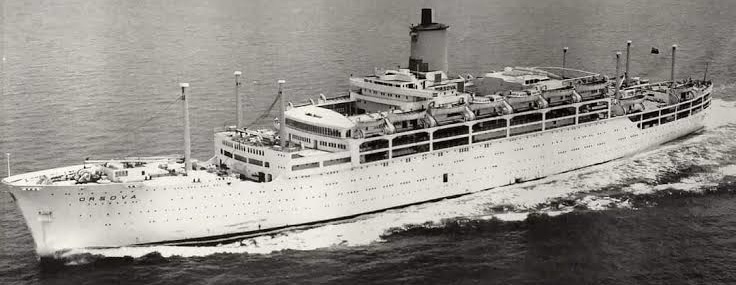
RMS Orsova (1954)
Orient Line · entered service 1954 · Ship Guide
Overview
RMS Orsova was one of the major postwar passenger liners built for the Britain–Australia service. Constructed by Vickers-Armstrongs at Barrow-in-Furness for the Orient Steam Navigation Company, she entered service in March 1954 and combined traditional long-distance liner work with an increasingly important program of Pacific and round-the-world voyages.
Her appearance marked a clear step into the postwar era. Orsova dispensed with a conventional mast, made extensive use of welded construction, and carried the broad, low-profile superstructure associated with a new generation of passenger ships. Her career also spans the transition from independent Orient Line identity to P&O ownership and the gradual shift from scheduled migrant and passenger traffic toward cruising.
Key Facts
Capacity note: period promotional material records slightly different passenger totals, including 681 first-class and 813 tourist-class berths. P&O’s technical fact sheet gives 685 first and 800 tourist. The difference likely reflects the configuration or date of the source rather than a contradiction about the ship’s identity.
A New Postwar Orient Liner
Orsova was launched at Barrow on 14 May 1953, the same day that P&O’s Arcadia was launched on the Clyde. The coincidence was appropriate: both belonged to the generation of large British liners built to restore and modernize the Australia service after the disruptions of the Second World War.
She took her name from Orșova, a town on the Danube near the Iron Gate. Her ship’s badge drew on the same association. P&O records also emphasize two design distinctions: she was the first large passenger ship to dispense with a conventional mast and she used welded hull construction extensively, giving her a notably clean postwar profile.
Machinery and Appearance
The ship was powered by geared steam turbines developing about 42,500 shaft horsepower to twin screws. Her normal service speed was about 22 knots, while trials produced more than 26 knots. This was not an Atlantic record-breaking arrangement; the priority was dependable high-speed operation over the very long distances of the Australia route.
Her single funnel carried a distinctive raised exhaust arrangement commonly described as a “Welsh Hat.” The fitting was intended to carry smoke and soot more effectively away from passenger decks. Combined with the mastless silhouette, it made Orsova immediately recognizable among the postwar British liners.
Britain, Suez, and Australia
Orsova sailed on her maiden voyage from London to Sydney on 17 March 1954. Her regular work linked Britain with Australia by way of the Mediterranean, Suez, the Indian Ocean, and Australian ports. The service carried tourists, business travellers, families, and migrants, making ships such as Orsova important participants in the postwar movement of people to Australia.
The liner’s large two-class accommodation reflected that mixed traffic. She was neither simply a luxury cruise ship nor merely a migrant carrier: like many successful long-route liners, she combined several passenger markets within the same vessel.
Round-the-World Service
On 27 April 1955, Orsova began the Orient Line’s first round-the-world voyage. The itinerary continued beyond Australia and New Zealand across the Pacific to Vancouver, San Francisco, and Los Angeles, then returned to Europe through the Panama Canal and Caribbean.
This pattern was an important development in liner economics. Instead of treating Australia as the end of a back-and-forth route, the company could sell through passages and cruise-like itineraries across several oceans. Orsova therefore belongs to the transitional period when traditional line voyages and modern cruising increasingly overlapped.
Grounding and Refit
On 24 May 1956 the ship grounded in Port Phillip Bay while at Melbourne. She was refloated later the same day. The incident did not end her service, and she continued on the route.
A major ten-week refit in 1960 included general air conditioning. The improvement was especially significant for a vessel routinely passing through tropical and subtropical waters. It also reflected the increasing expectation that older parts of a passenger ship’s accommodation would meet the comfort standards of newer liners.
Into the P&O Era
Management and operation transferred to P&O-Orient Lines on 2 May 1960, while ownership initially remained with the Orient Steam Navigation Company. In 1964 the ship adopted P&O’s white hull in place of the Orient Line’s traditional corn-coloured hull. Full ownership passed to the Peninsular and Oriental Steam Navigation Company on 31 March 1965.
These changes were more than cosmetic. They reflected the gradual absorption of Orient Line operations into P&O and the consolidation of Britain–Australia passenger services at a time when long-distance air travel was rapidly eroding the liner trade.
Changing Passenger Travel
By the late 1960s and early 1970s, Orsova was operating in a market very different from the one for which she had been designed. Jet aircraft had dramatically reduced the time required to travel between Britain and Australia, while cruising offered passenger ships a growing alternative use.
Her later career included more leisure-oriented voyages and cruises, but ships of her generation were expensive to operate and increasingly difficult to justify against newer vessels designed around the cruise market from the outset. P&O announced her withdrawal in 1973, and she left service in 1974.
Why Orsova Matters
Orsova is an especially useful ship for understanding the middle of the postwar liner era. She was built when the Britain–Australia passenger trade still seemed capable of sustaining major new construction, yet she survived long enough to witness that market transformed by aviation.
Her significance lies less in a single dramatic event than in what her career connects: postwar migration, long-haul scheduled service, technical modernization, round-the-world itineraries, corporate consolidation, and the rise of cruising. In that sense, Orsova was both a traditional ocean liner and a bridge toward the passenger-ship world that followed.
Related Liners
Sources
- P&O Heritage, Ship Fact Sheet: Orsova (1954).
- Museums Victoria, Pamphlet — Orcades, Oronsay, Orsova, Orion and Otranto, Orient Line, item HT 2659.
- Museums Victoria, Pamphlet — P&O-Orient Line, Pacific Services, John McKay Ship Brochures Collection.
- P&O Heritage Collection, launch and service photographs and ephemera for Orsova.