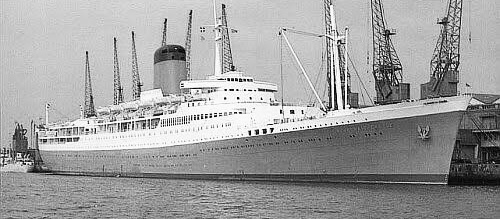
RMS Pendennis Castle (1958)
Union-Castle Line · entered service 1959 · Ship Guide
Overview
RMS Pendennis Castle was a postwar Union-Castle mail liner built for the Southampton–South Africa service. Completed by Harland & Wolff in 1958, she entered service on 1 January 1959 and spent more than seventeen years on the Cape Mail route.
Her significance lies partly in timing. She was ordered under the old Union-Castle management but substantially revised after the 1956 merger that created British & Commonwealth Shipping. The resulting ship bridged the conservative postwar Pretoria Castle generation and the more modern Windsor Castle and Transvaal Castle.
Key Facts
Designed During a Corporate Transition
Pendennis Castle was ordered before Union-Castle merged with Clan Line interests in 1956. Her keel had already been laid when the new British & Commonwealth management structure took shape, and the incoming management altered the design while construction was underway.
The original concept was closely related to the earlier Pretoria Castle and Edinburgh Castle. The revised ship was lengthened amidships to accommodate stabilizers and received a more contemporary interior arrangement. That makes her a physical record of an institutional change as much as a normal fleet replacement.
Naming, Launch, and Completion
The ship's launch sequence was unusual. She was named on 10 December 1957, but an industrial dispute prevented the planned launch from taking place. She finally entered the water without ceremony on Christmas Eve.
After fitting out and trials, Harland & Wolff delivered the liner in November 1958. She was the final Union-Castle passenger ship built by the Belfast yard, ending a long association between the company and one of Britain's most important shipbuilders.
The Cape Mail Service
Pendennis Castle began her maiden voyage from Southampton on 1 January 1959. Her regular route linked Britain with Las Palmas, Cape Town, Port Elizabeth, East London, and Durban.
This was not simply a passenger service. Union-Castle's mail ships formed part of a tightly scheduled transport system carrying passengers, refrigerated cargo, general freight, and mail between Britain and southern Africa. Reliability and regularity were central to the service's identity.
A More Modern Union-Castle Interior
The interior treatment marked a departure from earlier company practice. The Cayzer archive records the involvement of designer Jean Monro and a greater use of color, while familiar Union-Castle spaces were reorganized or replaced.
The change did not make the ship radically modern by contemporary international standards, but it did move Union-Castle away from some of the visual conventions that had defined its prewar and immediate postwar passenger ships.
Stabilizers and Hull Lengthening
One of the most consequential construction changes was the decision to fit Denny-Brown stabilizers. The hull was lengthened during construction to accommodate them, making Pendennis Castle the first Union-Castle mail ship fitted with such equipment.
The ship's structural behavior later attracted comment from those who served aboard her, including recollections of visible hull flexing and cracked accommodation windows. Such accounts are useful evidence of operating experience, but should be distinguished from formal engineering conclusions.
The Faster Mail Schedule
Union-Castle accelerated the Cape Mail service in 1965, reducing the scheduled passage time from thirteen days to eleven. The faster timetable allowed the service to be maintained with seven principal mail ships rather than eight.
Pendennis Castle was therefore part of Union-Castle's attempt to make sea travel more competitive during the jet age. The change improved schedule efficiency, but could not reverse the long-term movement of passengers toward air transport.
Life Aboard in the 1960s
Union-Castle continued updating passenger service during the 1960s. Air-conditioning was extended, cabin facilities improved, and female dining-room staff were introduced across more of the fleet after their use aboard Transvaal Castle.
The company also experimented with more organized recreation and a less formal passenger experience. These changes show an operator increasingly aware that a liner voyage had to compete as an experience, not merely as transportation.
1968 Southampton Fire
In May 1968 a fire broke out aboard Pendennis Castle while she was alongside at Southampton. Damage was limited to part of the forward accommodation and the ship returned to service after repairs.
The incident did not materially alter her long-term career, but it remains one of the more notable operational events of her Union-Castle years.
Decline of the Cape Mail
By the 1970s, aviation and containerization were undermining both sides of the traditional passenger-cargo liner model. Union-Castle progressively reduced its passenger fleet, and the historic mail service itself would disappear in 1977.
Pendennis Castle was withdrawn on 14 June 1976, one of the last large ships to leave the route before the service ended altogether.
Sale and Unsuccessful Afterlife
After sale, the former mail ship was renamed Ocean Queen and later Sinbad and Sinbad I. Several plans were proposed for further commercial use, but she never returned to sustained passenger service after leaving Union-Castle.
She was eventually sold for demolition and broken up at Kaohsiung in 1980. Unlike several contemporaries that found long cruise careers, Pendennis Castle's useful life effectively ended with the system for which she had been built.
Why Pendennis Castle Matters
The ship is important because she captures Union-Castle at a moment of transition. Her design was reshaped by a corporate merger, her service was accelerated in response to aviation, and her withdrawal came during the final dismantling of the traditional Cape Mail system.
She also provides a useful counterpoint to the better-known North Atlantic story. The postwar liner age was global, and Union-Castle's South Africa service represented one of its most disciplined and distinctive scheduled passenger networks.
Collecting Profile
Surviving material includes Union-Castle brochures, deck plans, menus, passenger lists, sailing schedules, postcards, photographs, luggage labels, and mail-service ephemera. Material showing the 1965 faster schedule can be especially useful for dating the ship's operational context.
Later items under Ocean Queen or Sinbad should be separated from Union-Castle material because those names belong to post-service ownership phases rather than an established second passenger career.
Interpretive Notes
Published passenger capacities vary: some references give different Tourist Class totals. Configuration changes and differing dates likely account for part of the variation, so the guide uses a rounded overall figure.
Named and launched are separate events: the industrial dispute in December 1957 created an unusual two-week gap between the naming ceremony and actual launch.
Post-Union-Castle names do not imply successful renewed service: the ship changed hands and names, but did not establish a durable commercial passenger operation after 1976.
Evidence-first ship guide