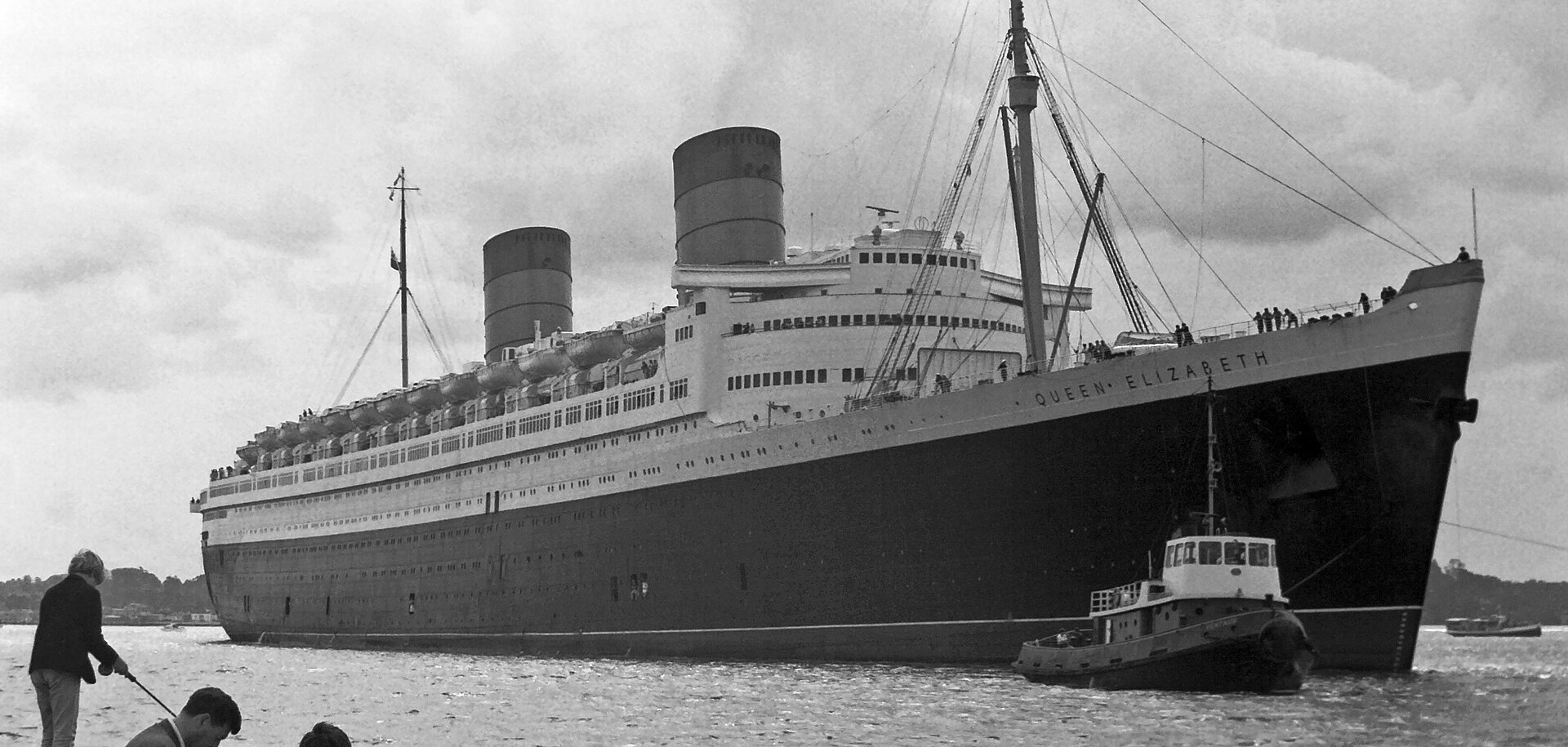
RMS Queen Elizabeth
Cunard-White Star Line / Cunard Line · launched 1938 · Ship Guide
Overview
RMS Queen Elizabeth was Cunard’s second great interwar “Queen”—built as the running mate to Queen Mary and, by commonly cited measures, the largest passenger liner ever built by gross tonnage. Launched in 1938, she was completed into a world at war and spent World War II primarily as a fast troop transport rather than as a peacetime liner.
Her commercial transatlantic career began after the war (maiden commercial voyage in October 1946) and ran through the final decades of the classic Atlantic run, before withdrawal in 1968 and a complex afterlife that ended with the Seawise University fire and loss in Hong Kong in 1972.
Evidence-first note: postwar memories tend to compress multiple refits, ownership changes, and renamed phases into a single “Queen Elizabeth” narrative. When publishing or cataloging, treat the career as distinct eras with different documentation trails.
Key Facts
Design & Construction (Context)
Queen Elizabeth was designed as an improvement on Queen Mary, with major engineering and layout changes rather than being a simple repeat. The result was a ship optimized for the same strategic goal: sustained weekly prestige service on the North Atlantic—comfort, reliability, and scale—rather than a single-record obsession.
In collecting terms, the ship’s design language (graphics, stationery, onboard print) sits at a junction: late-1930s modernism, wartime government use, and postwar Cunard presentation. The same hull produced very different paper trails, and they should not be mixed casually.
Service History (Summary)
1938–1940: Launch and wartime onset. Launched on 27 September 1938 at Clydebank and completed in 1940, Queen Elizabeth entered a world where civilian liner plans were already under threat from war conditions.
1940–1945: Troop transport service. During World War II she served as a fast troopship, with widely cited totals exceeding 750,000 troops carried over the war years. (Treat exact totals as a claim to footnote to a specific source when publishing.)
1946–1968: Postwar Atlantic liner. After refit and return to civilian use, her maiden commercial voyage occurred on 16 October 1946. She then spent decades on transatlantic service as one half of the iconic two-ship “Queens” pairing.
1968–1972: Withdrawal, sale, and loss. Withdrawn in 1968, she passed through new owners and redevelopment plans, ultimately renamed Seawise University. On 9 January 1972, a major fire broke out while in Hong Kong, and the ship capsized/sank in the harbor.
Interpretive Notes
Queen Elizabeth is a prime “era-splitting” ship for curatorial writing: wartime troopship service and postwar luxury service are not merely different chapters—they produce different artifact types, different markings, and different degrees of survivability. A menu or letterhead from the 1950s is not the same collecting object as a wartime transport document, even when both legitimately relate to the same vessel.
Be especially careful with late-life material. Items labeled Elizabeth or Seawise University are sometimes marketed as “Queen Elizabeth” without the renaming context. Your cataloging should preserve the name used at the time the item was created, with cross-references.
Two very different “first voyages”: Queen Elizabeth made her first Atlantic crossing secretly in 1940 under wartime conditions, years before her 1946 commercial maiden voyage. Those events should never be collapsed into one ceremonial beginning: the first was an emergency movement of an unfinished passenger liner into wartime safety and service, while the second marked her long-delayed entry into the civilian North Atlantic trade.
Her 1972 destruction in Hong Kong also requires restraint. The fire ended the ship during conversion for a new use, but later accounts have often attached more certainty to cause and responsibility than the surviving evidence comfortably supports. The safest treatment separates what is documented about the fire and loss from later speculation.
Evidence-first ship guide