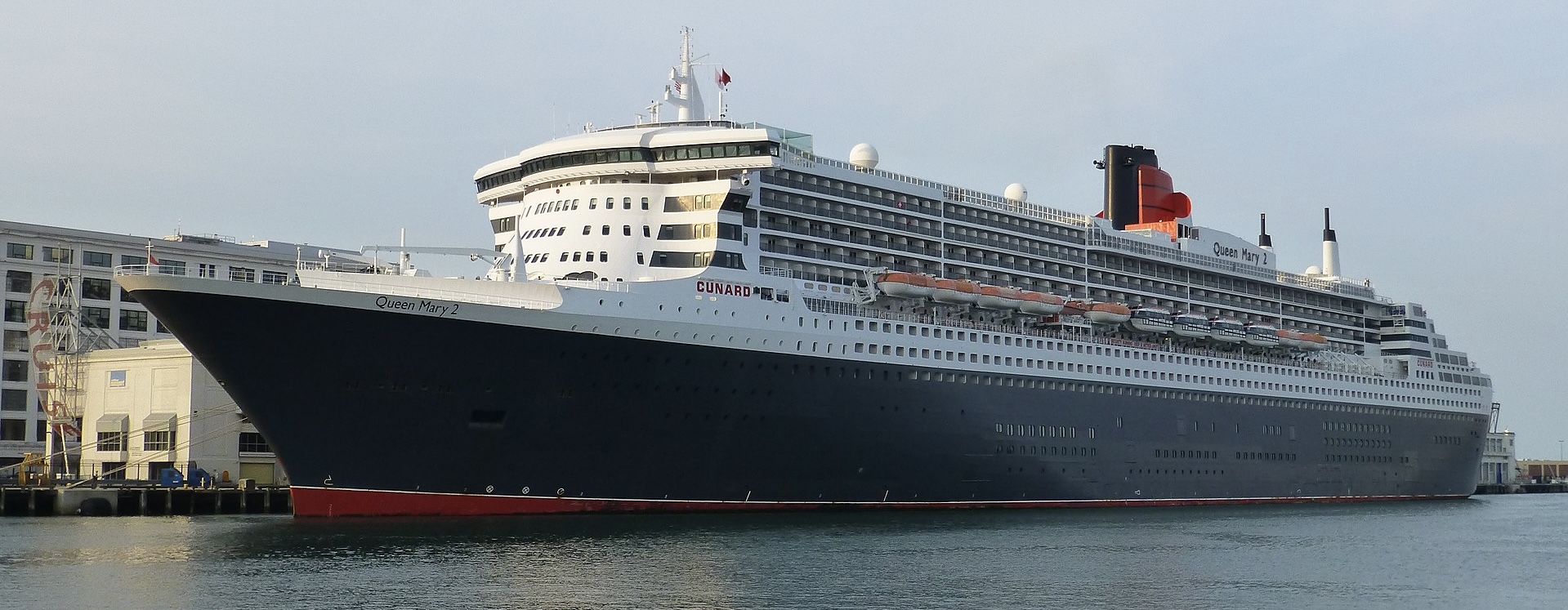
RMS Queen Mary 2
Cunard Line · 2004 · Ship Guide
Overview
RMS Queen Mary 2 is Cunard’s flagship and the only passenger ship in current scheduled service built specifically around regular North Atlantic liner crossings. Constructed by Chantiers de l’Atlantique at Saint-Nazaire, she entered service in January 2004 and continues to operate transatlantic crossings between Southampton and New York alongside world voyages and seasonal cruises.
Because she remains in service, this guide treats her as a living historical subject. Capacity figures, interior arrangements, and operating schedules can change, so current company material should be dated rather than allowed to overwrite earlier configurations.
Key Facts
Designed as an Ocean Liner
The distinction between Queen Mary 2 and a conventional cruise ship is rooted in design and operating purpose rather than nostalgia. Her hull proportions, high freeboard, structural design, power reserve, and speed were selected for repeated North Atlantic passage-making, where schedule keeping and heavy-weather performance matter in ways that are less central to most cruise itineraries.
Her electrical plant combines four Wärtsilä diesel generator sets with two GE LM2500+ gas-turbine generator sets. Those generators supply both hotel loads and four podded propulsion motors. Two pods are fixed and two can steer, eliminating the conventional arrangement of long propeller shafts and separate rudders.
Entry into Service and the Transatlantic Role
Queen Mary 2 sailed her maiden voyage on 12 January 2004 from Southampton to Fort Lauderdale. Her first season deliberately presented the ship as a continuation of Cunard’s liner tradition at a time when scheduled ocean passage had largely disappeared from the passenger market.
The transatlantic crossing remains central rather than ceremonial. Cunard continues to publish recurring eastbound and westbound New York–Southampton crossings in its 2026 schedules, while world voyages, Caribbean voyages, and other cruises are arranged around a much broader annual program.
Twenty Years of an Evolving Ship
A major 2016 remastering changed a number of public spaces and accommodation areas. Cunard records work to the aft section, Kings Court, the Grand Lobby, spa areas, and the creation or reworking of venues including the Carinthia Lounge. This means interior photography should always be dated when possible; a room name alone does not guarantee an as-built appearance.
In 2024 Cunard marked the ship’s 400th transatlantic crossing. As of 2026, the company continues to advertise regular crossings and has announced another substantial refinement program for 2027. That future work should be described as planned until completed.
Capacity and Configuration Caution
Current Cunard pages illustrate why living ships require versioned data. Different official pages presently give different guest capacities while agreeing on core dimensions and crew scale. The discrepancy does not necessarily indicate an error; berth definitions, cabin configurations, and operating assumptions can differ.
For exhibit labels or catalog records, date the capacity figure and identify the company page or deck plan from which it came. The same discipline applies to venue names, cabin categories, and deck arrangements after refits.
Collecting a Living Liner
Unlike a retired historical ship, Queen Mary 2 continues to generate primary material every season. Daily programs, embarkation cards, menus, crossing certificates, voyage maps, commemorative merchandise, and deck plans can often be tied to an exact voyage number. That makes provenance unusually recoverable, but it also means undated material can quickly become ambiguous as branding and onboard spaces evolve.
Special crossings and anniversaries deserve especially precise labels. A piece from the 400th transatlantic crossing in 2024, for example, documents a specific milestone rather than simply “modern Cunard.” The same principle applies to post-2016 interiors and to material produced after future refits.
Why Queen Mary 2 Matters
Queen Mary 2 matters because she preserved scheduled ocean-liner passage as a functioning transport tradition rather than as a museum reenactment. Her service connects the engineering demands of the historical North Atlantic liner with a twenty-first-century passenger economy dominated by cruising.
For collectors, she also demonstrates how a living ship creates a continuously layered archive: inaugural material, crossing-specific programs, refit-era deck plans, anniversary ephemera, and present-day onboard documents can all be authentic while representing different physical and corporate moments.
Evidence-first ship guideSources (Selected)
Starting points for chronology and core figures. For publish-ready technical detail (machinery configuration, capacities, refit dates), corroborate with shipbuilder/flag/owner documentation or Cunard primary material.