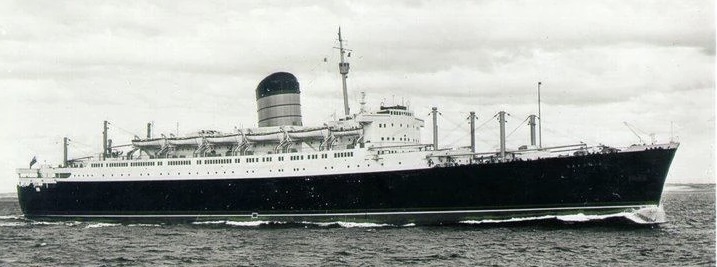
RMS Saxonia (1954)
Cunard Line · entered service 1954 · Ship Guide
Overview
RMS Saxonia was the first of Cunard's four postwar Canadian-service sisters, built by John Brown & Co. at Clydebank as yard no. 692. Launched on 17 February 1954 and entering service that September, she was conceived not as a smaller imitation of Cunard's New York flagships but as a ship tailored to the commercial and physical realities of the St. Lawrence route.
That distinction is central to her story. Saxonia belonged to a generation in which tourist-class travel, seasonal deployment, and commercial flexibility mattered as much as prestige. In summer she served Quebec and Montreal; when ice closed the St. Lawrence, she could shift toward Halifax, New York, and other Atlantic work. Later, after extensive rebuilding and renaming as Carmania, the same hull moved still further toward the cruise market.
Key Facts
Design for the Canadian Trade
Saxonia was designed for a very different market from the great express route. The St. Lawrence imposed practical constraints on draft and dimensions, while postwar traffic increasingly favored large tourist-class accommodation over the older hierarchy dominated by elite first-class travel. Her proportions and passenger distribution therefore tell a social as well as a technical story.
The ship's moderate size also made seasonal flexibility possible. A Cunard liner that could work Montreal in summer and switch to other Atlantic deployments in winter had a commercial advantage in a market where year-round utilization mattered increasingly.
Service History
After entering service on 2 September 1954, Saxonia became the first member of a quartet completed over the next several years: Ivernia, Carinthia, and Sylvania followed. Together they renewed Cunard's medium-sized Canadian fleet at a time when the company was still investing heavily in scheduled ocean travel but could already see the need for greater versatility.
By the late 1950s route patterns and marketing evolved. The sisters were increasingly deployed in ways that balanced regular liner work with leisure demand, and the distinction between crossing and cruise began to soften. This was not yet the modern cruise industry, but it was no longer the rigid timetable world of the prewar Atlantic either.
Rebuilding as Carmania
In 1962 Saxonia underwent a major rebuilding and was renamed Carmania. That change should be treated as a genuine provenance boundary rather than a simple change of name. Tonnage, accommodation, appearance, and commercial emphasis all shifted as the vessel moved toward dual-purpose liner-and-cruise work.
Artifacts from the original Saxonia period therefore belong to a different documentary world from material marked Carmania. The distinction is particularly important for deck plans, brochures, cabin descriptions, and photographs, where later rebuilding can otherwise be mistaken for original specification.
Leonid Sobinov and the Long Afterlife
Sold in 1973, the ship became Leonid Sobinov under Soviet ownership and continued operating for decades. That extended afterlife is historically significant because it demonstrates how adaptable these postwar liners could be, but it should not overshadow the original Canadian-service identity for which the ship was built.
Passenger Experience and Route Evolution
The distinction between first and tourist class is useful for understanding how Saxonia fit into the 1950s Atlantic. Her roughly 800 tourist-class berths greatly outnumbered first class, reflecting a market in which students, families, migrants, visiting relatives, and middle-income travelers were increasingly important. This was not simply a reduced version of prewar third class; postwar tourist class had its own expectations of comfort, public rooms, dining, and social life.
Route adjustments during the later 1950s also show Cunard testing how best to use the ship. Montreal remained the defining seasonal destination, but Southampton, New York, Halifax, and occasional leisure-oriented deployment appeared as the company tried to keep the vessel productive outside the Canadian summer. Those changes make dated timetables especially valuable evidence.
The Carmania Rebuild, 1962–63
Saxonia returned to John Brown’s yard for major conversion over the winter of 1962–63 and emerged as Carmania. The change went well beyond the name: tonnage, passenger arrangement, public spaces, livery, and commercial emphasis were altered for a more cruise-oriented role. Contemporary summaries place post-rebuild capacity at roughly 881 passengers.
Lay-Up and Soviet Sale
Carmania was laid up in the River Fal in May 1972 after Cunard’s service had contracted and a manning dispute complicated continued operation. Black Sea Shipping Company purchased her in 1973; after a refit she became Leonid Sobinov and returned to passenger cruising under Soviet ownership.
This sequence is useful for dating ephemera: material marked Carmania can belong to Cunard through 1973 even though normal active service had already ended, while Leonid Sobinov material belongs to the Soviet and later post-Soviet phases.
Why Saxonia Matters
Saxonia is one of the clearest examples of postwar liner adaptability. Designed for seasonal Canadian service, rebuilt for liner/cruise flexibility as Carmania, and then reused for decades as Leonid Sobinov, she shows how a medium-sized 1950s liner could survive by repeatedly changing commercial purpose.
Interpretive Notes
Name discipline matters: Saxonia, Carmania, and Leonid Sobinov refer to one hull but to different operators, route systems, passenger markets, and visual configurations. Canadian-route context is equally important. Saxonia should not be interpreted simply as a secondary New York liner; her real significance lies in Cunard's postwar Canada service and the seasonal operating logic that shaped it.
Tourist-class travel is also part of the historical substance rather than a specification footnote. Menus, brochures, deck plans, and cabin material from Saxonia document the broadening social base of transatlantic travel during the 1950s.
Fleet context: Cunard’s Postwar Fleet Strategy places this ship within the company’s changing postwar mix of express service, cruising, Canadian routes, and jet-age adaptation.
Evidence-first ship guide