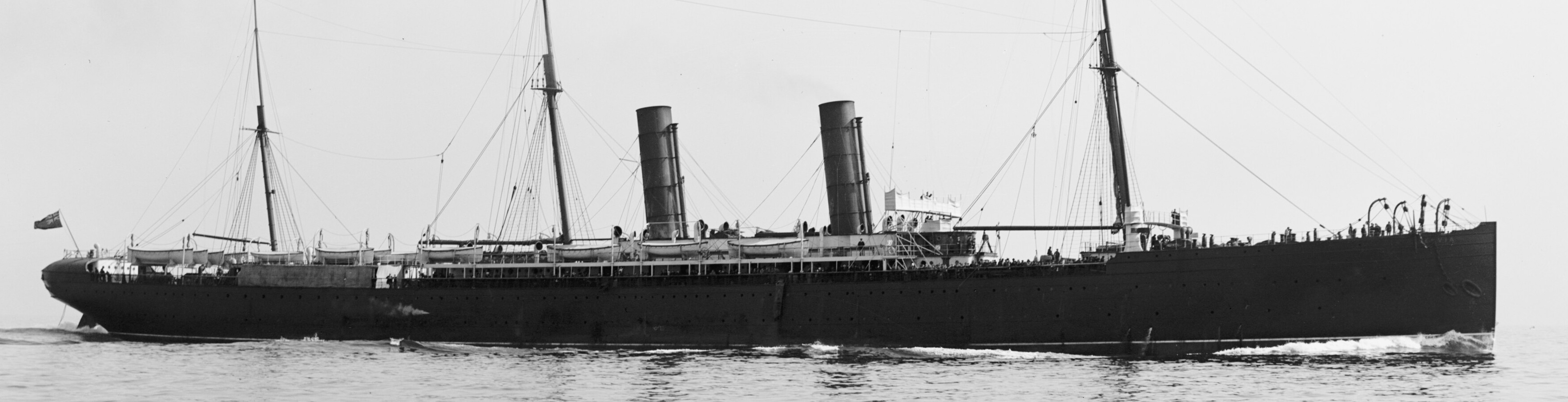
RMS Servia
Cunard Line · entered service 1881 · Ship Guide
Overview
RMS Servia was one of Cunard's most important transitional liners and one of the clearest examples of how ocean travel was modernizing in the early 1880s. Built by J. & G. Thomson at Clydebank, launched on 1 March 1881, and entering Liverpool–Queenstown–New York service that November, she combined major innovations with features inherited from an older steamship world.
Her significance lies less in one famous voyage than in the systems embodied by the ship. Servia is widely identified as the first large ocean liner built of steel and the first Cunard ship fitted with electric lighting. Yet she remained single-screw, carried a substantial barque rig, and retained the visual language of the sail-assisted Atlantic steamer. She is therefore a threshold ship in the strongest sense: old and new technologies coexisted within one hull.
Key Facts
Steel Changes the Liner
Servia's steel hull is central to her meaning. Steel offered a better strength-to-weight relationship than iron and opened the way toward larger, lighter, and increasingly efficient passenger ships. In the 1880s that change was still new enough to be historically visible, making Servia an important marker in the industrial evolution of the liner.
The shift should not be understood as a sudden break with everything that came before. The ship still carried three masts and a barque rig, and her silhouette retained much of the mid-Victorian steamer idiom. That mixture is precisely what makes her valuable to interpretation: liner modernity arrived incrementally.
Electric Lighting and Onboard Life
The introduction of electric lighting to Cunard service represented another major change. Illumination affected passenger comfort, safety, public-room use, and the practical rhythm of life aboard ship. In an era when ocean passages were still long and shipboard interiors could be dark, smoky, and dependent on older forms of lighting, electricity materially changed the passenger experience.
For collectors and researchers, this systems history can be as important as speed. Brochures, engineering descriptions, deck plans, and contemporary reporting that mention electric lighting are evidence of how the ship was marketed as modern.
Passenger and Mail Service
Servia entered Cunard's main North Atlantic passenger and mail service at a time when cabin travel and large steerage movements coexisted within the same ship. Her roughly 750 steerage berths placed migration at the center of the commercial model, while first-class accommodation represented the prestige face of the company.
This dual social role is easy to overlook when focusing on engineering. The same ship that demonstrated modern steel construction also carried hundreds of ordinary migrants, linking technological history with the social history of transatlantic movement.
From Flagship to Older Tonnage
In her first years, Servia stood near the front rank of Cunard's fleet. But liner technology moved quickly. By the 1890s, newer twin-screw express vessels were redefining the company's prestige service, and Servia increasingly represented an older generation.
Accommodation changes and secondary employment in later years should therefore be read in context. They show how major liners could move down the fleet hierarchy without becoming historically unimportant. Her later Boer War-era transport connections belong to this secondary-service phase, not to the core identity of the 1881 breakthrough ship.
Cargo, Coal, and the Economics of the Ship
Servia's large cargo and bunker capacities remind us that a liner was an integrated transport machine rather than merely a passenger hotel. Coal, water ballast, mail, baggage, and freight all shaped how much space and weight remained available for passengers.
These operational details also explain why technical descriptions from the period can differ from later popular summaries. A ship's “size” could be discussed through tonnage, dimensions, cargo capacity, or machinery output depending on what the writer was trying to convey.
Why the Transitional Appearance Matters
The ship's masts and rig can make her look older than the technological claims attached to her, but that apparent contradiction is historically useful. Steam power had not instantly erased sailing practice, and conservative redundancy remained attractive on long ocean routes. The result was a vessel that looked partly familiar while incorporating construction and electrical systems pointing firmly toward the future.
For image attribution, this means Servia should be compared with both earlier iron screw steamers and later steel liners. Her transitional silhouette is part of the evidence, not a stylistic inconsistency.
Fleet Context and Historical Position
Servia's long career also helps show how quickly technological leadership could become ordinary fleet service. A ship introduced as a major modern statement in 1881 was, within little more than a decade, operating alongside vessels that surpassed her in speed, machinery, and scale. That does not diminish her importance; it clarifies it. Historical significance and continued front-line status are not the same thing.
Her career therefore spans two Cunard worlds: the late-Victorian transition away from iron and sail-assisted practice, and the approach of the twin-screw express generation represented by ships such as Campania and Lucania.
Interpretive Notes
Servia should be read as a technological threshold rather than simply another successful Cunarder. Steel construction and electric lighting are central, while the masts, rig, and single-screw machinery preserve the older engineering world she was helping to replace.
For attribution, date matters. Early publicity presents a new technological showcase; later material documents a veteran displaced by faster and more modern tonnage. The same name can therefore carry very different meanings depending on the period.
Evidence-first ship guide