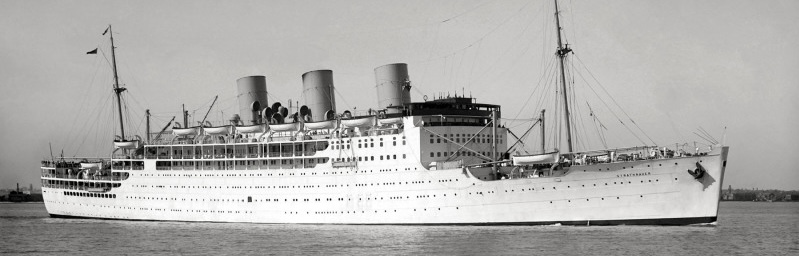
RMS Strathnaver
P&O · entered service 1931 · Ship Guide
Overview
RMS Strathnaver was the first of P&O’s celebrated “Strath” class—large, fast, and visually distinctive with her white hull and buff funnel, a deliberate break from the company’s earlier black-liveried liners. Designed for the long-haul Australia mail route from Tilbury via the Suez Canal, she represents the interwar peak of P&O’s regular liner service: not a North Atlantic speed contender, but a premium distance ship built to carry passengers comfortably across weeks at sea.
Her collecting footprint is broad: prewar passenger ephemera and advertising (especially Australia-route material), wartime documents tied to troop transport service, and postwar “tourist class” migration-era printing after refit. Because the ship served for over three decades and was significantly altered after World War II, the safest cataloging approach is to treat era as part of attribution: what the object says (date, route, accommodation class, and ship depiction) matters as much as the ship name.
Evidence-first note: “Strath” liners can be visually confusing in photographs and on stylized brochure art. When possible, anchor attribution to printed ship name + date/route, or to a passenger list/sailing card with ports and departure dates, rather than to a generic “P&O white liner” description.
Key Facts
Design & Construction (Context)
Strathnaver emerged from P&O’s early-1930s fleet modernization program—built to make the Australia run feel contemporary in both speed and style. The “White Sister” livery is not a trivial detail: it was a public-facing branding statement, and it shows up repeatedly in advertising art and in souvenir printing.
Technically, she is often summarized by one phrase: turbo-electric. That descriptor can be a useful cataloging cue, because period brochures sometimes advertise machinery and “modern ship” features more explicitly than earlier Edwardian material. When a printed piece emphasizes modern power, reliability, and long-distance comfort (rather than record speed), it often aligns neatly with interwar P&O marketing for ships like Strathnaver.
Service History (Summary)
1931–1939: Australia mail route. After completion in September 1931 and her maiden voyage on 2 October 1931, Strathnaver operated primarily on P&O’s Tilbury-to-Australia service via the Suez Canal, with advertised port sequences typically involving major Mediterranean and Indian Ocean calls (e.g., Marseilles, Suez, Bombay, Colombo) on the way to Australia. Prewar ephemera most often ties to this long-route identity: passenger lists, sailings, and brochures whose value increases dramatically when port sequence and date are printed.
1939–1948: Requisition and troopship service. Like many big interwar liners, Strathnaver was taken into government service as a troopship. Compiled histories credit her with extensive wartime mileage and large troop totals, with repeated movements through the Middle East and Mediterranean; accounts commonly cite her involvement supporting operations connected to the Italian campaign, including the Anzio landings. Troopship-era artifacts exist, but they tend to be less “ship souvenir” and more documentary: letters, printed movement notices, and photographs. Treat “troopship memorabilia” claims skeptically unless the object itself provides a date/unit/location anchor.
1948–1950: Return and refit. In late 1948 she returned to P&O and underwent refit at Harland & Wolff. Sources commonly describe changes to accommodation (including major tourist-class emphasis) and exterior alterations (removal of dummy funnels), creating a “different-looking” Strathnaver in postwar photographs.
1950–1962: Postwar service and retirement. Returned to service in 1950, she continued on the Australia route in the era of mass migration and tourist-class travel. She was sold for breaking in the early 1960s and arrived in Hong Kong for scrapping in 1962.
Interpretive Notes
Strathnaver is a classic case where “same ship” can mean different artifact families depending on era: prewar luxury/tourist-class liner printing, wartime troopship documentation, and postwar migrant-era materials after refit.
Practical checks:
1) Route language: “Tilbury,” “Australia mail service,” and Suez/Indian Ocean port sequences are strong anchors.
2) Class cues: “First class” and “tourist class” language often helps separate prewar from postwar refit-era material.
3) Silhouette mismatch: Post-1950 depictions may reflect the altered funnel arrangement—use that as a clue, not as sole proof.
4) Don’t over-trust seller stories: For troopship claims, insist on object-level dates, official headers, censor marks, or unit context.
The Strath class as a design system: Strathnaver and her sisters embodied P&O’s early-1930s modernization of the Britain–India–Australia route. Their distinctive three-funnel appearance was partly visual theater: one funnel was a dummy, a reminder that liner design still used silhouette and proportion as marketing tools even when machinery no longer required every funnel shown above deck.
Her wartime personnel work and later postwar rebuilding create clear provenance breaks. Troopship-era photographs, austerity fittings, and peacetime passenger material should not be treated as interchangeable representations of the ship. The postwar reconstruction altered class arrangement and passenger experience enough that date remains essential when interpreting interiors or printed ephemera.
The dummy funnel is therefore more than a curiosity. It is a useful visual clue when comparing photographs, plans, and later refit states, particularly because the Strath sisters can otherwise appear deceptively similar in undated material.
Evidence-first ship guide