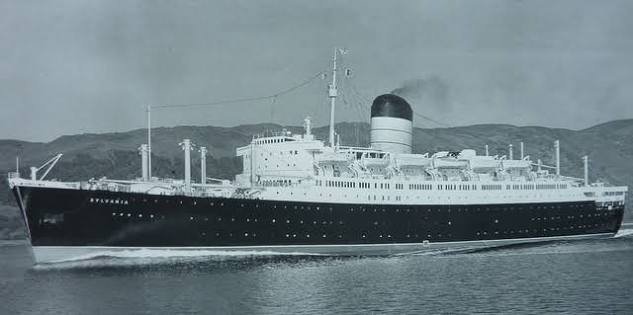
RMS Sylvania (1957)
Cunard Line · entered service 1957 · Ship Guide
Overview
RMS Sylvania was the fourth and final member of Cunard's postwar Saxonia-class quartet. Launched by John Brown & Co. at Clydebank on 31 October 1956 and entering service on 5 June 1957, she arrived at almost the last possible moment for a traditional transatlantic liner conceived primarily around regular passenger service.
Her long career makes her one of the clearest examples of the transition from liner to cruise ship. She began as a seasonal Canadian-route Cunarder, later became Fairwind, then served under identities including Dawn Princess and Albatros. The continuity of the hull is striking, but the commercial worlds represented by those names were very different.
Key Facts
The Last of the Canadian Sisters
Sylvania followed Saxonia, Ivernia, and Carinthia into a service pattern built around the St. Lawrence. Her moderate dimensions, practical draft, and very large tourist-class accommodation were deliberate responses to the Canadian market.
By 1957, however, the commercial environment was already changing rapidly. Jet aircraft were beginning to alter passenger expectations and journey times, so a new liner needed to be useful beyond a single seasonal route. The class's ability to shift into winter Atlantic and cruise work was therefore not incidental; it was part of its long-term survival strategy.
Tourist-Class Atlantic Travel
The social importance of ships like Sylvania lies partly in their passenger mix. With far more tourist-class berths than first-class berths, they document the broadening of transatlantic travel during the 1950s. The ship was designed for a mass middle-market public that does not always receive the same attention as the elite passengers associated with famous prewar liners.
Sale and Fairwind
Cunard sold the ship in 1968, and under Sitmar she became Fairwind. The transition marked a decisive change from scheduled liner service to the modern cruise market. Rebuilding, new branding, and new itineraries changed the experience of the ship even though much of the original structure remained.
A Long Cruise Career
Later identities included Dawn Princess and Albatros. That afterlife lasted far longer than her original Cunard career and makes the ship a rich study in reinvention. Yet the longevity can distort interpretation if the original Canadian-service phase is treated merely as a prelude to cruising.
A Ship Entering an Already Changing Market
Sylvania's 1957 service entry is historically revealing because she was brand new just as the market that had justified her construction began to weaken. Cunard was still operating a substantial scheduled network, but faster transatlantic aircraft were rapidly changing how travelers valued time. The ship therefore spent her Cunard career in a constant tension between the traditional timetable and the need to find profitable alternative employment.
Passenger Culture
Her unusually large tourist-class complement—more than seven times the first-class capacity—captures the social reality of the service. These ships carried a broad public rather than merely an elite. Family groups, migrants, tourists, and people maintaining transatlantic ties all belonged to the passenger world represented by surviving menus, sailing lists, baggage labels, cabin plans, and promotional literature.
That broad market also explains why later cruise conversion was plausible. Public rooms and accommodation designed for hundreds of non-elite passengers could be reworked for leisure cruising more readily than the formal first-class spaces of much older express liners.
Continuity and Reinvention
The later careers under Sitmar, Princess, and other operators show how much of a ship's identity can change while the hull survives. Each rebuild altered the relationship between accommodation, public space, route, and brand. For curatorial purposes, those changes are not clutter at the end of the story; they are evidence of how the passenger-ship industry itself evolved after the liner era.
Interpretive Notes
Name discipline matters: Sylvania, Fairwind, Dawn Princess, and Albatros are connected by hull but separated by operator, branding, route system, and passenger culture. Canadian-route context should remain primary when discussing the Cunard years.
The ship is also one of the clearest liner-to-cruise transition cases in the archive. Preserving that transition requires resisting the temptation to collapse half a century of different commercial identities into a single smooth narrative.
Evidence-first ship guide