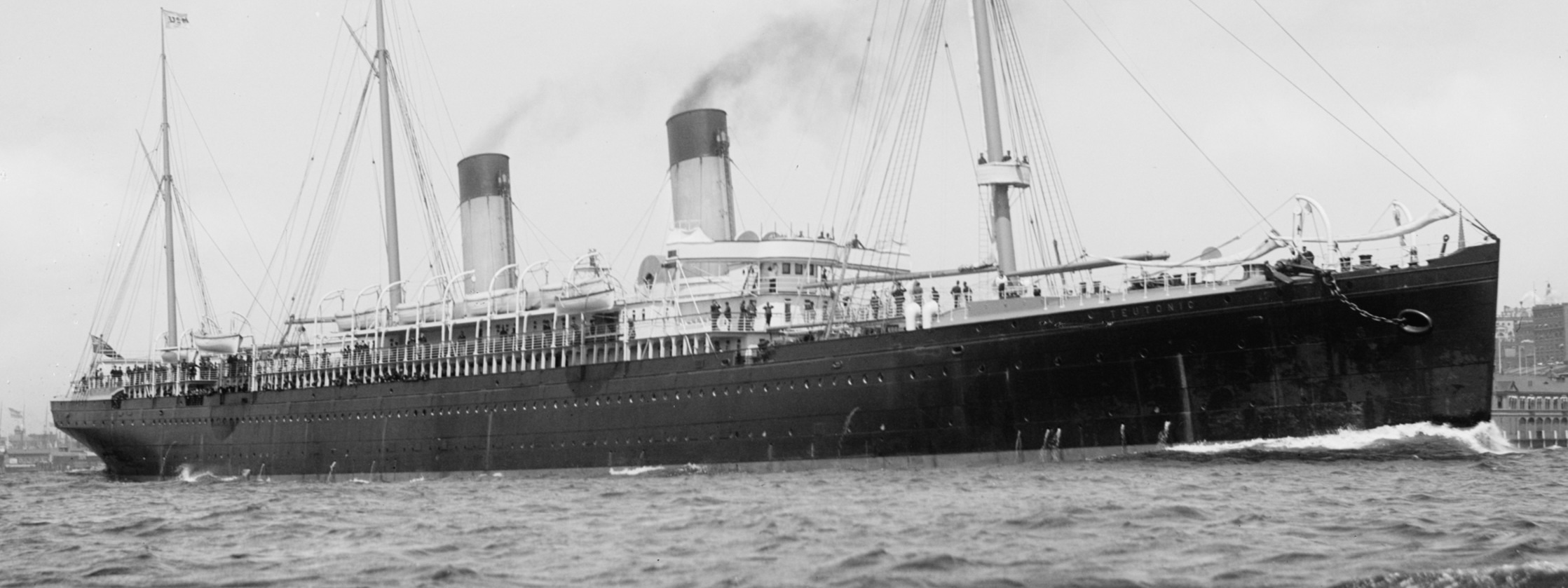
RMS Teutonic (1889)
White Star Line · entered service 1889 · Ship Guide
Overview
RMS Teutonic was Harland & Wolff yard no. 208, built for the Oceanic Steam Navigation Company—White Star Line. Launched on 19 January 1889 and handed over on 25 July, she represented a major technical break for White Star: twin screws, no auxiliary sailing rig, and a design created under an Admiralty subsidy that anticipated rapid conversion to an armed merchant cruiser.
That dual commercial-strategic purpose makes Teutonic more than a speed-era liner. She belongs equally to the history of state-supported merchant shipping, naval preparedness, and the transition from sail-assisted steamers to machinery-dependent express liners.
Key Facts
Admiralty Subsidy and Naval Reviews
Teutonic and sister Majestic were built with annual Admiralty subsidies so they could be converted quickly for naval service in an emergency. Titanic Belfast identifies Teutonic as the first twin-screw White Star ship and the first of the line not fitted with sails as a reserve in case of machinery failure.
Her symbolic role was visible almost immediately. On 21 May 1889, before delivery, she was used for the formal opening of Belfast's Alexandra Graving Dock. She later represented White Star at Royal Naval Fleet Reviews in 1889 and 1897, reinforcing the overlap between commercial prestige and national maritime power.
Design and the End of the Auxiliary-Sail Era
Teutonic belongs to a moment when confidence in marine machinery was changing the outward form of the Atlantic liner. White Star had long favored large, comfortable steamers with auxiliary sailing rigs retained as insurance against machinery trouble. Teutonic dispensed with that convention, pairing twin screws with triple-expansion machinery and no reserve sail plan. The change was practical, but it also signaled a new expectation: a premium liner could trust engines, redundancy, and engineering practice rather than masts and canvas to keep schedule.
Her Admiralty arrangement gave that technical shift a second meaning. The ship was conceived from the outset as commercially useful tonnage that could also support national defense. In that sense, her design linked private passenger competition with public maritime policy well before wartime requisition made the connection visible.
Express Service and Records
In regular service, Teutonic operated the Liverpool–Queenstown–New York route. Her fast passages culminated in an eastbound Blue Riband performance in 1891. The precise record language used by later historians should be dated carefully, but there is no question that Teutonic helped establish White Star as a serious express competitor before the company shifted emphasis toward larger, more comfort-oriented ships.
Changing Service before 1914
Although her reputation is tied to the express race of the early 1890s, Teutonic spent most of her commercial life doing the less spectacular work of a mature liner: repeated crossings, schedule changes, and adaptation as newer White Star tonnage entered service. That longer perspective matters because it prevents the Blue Riband episode from swallowing the rest of the ship's biography. Her value to White Star was not only that she could make a headline passage, but that she remained useful after the technological frontier moved on.
The same longevity also explains the variety of surviving material. Early publicity tends to emphasize novelty and speed, while later documents reflect established service rather than breakthrough performance. Dating the item is therefore essential when interpreting what White Star was trying to say about the ship.
Wartime Service
The strategic logic built into the ship finally became operational during the First World War, when Teutonic was requisitioned as an armed merchant cruiser and served with the Northern Patrol before later transport work. This wartime phase is not an unrelated epilogue: it was the realization of a requirement embedded in her original financing and design.
Why Teutonic Matters
Teutonic marks a technological and institutional transition: twin screws, confidence in steam machinery without reserve sails, Admiralty-supported merchant construction, and increasingly formalized expectations that fast liners could become naval auxiliaries. Those features make her a useful anchor for interpreting late-Victorian liner development well beyond record-crossing statistics.
Evidence-first ship guide