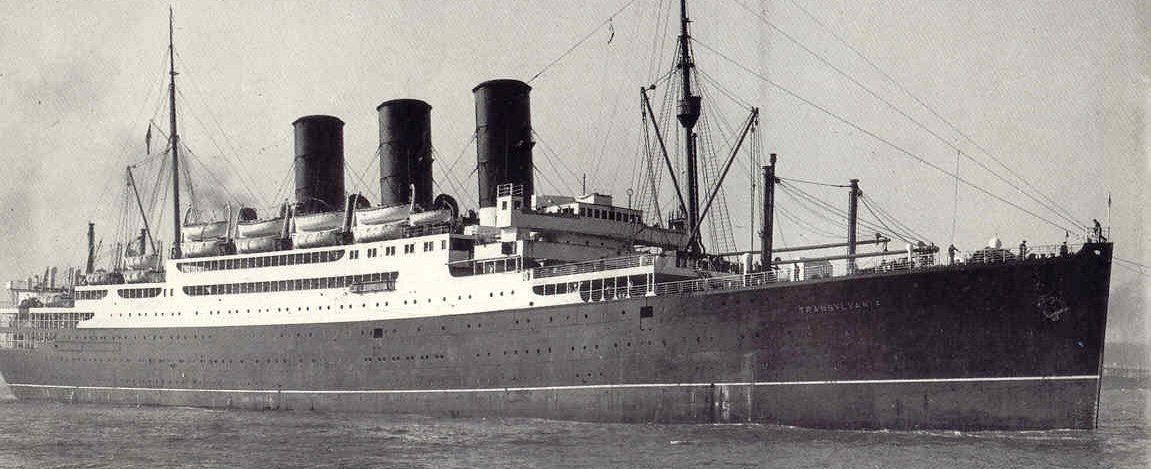
RMS Transylvania
Anchor Line · 1925 · Ship Guide
Overview
RMS Transylvania was an Anchor Line passenger liner launched by Fairfield at Govan in 1925 for North Atlantic and tourist service. She belonged to the same interwar Anchor Line family as Caledonia, another Glasgow–New York liner later converted for armed merchant cruiser service. Her civilian career belonged to the interwar transition toward more flexible passenger markets; her wartime career was much shorter and more sharply documented. Requisitioned by the Admiralty in August 1939, she became the armed merchant cruiser HMS Transylvania (F56) and joined the Northern Patrol.
On 10 August 1940, German submarine U-56 torpedoed her about forty nautical miles northwest of Malin Head. She was taken in tow but later foundered. U-boat records give a complement of 336, with 36 dead and 300 survivors.
Key Facts
Anchor Line in the Tourism Era
Transylvania entered service when the traditional three-class migrant trade was already changing. Restrictive U.S. immigration law reduced some of the traffic that had sustained earlier North Atlantic fleets, while tourism and seasonal leisure travel became more important. Ships such as Transylvania therefore need to be read through more than one commercial lens.
Her three-funnel profile also demonstrates the persistence of visual tradition. By the 1920s, funnel number was no longer a simple measure of machinery need, but passengers still associated a multi-funnel silhouette with scale and prestige.
Passenger Service and the 1929 Grounding
During the interwar years, Transylvania worked Anchor Line passenger routes that included North Atlantic service and tourism-oriented voyages. That civilian phase generated the menus, passenger lists, stationery, deck plans, postcards, and travel brochures most likely to appear in private collections.
On 28 March 1929 the liner grounded in fog near Cherbourg. Passengers were safely removed and the ship was subsequently refloated and repaired. News photographs and souvenir material from the incident should be treated as casualty documentation rather than as evidence of a normal voyage.
Conversion to Armed Merchant Cruiser
The Admiralty requisitioned Transylvania in August 1939. Conversion to an armed merchant cruiser was completed by 5 October, when she entered Royal Navy service as HMS Transylvania, pennant F56. U-boat records list an armament of eight 6-inch guns and two 3-inch guns.
She served with the 10th Cruiser Squadron on the Northern Patrol, a blockade and interception role in which converted passenger liners provided endurance and deck space but were vulnerable compared with purpose-built warships.
Loss off Malin Head
At about 01:00 on 10 August 1940, U-56 fired a torpedo that struck Transylvania aft of the funnel. The ship was roughly forty nautical miles northwest of Malin Head, County Donegal. Nearby vessels and HMS Ashanti assisted with rescue while the disabled cruiser was taken in tow.
The towing attempt failed and Transylvania eventually foundered. U-boat documentation records 336 aboard: 300 survivors and 36 dead, comprising three officers and 33 ratings. Those figures are preferable to vague “dozens lost” language when identifying the wartime casualty.
Name-Collision Caution
This 1925 ship is frequently confused with the earlier Anchor Line Transylvania completed in 1914 and sunk during the First World War in 1917. The year, silhouette, and wartime designation are therefore essential cataloging fields.
Likewise, RMS and HMS are not interchangeable stylistic prefixes here. Civilian passenger artifacts belong to RMS Transylvania; naval documents after requisition belong to HMS Transylvania F56.
Why Transylvania Matters
Transylvania shows how quickly an interwar passenger liner could be absorbed into the machinery of naval blockade. Her peacetime tourist identity and her ten-month armed-merchant-cruiser career are both real, but they produced very different evidence.
For curatorial work, the strongest practice is phase-specific attribution: civilian route and date first, naval pennant and service role second, and no assumption that interior plans or passenger capacities remained meaningful after wartime conversion.
Interpretive Notes
Passenger and armed-merchant-cruiser phases should be separated: civilian Anchor Line material and HMS Transylvania naval records reflect different configurations and purposes.
Name collisions require caution: several ships have carried Transylvania; build date, operator, and wartime designation should be used together when attributing material.
Evidence-first ship guideSources (Selected)
Use these as a starting index and corroborate publish-ready details (especially measurements, accommodation changes, and casualty totals).
- Ocean Liner Curator — Sources (master bibliography)
- Uboat.net — HMS Transylvania loss record
- Uboat.net — HMS Transylvania F56 service summary
- Anchor Line contemporary passenger-service literature and fleet material