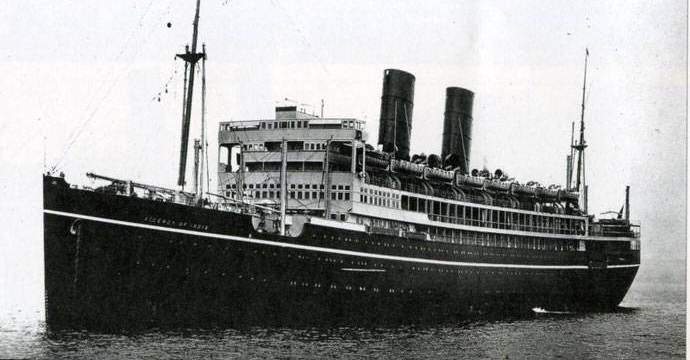
RMS Viceroy of India
P&O · 1929 · Ship Guide
Overview
RMS Viceroy of India was a Peninsular & Oriental Steam Navigation Company (P&O) ocean liner built for the company’s premier London–Suez–Bombay mail and passenger service. Entering service in March 1929, she represents a distinct P&O type: fast, comfortable, and optimized for imperial-route regularity rather than Atlantic record races.
She is also a technology-and-experience ship: a large British turbo-electric liner (a configuration often highlighted in engineering histories), and a floating expression of interwar colonial travel culture—luxury public rooms, a strong “express steamer” identity, and a stable route pattern that generated a rich printed and photographic record.
Evidence-first note: P&O route descriptions are often shortened (“Tilbury–Bombay”) even when a voyage implies multiple intermediate ports. When using ephemera (menus, passenger lists, baggage labels) as evidence, treat the specific port chain as the primary fact, and the route label as shorthand.
Key Facts
Design & Construction (Context)
Ordered by P&O in 1927 and built on the Clyde, Viceroy of India was conceived as a high-quality “express” vessel for the Indian route. Contemporary descriptions emphasize modern machinery and careful attention to passenger comfort. The ship’s turbo-electric propulsion is often singled out in technical literature as a major British application at scale—useful context when writing about how interwar liners blended engineering innovation with a carefully staged onboard experience.
For collecting, the ship’s design story shows up indirectly: stationery and printed material frequently lean into a controlled, modern P&O visual identity, while postcards and brochures often foreground the ship’s long, clean profile and P&O’s recognizable livery. If an item claims to be “from the ship,” verify it against dated sailings or known onboard printers rather than relying on a generic P&O look-alike.
Service History (Summary)
1929–1939: Indian mail service and cruising. Entering service in March 1929, Viceroy of India worked P&O’s London–Suez–Bombay pattern and also undertook leisure cruises during the interwar years. Her career includes several well-documented incidents typical of a heavily worked liner: collisions in port, assists to vessels in distress, and passenger transfers from damaged ships.
Rescues and assistance (selected highlights). Period sources and later compilations note multiple rescues/assists, including the rescue of crew from an Italian cargo steamer in the eastern Mediterranean (1929) and later assistance to other vessels at sea. These moments can generate collectible paper: shipboard accounts, newspaper coverage, and commemorative mentions in company literature—high-risk for misattribution unless anchored to date and location.
September 1932: record run. In September 1932, Viceroy of India set a record time between London and Bombay of 17 days, 1 hour, 42 minutes—an example of how “route records” (not just Atlantic sprints) were part of the era’s prestige economy.
1939–1942: wartime conversion and loss. With the outbreak of war, the ship was requisitioned and employed as a troopship/transport. After arriving at Algiers with convoy KMF-1A and disembarking troops for Operation Torch, she departed empty for Gibraltar. At about 05:24 on 11 November 1942 she was torpedoed by U-407 roughly 34 miles northwest of Oran. Taken in tow by HMS Boadicea, she later sank at approximately 36°24′N, 00°35′W. Four crew members were killed.
A Record-Rich Interwar Career
Viceroy of India generated an unusually varied peacetime record. She collided with the tug Olanda at Venice in August 1929, rescued 25 crew from the Italian steamer Maria Luisa that November, and was involved in further assistance and collision episodes during 1930.
In September 1932 she completed London–Bombay in 17 days, 1 hour, 42 minutes. In February 1939 she became the first P&O liner to visit Tristan da Cunha, demonstrating how the same ship could function as scheduled mail liner, prestige express vessel, and cruise ship within a single civilian career.
Operation Torch and the Final Voyage
Requisitioned on 12 November 1940, Viceroy of India served as a troop transport. In November 1942 she reached Algiers with convoy KMF-1A and disembarked troops for Operation Torch.
While returning empty toward Gibraltar on 11 November, she was hit at 05:24 by two torpedoes from U-407 about 34 miles northwest of Oran. HMS Boadicea took the damaged ship in tow, but she later sank. U-boat records give 454 aboard: four dead and 450 survivors.
Why Viceroy of India Matters
Viceroy of India combines three themes often separated in liner history: interwar turbo-electric engineering, the scheduled imperial mail route to India, and wartime troop transport. Her rich incident and rescue record also makes dated voyage evidence particularly valuable because the ship’s activities varied far beyond a simple Tilbury–Bombay timetable.
Interpretive Notes
Viceroy of India is a strong “system ship” for P&O: she makes sense when you read her as an instrument of schedule, route discipline, and imperial connectivity. That framework helps keep the collecting story honest, too. A menu or letterhead from this ship is not inherently “war” or “empire” material—until you date it, place it, and understand what voyage it served.
The ship’s name invites narrative inflation. Avoid treating it as an automatic signifier of official state travel. When a claim involves dignitaries, confirm with contemporary passenger lists, newspapers, or official diaries rather than repeating a pleasing anecdote.
Evidence-first ship guideSources (Selected)
Use these as a starting index and corroborate publish-ready details (dimensions/tonnage by register edition, passenger totals, incident specifics) with institutional sources where possible.
- Ocean Liner Curator — Sources (master bibliography)
- P&O Heritage — Viceroy of India (1929) Fact Sheet (PDF)
- uboat.net — Troop transport Viceroy of India (loss details and coordinates)
- Lloyd’s Register Foundation — Archive listings for Viceroy of India (1929)
- Wikipedia — RMS Viceroy of India (starting index; corroborate key facts)