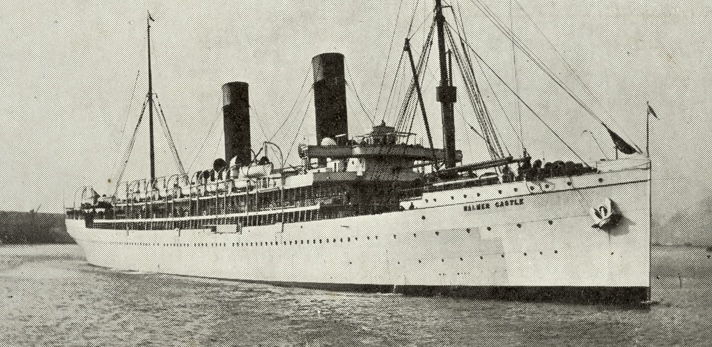
RMS Walmer Castle
Union-Castle Line · 1902 · Ship Guide
Overview
RMS Walmer Castle was a Union-Castle Royal Mail steamer built for the established passenger and mail route between Britain and South Africa. Completed in 1902, she belonged to the generation that gave the newly formed Union-Castle Line a more unified fleet identity: large twin-screw ships, regular schedules, and dependable service rather than competition for North Atlantic speed records.
She spent most of her career on the Southampton–Cape Town mail run, with onward calls in South African waters varying by voyage and timetable. Her long working life also included wartime requisition as a troopship, two postwar Liverpool–New York voyages operated for Cunard, and a final return to the Cape service before withdrawal in 1930.
Evidence-first note: the name Walmer Castle was carried by several vessels. This guide concerns the 12,546-ton Union-Castle passenger liner launched in 1901 and completed in 1902, not the smaller 1936 cargo vessel of the same name.
Key Facts
Design & Construction (Context)
Walmer Castle was laid down as Celt for the Union Line shortly before the 1900 merger that created the Union-Castle Mail Steamship Company. Renamed before launch, she emerged as one of the first important new passenger liners associated with the combined company and was, at completion, among its largest ships.
Her two funnels, twin screws, and balanced passenger accommodation gave her the appearance and operating flexibility expected of an Edwardian mail steamer. Although comfortably appointed, she was fundamentally a route ship: her design served the movement of passengers, mail, officials, migrants, and commercial traffic over the long sea road between Britain and southern Africa.
Service History (Summary)
1902–1914: Establishing the Cape mail service. After completion in February 1902, Walmer Castle entered Union-Castle’s Southampton–Cape service. She became part of the weekly mail system linking Britain with Cape Town and, according to individual schedules, ports farther along the South African coast.
Notable passengers. Her passenger lists reflected the political and cultural importance of the route. Lord Gladstone travelled aboard her in 1910 on his way to become the first Governor-General of the Union of South Africa, and Rudyard Kipling returned to Britain aboard the ship later that year. Lord and Lady Milner also travelled in her in 1924.
1914–1917: Mail service under wartime conditions. Unlike liners immediately taken for military use, Walmer Castle initially remained on the mail run. Wartime routing, quarantine, convoy requirements, and the threat of German commerce raiders could transform a scheduled passage into a prolonged operation. A voyage beginning in December 1916 reportedly required 49 days from Tilbury to Cape Town.
1917–1919: Troopship. In April 1917 she was requisitioned under the Liner Requisition Scheme. She carried troops from South Africa and later served in the North Atlantic, at times wearing disruptive dazzle camouflage.
1919–1930: Return to commercial service. During 1919 she made two Liverpool–New York voyages for Cunard before resuming Union-Castle service. By the end of the 1920s, however, a new generation of larger and more modern motor liners was entering the Cape route. Replaced by Winchester Castle, she made her last regular sailing in October 1930 and was laid up at Netley.
1932: Breaking up. After a period in reserve, Walmer Castle was sold for £13,500 and taken to Blyth, where Hughes Bolckow dismantled her in February 1932.
1919 Cunard Voyages
After troopship service, Walmer Castle briefly entered an unusual transitional phase: in 1919 she made two Liverpool–New York voyages for Cunard before returning to Union-Castle’s Cape mail run. Those sailings are especially useful for cataloging because Cunard-branded material can otherwise look like a misattribution.
Corporate Identity and the Projected Name Celt
The ship had been intended as Celt for the Union Line before the 1900 merger created Union-Castle. Renaming before launch therefore preserves a corporate transition inside the ship’s construction history. Pre-launch documentation may legitimately use the projected Union identity even though the completed vessel never entered service under that name.
Why Walmer Castle Matters
Walmer Castle illustrates how a dependable mail liner could move through merger-era corporate identity, wartime requisition, a brief Cunard interlude, and nearly three decades of Cape service without requiring a dramatic celebrity narrative. Her value lies in continuity and in the documentary precision needed to distinguish those phases.
Interpretive Notes
Walmer Castle represents a category of liner that can be overshadowed by faster or more luxurious contemporaries: the dependable imperial mail ship. Her importance lies not in a single spectacular event but in nearly three decades of regular movement between Britain and southern Africa. That continuity made ships like her part of the infrastructure of government, migration, commerce, tourism, and personal correspondence.
Her origin as the projected Celt also makes her useful for understanding corporate merger and fleet identity. The ship was conceived for one company but completed for its successor, carrying a Castle name and helping establish the visual and operational character of Union-Castle’s early twentieth-century fleet.
For collectors and researchers, voyage-dated passenger lists, menus, postcards, luggage labels, and correspondence are especially valuable because they can connect the ship’s broad service history to an individual sailing. Route wording should be read carefully: Southampton–Cape Town was the core mail passage, while advertisements and passenger lists may describe additional coastal calls or final destinations.
Evidence-first ship guideSources (Selected)
Use these as a starting index and corroborate publish-ready details with contemporary registers, passenger lists, company timetables, and archival records where possible.
- Ocean Liner Curator — Sources (master bibliography)
- Harland & Wolff Shipbuilding Database — Walmer Castle, Yard No. 342
- British & Commonwealth Staff Register — Walmer Castle (2)
- GG Archives — Walmer Castle passenger-list index
- Wikipedia — RMS Walmer Castle (starting index; corroborate key facts)
- Norman Hodson, The Race to the Cape (bibliographic reference; availability may vary)