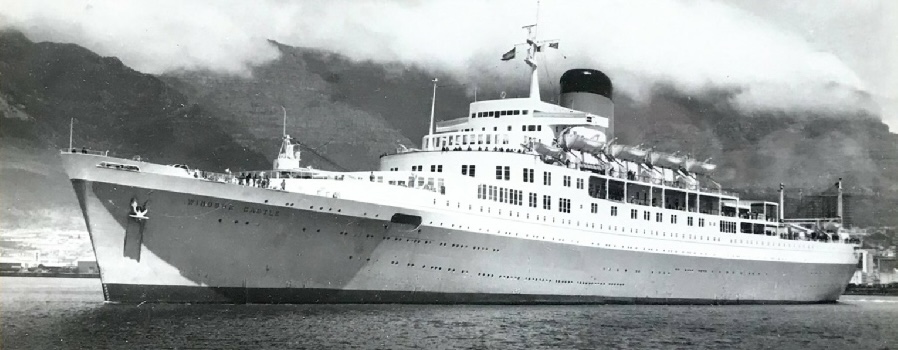
RMS Windsor Castle
Union-Castle Line · entered service 1960 · Ship Guide
Overview
RMS Windsor Castle was Union-Castle Line’s last great purpose-built mailship for the South Africa run: a large, fast passenger-and-cargo liner designed for the Cape Mail pattern between Britain and South Africa. Entering service in 1960, she represents the “late steamliner” moment when comfort, air-conditioning, stabilizers, and carefully separated first/tourist public rooms were still central to ocean travel—even as the jet age was already reshaping passenger expectations.
For collectors, Windsor Castle material often survives in strong condition because a lot of it is relatively modern (1960s–1970s printing, glossy brochures, consistent house style). The main hazard is name confusion (Union-Castle reused “Castle” names across decades, and there was an earlier Windsor Castle of the 1920s). As always: let the object speak—operator branding, route wording, dates, and typography will usually anchor the era.
Evidence-first note: this page covers the 1960-entry Union-Castle Cape Mail flagship (launched 1959; completed 1960), later sold in 1977 and best known afterward as Margarita L. If your artifact looks prewar or references the 1920s South Africa service, you may be dealing with the earlier vessel of the same name.
Key Facts
Design & Construction (Context)
The ship was conceived as a modernized successor generation for Union-Castle’s South Africa service—large enough to combine serious refrigerated/dry cargo capacity with a premium passenger product, and fast enough to maintain schedule expectations on a route that prized regularity and reputation. In the late 1950s–early 1960s, “mailship” still meant an integrated system: passengers, cargo, and postal contracts moving on a dependable cadence with strong brand ritual at both ends of the run.
Collecting implication: Union-Castle material from this era tends to be schedule-anchored (sailing lists, route descriptions, port sequences, and onboard-program formats that assume repeat voyages). That regularity is a gift: many objects can be dated and authenticated by cross-checking ports-of-call wording, typography/house style, and the presence (or absence) of airline-era marketing language.
Service History (Summary)
1960–1977: Cape Mail flagship era. After completion in June 1960, Windsor Castle entered commercial service with her 18 August 1960 maiden voyage from Southampton to Durban. She then worked the established Union-Castle pattern via Las Palmas to Cape Town and onward to the additional South African ports, returning by the same route. In the mid-1960s, schedule acceleration demanded sustained high service speed—part of the late steamliner story where ships were pushed hard to stay competitive against time-saving air travel.
1977 onward: sale and second life. With the decline of traditional mail/passenger liner economics, Windsor Castle left Union-Castle service in 1977 and was sold, becoming Margarita L. Her later career belongs to a different category (cruise/charter use and lay-up phases in many references), and collectors should catalog objects under the correct operator and name rather than back-projecting “Union-Castle Cape Mail” romance onto later souvenirs.
Interpretive Notes
Windsor Castle is a satisfying ship for evidence-first collecting because so many objects can be cleanly grounded in operator + route + date. The recurring pitfalls are mostly avoidable: (1) confusing this ship with the earlier Windsor Castle of the 1920s, (2) assuming every “Castle Line” souvenir is ship-specific, and (3) listing post-1977 material as Union-Castle without documentation.
Practical checks:
1) Brand line: “Union-Castle” wording/logos are your first separator.
2) Route language: “Southampton–Las Palmas–Cape Town–Durban” (and the intermediate South African ports) is a strong anchor.
3) Dating cues: printed sailing dates, menu/program dates, or “maiden voyage” / “final voyage” inscriptions outrank visual ID.
4) Name reuse guardrail: if your item feels prewar in paper stock, typography, or design language, treat “Windsor Castle” as a keyword—verify the era before attribution.
The accelerated Cape Mail system: the 1960 Windsor Castle belonged to a mature Union-Castle operating system in which reliability and schedule discipline were defining qualities. Her role is best understood not as an isolated prestige ship but as part of the accelerated mail service linking Britain and South Africa on a tightly managed timetable.
That operating context shaped everything from machinery and turnaround expectations to passenger marketing. Route schedules, port calls, and service frequency are therefore part of the ship’s historical identity, not merely logistical detail. Later political and commercial changes affecting the South African trade also help explain why a relatively modern liner could face obsolescence despite remaining technically capable.
That system-level role is central to understanding why the ship mattered.
Evidence-first ship guide