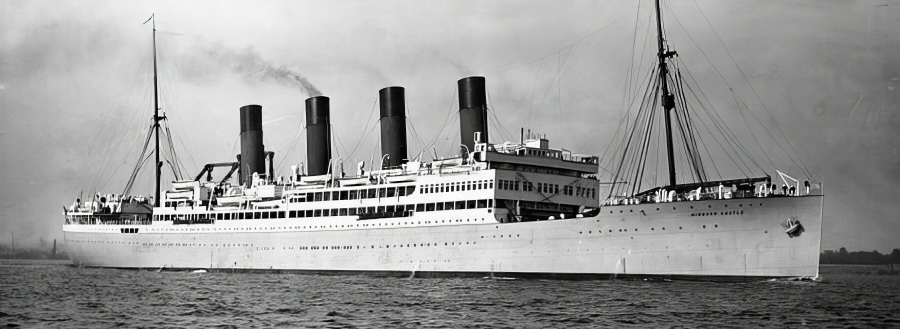
RMS Windsor Castle (1921)
Union-Castle Line · entered service 1922 · Ship Guide
Overview
RMS Windsor Castle (launched in 1921; delivered in 1922) was a major Union-Castle mail liner built for the Southampton–South Africa run—an ambitious ship that carried the visual drama of the four-funnel era into a route that was not the North Atlantic. Together with her sister Arundel Castle, she anchored the “Cape Mail” service pattern as a large, high-capacity liner intended to project reliability and prestige on a long-distance schedule.
For collectors, Windsor Castle can be especially satisfying because Union-Castle printed a lot of material with clear route language and consistent house branding: sailing lists, passenger lists, menus, onboard programmes, postcards, and mail-related stationery. The main risk is name confusion—later Union-Castle ships reused the name (most famously the 1959/1960 Windsor Castle), and sellers sometimes collapse “Windsor Castle” into a single romanticized identity.
Evidence-first note: This page covers the 1921-launched Union-Castle liner (delivered 1922; sunk 1943). If your item references air travel, “Tourist Class” modern branding, or 1960s design language, it likely belongs to the 1959/1960 ship instead.
Key Facts
Design & Construction (Context)
Windsor Castle is best understood as a ship designed in one era and finished in another. Ordered in the prewar design climate (when “four funnels” still signaled modernity and power), her construction timeline was stretched by World War I and its industrial disruptions. The result was a striking four-funnel liner whose silhouette felt grand and slightly anachronistic by the early 1920s—yet well suited to Union-Castle’s prestige positioning on the South Africa route.
The ship’s later modernization matters to collectors: in the late 1930s she was rebuilt to look (and perform) more “modern,” with a new bow profile, altered funnels, and reported increases in speed and tonnage. That means photographs, postcards, and printed silhouette art can depict materially different “versions” of the same ship. Don’t let appearance alone drive attribution; route/date text is usually stronger.
Service History (Summary)
1922–1939: Cape Mail service. After delivery in March 1922, Windsor Castle entered the Union-Castle schedule with her maiden voyage in April 1922, working the long UK–South Africa run. This is the core collecting window for classic passenger ephemera: menus, passenger lists, sailing cards, souvenir folders, and postcards associated with named ports (Southampton, Cape Town, and onward stops).
1937: Major refit and “new look.” In the late 1930s, Windsor Castle and her sister underwent extensive modernization. Secondary sources consistently describe funnel reduction and a more modern bow (with associated dimensional and performance changes). If your item shows a two-funnel profile, it may reflect the post-refit appearance even though it is still the same ship.
1939–1943: Troopship career and loss. Requisitioned at the start of World War II, Windsor Castle served as a troop transport. She was ultimately sunk on 23 March 1943 in the Mediterranean, off Algiers, by an aerial torpedo from a German aircraft while in convoy. Wartime documents can be highly collectible, but this is also where seller narratives tend to outrun the object—prefer items with explicit dates, official headers, or unit/route context.
Interpretive Notes
The biggest evidence trap with Windsor Castle is simple: there are two prominent Union-Castle ships with this name (1921 launch and 1959/1960 build), and “Castle Line” sellers often don’t differentiate. Treat “Windsor Castle” as a keyword, not a conclusion.
Practical checks:
1) Era cues: 1920s–1930s printing, paper stock, and typography often look fundamentally different from the 1960s ship’s materials.
2) Route text: look for “Cape Town” and the classic Union-Castle “mailship” language; modern tourist branding tends to indicate the later ship.
3) Profile art: four funnels often indicate pre-1937 depiction; two funnels can indicate post-1937 depiction—use as supporting evidence only.
4) Wartime items: require explicit dates/units/official markings; generic “troopship” claims are weak without documentation.
Sister ship, separate fate: Windsor Castle and Arundel Castle formed a conspicuous four-funnel pair, but their later records diverged sharply. That makes sister-ship comparison useful for design history while also making ship-specific wartime attribution essential.
Her 1930s rebuilding changed the outward appearance enough to serve as a dating tool for photographs and postcards. The 1943 loss belongs to a still different phase: she was struck by German aerial torpedo attack while in convoy KMF 11, not sunk by submarine. That distinction should remain explicit in any concise service summary.
The same principle applies to wartime imagery. A troopship photograph belongs to a military transport context with altered fittings, camouflage, and operating priorities; it should not be used uncritically to reconstruct peacetime passenger appearance. The shared class design helps comparison, but provenance still has to remain ship- and period-specific.
For this sister pair, appearance, date, and service context have to be read together.
That discipline is particularly important because the sisters’ similar silhouettes can otherwise encourage confident but incorrect identification.
The modernization also changed passenger-facing spaces and publicity, so pre-refit and post-refit brochures should be treated as separate descriptive records of the same ship rather than blended into one timeless interior.
Evidence-first ship guide