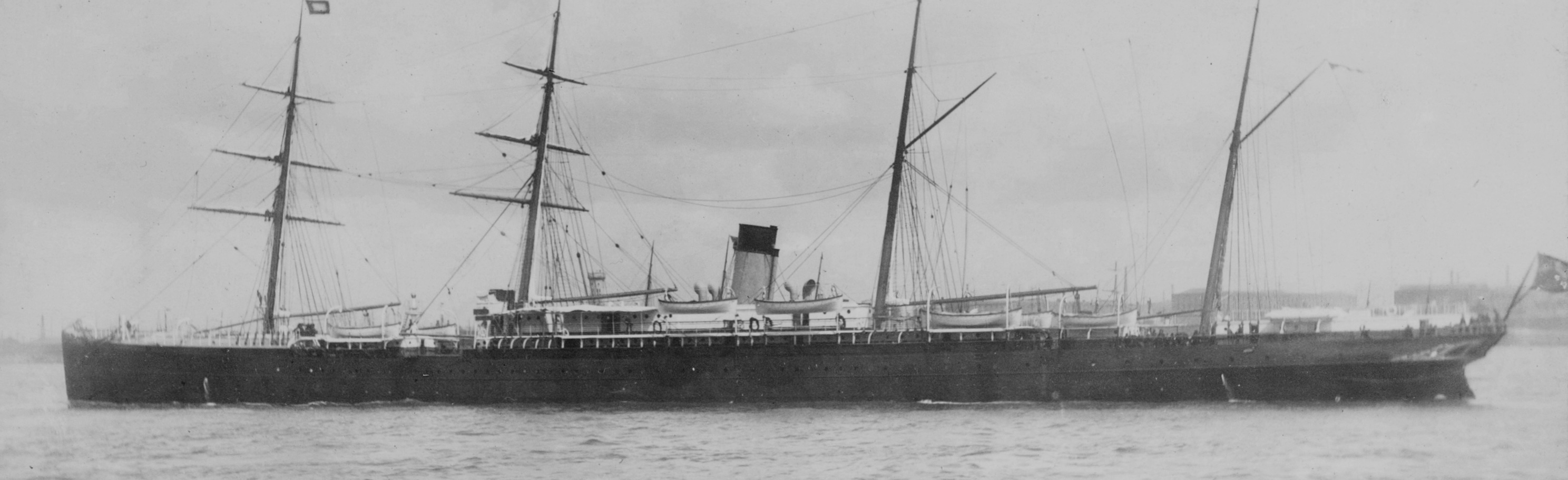
SS Adriatic (1872)
White Star Line · 1872 · Ship Guide
Overview
SS Adriatic belonged to the first generation of steamships built by Harland & Wolff for Thomas Henry Ismay’s reorganized White Star Line. Launched at Belfast on 17 October 1871 and completed on 31 March 1872, she entered the Liverpool–Queenstown–New York service on 11 April. She followed the broad design philosophy introduced by SS Oceanic: an iron hull, screw propulsion, auxiliary sail, and a passenger arrangement that helped distinguish the new White Star operation from older Atlantic practice.
Her historical importance is not a short-lived career or an early loss—the previous version of this guide incorrectly stated that she sank in 1873. Adriatic remained in service for more than a quarter-century. In May 1872 she made a record westbound passage from Queenstown to Sandy Hook in 7 days, 23 hours and 17 minutes at an average of 14.53 knots, a performance retrospectively associated with the Blue Riband. She was finally sold for breaking up in 1899.
Name reuse matters here. This is the 1871-launched / 1872-entered-service Adriatic, not the much larger RMS Adriatic of 1907.
Key Facts
Published dimensions and machinery figures differ slightly among later summaries. Exact figures should be tied to the source and date being cited rather than silently harmonized.
Design & Construction Context
Adriatic was one of the early White Star ships that turned the company’s new identity into a repeatable fleet program. Her single funnel and four masts still advertised a transitional steam-and-sail world, but the ship’s commercial logic was increasingly modern: dependable powered passages, regular schedules, large passenger capacity, and a recognizable family resemblance across the fleet.
The ship is therefore useful as evidence of a transition rather than as a technological endpoint. Auxiliary rig remained prudent insurance, while steam propulsion had become the basis on which service regularity and competitive performance were judged.
Service History
1872 — entry into service: Adriatic sailed from Liverpool on her maiden voyage on 11 April 1872 under Captain Digby Murray. The route ran through Queenstown before the Atlantic crossing to New York.
May 1872 — record passage: on 25 May she completed a westbound passage from Queenstown to Sandy Hook in 7 days, 23 hours and 17 minutes, averaging 14.53 knots. Later Blue Riband histories credit this as the fastest westbound passage then recorded; White Star’s Germanic surpassed it in 1875.
1870s–1890s — continuing Atlantic work: the ship continued in White Star service through the period in which the company’s fleet grew dramatically in size and technical sophistication. A collision with Cunard’s Parthia in 1874 caused damage but did not end Adriatic’s career. She underwent a refit in 1884 and remained part of the older generation of White Star tonnage as newer ships entered service.
1899 — disposal: after a career spanning roughly twenty-seven years, Adriatic was sold for scrap. Her survival into the late 1890s is itself a useful corrective to the mistaken idea that she was lost in the early 1870s.
Why Adriatic Matters
Her significance lies in scale and continuity. The later White Star story is dominated by much larger ships, but Adriatic belongs to the fleet that established the company’s operating identity in the first place. She also demonstrates how quickly the competitive North Atlantic could generate measurable claims of performance before the celebrated express liners of the 1880s and 1890s.
For collectors and researchers, the reused name creates a persistent attribution problem. A period item that says only “Adriatic” is not enough: date, route, company typography, dimensions, imagery, and surrounding context should be used to distinguish this ship from the 1907 liner.
Evidence-first ship guide