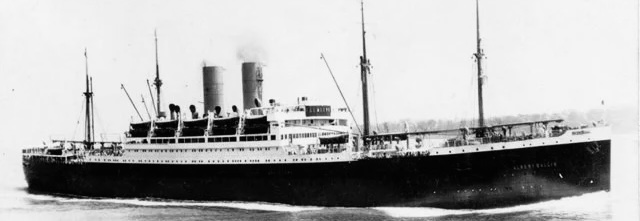
SS Albert Ballin
Hamburg America Line (HAPAG) · entered service 1923 · Ship Guide
Overview
SS Albert Ballin was one of HAPAG’s important interwar North Atlantic liners, built in Hamburg and named for the company’s famed director Albert Ballin. She belonged to the post-First World War rebuilding phase of German passenger shipping, when major lines sought to re-establish transatlantic service under very different political and commercial conditions from those of the pre-1914 era. Though not a record-breaking express liner, she became a substantial and recognizable presence on the Hamburg–New York route and later underwent enough alteration that her appearance and performance changed meaningfully over time.
In collecting and interpretation, Albert Ballin should be divided into at least three phases: original HAPAG service under her commemorative name, later service after technical alteration and lengthening, and her post-1935 career as Hansa. Material from those phases should not be merged casually, especially given the political reasons behind the renaming.
Key Facts
Design & Construction Context
Albert Ballin belongs to the interwar recovery phase of German transatlantic shipping. She was not one of the giant prewar HAPAG flagships, but rather part of the fleet with which the company reasserted a strong North Atlantic presence after the disruption and losses of the First World War. That makes her historically important as a ship of restoration and adaptation rather than imperial-era excess.
Her naming also matters. To dedicate a HAPAG liner to Albert Ballin was to honor one of the most consequential figures in prewar passenger-shipping history. Because that commemorative identity was later erased under the Nazi regime, the ship occupies an especially revealing place in the intersection of liner history and political culture.
Service History (Summary)
1922–1923: Built by Blohm & Voss at Hamburg, launched in December 1922, and placed in service in 1923. Her maiden voyage began on 5 July 1923 in HAPAG’s North Atlantic passenger trade.
1920s early service: In her initial years, Albert Ballin operated on the Hamburg–New York route as part of HAPAG’s rebuilt interwar fleet. This is the correct context for early passenger lists, route brochures, and publicity material using her original commemorative name.
1928–1929: Tourist class was added in 1928, reflecting shifting passenger-market realities in the interwar Atlantic trade. In 1929 the ship was re-engined, improving her speed and materially changing her performance profile.
1934: She was lengthened by about fifty feet and her speed increased again. This is a meaningful interpretive dividing line, because pre-1934 and post-1934 images or specifications may not describe the same physical configuration.
1935 renaming: In 1935 the Nazi government ordered the ship renamed Hansa, because Albert Ballin had been Jewish. This change is not a superficial naming detail but a politically charged rupture in the ship’s public identity.
1935–1939: Under the name Hansa, she continued in transatlantic service. Her last Atlantic crossing took place in 1939.
Second World War: In the war’s later phase, the ship was employed in evacuation work associated with the collapsing eastern front and Operation Hannibal. During one such movement in March 1945, she struck a mine off Warnemünde and sank.
Postwar afterlife: The hull did not end with the 1945 sinking. She was later raised, rebuilt by the Soviet Union, and entered service anew as Sovetskiy Soyuz, later Tobolsk, surviving into the early 1980s before scrapping.
Interpretive Notes
This is a HAPAG interwar recovery liner first: Albert Ballin should be understood within the context of Germany’s restored post-1918 North Atlantic service, not as a prewar imperial giant.
The name is historically loaded: because the ship honored Albert Ballin and was later forcibly renamed for antisemitic political reasons, artifacts using Albert Ballin versus Hansa belong to markedly different historical environments.
Technical changes matter: the 1929 re-engining and especially the 1934 lengthening mean that “Albert Ballin” was not a static object across her whole career. Specifications and photographs should be dated carefully.
The later Soviet life is real, but secondary to this guide’s core identity: the same hull’s later service as Sovetskiy Soyuz is important and worth noting, but it should not obscure the ship’s original HAPAG identity in a guide centered on Albert Ballin.
A name changed by politics: Albert Ballin is a case where a ship’s renaming cannot be treated as ordinary fleet housekeeping. The forced 1935 change to Hansa belonged to the political climate of Nazi Germany and the removal of Ballin’s Jewish name from public commemoration. That context is part of the ship’s history, not merely a note about nomenclature.
For provenance, the two names should remain date-specific. Material marked Albert Ballin belongs to the earlier HAPAG phase; Hansa material belongs to the later political and operational context. Treating them as interchangeable erases the reason the change occurred.
The renaming is therefore itself a historical event, not just a catalog synonym.
Evidence-first ship guide