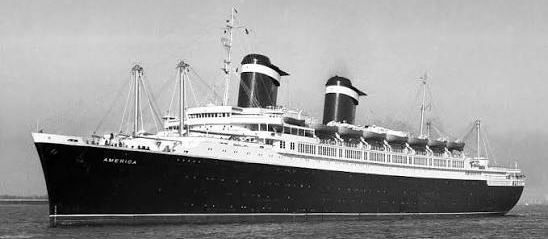
SS America
United States Lines · 1940 · Ship Guide
Overview
SS America was a major U.S.-built ocean liner for United States Lines—designed by William Francis Gibbs and constructed at Newport News. Completed in 1940, she entered service during a moment when the Atlantic passenger trade was being reshaped by war conditions, neutrality policy, and the rapid militarization of large ships.
Her career is best understood in three layers: (1) a short peacetime debut under United States Lines, (2) wartime conversion and service as USS West Point (AP-23), and (3) a long postwar afterlife—first again as America, then as Australis, Italis, Noga, Alferdoss, and finally American Star, wrecked in 1994 off Fuerteventura in the Canary Islands.
Evidence-first note: the ship’s identity is often blurred by repeated renamings and by “America” being a common word used in captions. When attributing photos, postcards, or ephemera, anchor the claim to a date-range and the ship’s name at that time (e.g., America vs West Point vs Australis).
Key Facts
Note on measurements: gross register tonnage (GRT) and later gross tonnage (GT) are registry measures and can differ across sources and refits. If you publish an exact figure, cite the source and the measurement date/context.
Design & Construction (Context)
America represents an “American answer” to the interwar prestige liner: modern lines, careful brand presentation, and an interior program meant to signal contemporary U.S. design. She is also a reminder that many late-1930s/early-1940s liners were built with an implicit second life in mind: wartime conversion was not a distant hypothetical—it was a planning assumption.
For researchers and collectors, the key takeaway is that wartime conversion changes the paper trail. Once she became USS West Point, the ship’s documentation shifts toward naval records, convoy movement, and military logistics—and many peacetime “liner” assumptions (passenger lists, souvenir material, branded stationery) become less relevant.
Service History (Summary)
1940–1941: United States Lines debut. Completed in April 1940, the ship entered service that summer. With the European war underway and the U.S. still neutral, early operations are commonly summarized as cruising closer to U.S. waters rather than committing immediately to the classic North Atlantic run.
1941–1946: USS West Point (AP-23). Acquired by the U.S. Navy on 1 June 1941, America was converted for troop transport service and commissioned as USS West Point. In this role she carried personnel across multiple theaters of war—a career that makes her one of the major “liner-to-transport” conversions of the period.
1946–1964: Return to commercial liner service. Decommissioned in March 1946 and returned to United States Lines, she resumed passenger service, commonly summarized on New York–Le Havre–Southampton sailings through the postwar peak and into the early jet-age transition.
1964–1994: Long afterlife and renamings. Sold in the mid-1960s, she became Australis under Chandris and continued as a passenger ship in different configurations. After further ownership changes and periods of lay-up, she was renamed American Star for a tow associated with a planned conversion; the tow failed, and the ship wrecked off Fuerteventura in January 1994. The wreck then progressively collapsed.
America Becomes USS West Point
The United States entered the Second World War before America had established a long peacetime liner career. Taken over by the Navy and commissioned as USS West Point (AP-23), she became one of the largest troop transports in American service.
U.S. Naval History and Heritage Command records that West Point carried more than 350,000 troops during her naval career. On one August 1944 voyage, the total number of people aboard—including ship's company—reached 9,305.
Return to America
After the war, the ship returned to Newport News, recovered the name America, and was rebuilt for passenger service. United States Lines resumed her civilian operation in late 1946, giving the hull a second, much more conventional transatlantic identity after years of military use.
Australis and the Long Afterlife
Sold to Chandris in 1964 and renamed Australis, the former flagship entered another major phase carrying migrants and cruise passengers between Europe, Australia, New Zealand, and the wider Pacific.
Later names—Italis, Noga, Alferdoss, and American Star—belong to increasingly different commercial circumstances. The famous wreck at Fuerteventura in 1994 was therefore the end of a hull whose identity had already changed repeatedly over more than half a century.
Interpretive Notes
1) “America” is not enough. In captions and listings, “SS America” is easily confused with other ships, concepts, or patriotic graphic themes. Strong attribution uses multiple anchors: builder/location, funnel profile, superstructure details, registry/flag, and—when available—dateable markings.
2) The naval boundary is decisive. June 1941 is a hard documentary break. If an object is claimed as “from SS America,” ask whether it is (a) pre-acquisition United States Lines material, (b) wartime USS West Point material, or (c) postwar U.S. Lines material. Those are three different collecting fields even though the hull is the same.
Evidence-first ship guideSources (Selected)
Starting points for chronology and identifiers. For publish-ready figures (tonnage, passenger totals, speed), corroborate with dated references and primary records.
- Ocean Liner Curator — Sources (master bibliography)
- Wikipedia — SS America (1939) (starting index; corroborate key facts)
- Naval History & Heritage Command (DANFS) — USS West Point (AP-23)
- ssMaritime — SS America (timeline/specs overview)
- NavSource — USS West Point (AP-23) (photo index)
- U.S. Naval History and Heritage Command — USS West Point / SS America