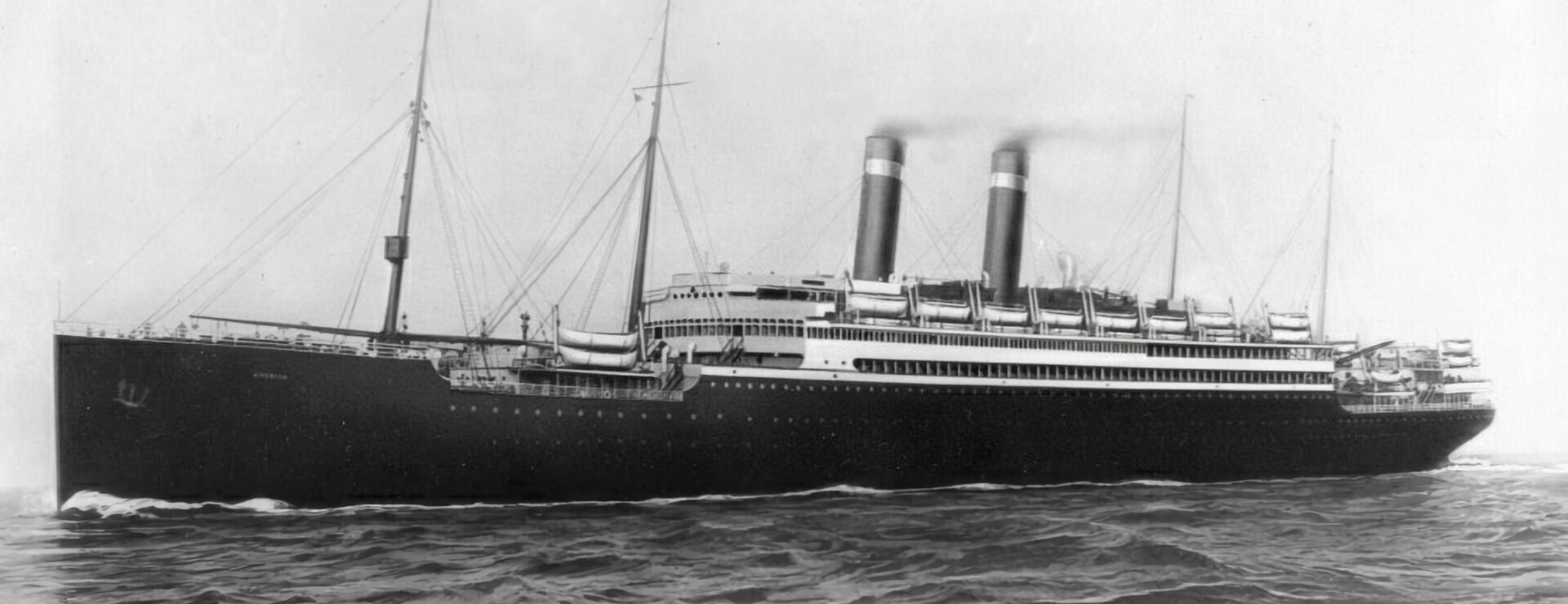
SS Amerika (1905)
Hamburg America Line (HAPAG) · launched 1905 · Ship Guide
Overview
SS Amerika was a large Hamburg America Line passenger liner built by Harland & Wolff and launched at Belfast on 20 April 1905. Entering service that October, she combined substantial immigrant capacity with first-class prestige on the Hamburg–New York route. Her later history under the names America and Edmund B. Alexander produced an unusually long paper trail spanning German commercial service, two world wars, U.S. naval transport work, interwar passenger service, and U.S. Army employment.
The ship is especially easy to misidentify because “America” was repeatedly reused. Attribution should therefore be anchored to operator, date, official designation, and route rather than to the ship name alone.
Key Facts
HAPAG’s Large-Ship Strategy
Amerika belonged to a period when North Atlantic competition was about more than record speed. HAPAG could compete through scale, accommodation, cargo, schedule reliability, and the enormous migration market. A ship with large steerage capacity could be commercially powerful without being the fastest vessel afloat.
That business model is visible in surviving ephemera. Passenger lists, rate sheets, immigration documents, agent material, and route brochures can be as historically revealing as first-class menus or promotional images.
From Amerika to USS America
The First World War ended Amerika’s German commercial career. After the United States entered the war in April 1917, the liner was seized and taken into U.S. service. Commissioned as USS America (ID-3006), she became a troop transport carrying American personnel across the Atlantic.
U.S. Naval History and Heritage Command records her as a steel-hulled, twin-screw passenger liner and preserves a detailed naval service chronology. The naval identity should be treated as a distinct documentary phase: official Navy photographs, movement records, orders, and shipboard paperwork belong to USS America, not to prewar HAPAG service.
The Hoboken Sinking
In 1918 the transport sank at her Hoboken mooring. The incident did not end the ship’s career: she was raised, repaired, and returned to service. This makes the casualty particularly important for artifact attribution because press material and official records from the sinking can look like end-of-career documentation even though decades of service still followed.
Interwar Civilian Service
After wartime transport work, the ship returned to civilian operation under the anglicized name America. Interwar management, routes, and accommodation evolved, and the vessel underwent further rebuilding after a major 1920s fire. Exact configuration should therefore be dated rather than projected backward from later photographs or deck plans.
This American commercial period adds another layer to a hull already represented in German corporate material and U.S. Navy records.
USAT Edmund B. Alexander
The ship returned to government service around the beginning of the Second World War and operated for the U.S. Army as USAT Edmund B. Alexander. That name is the key identifier for late-career military material and prevents confusion with newer passenger ships named America.
She remained useful into the postwar era before final reserve and disposal. When scrapped in 1957, the hull had survived more than half a century of changing operators, national identities, passenger markets, and military roles.
Migration, Class, and the Atlantic Business
The large steerage component aboard Amerika was not a secondary feature hidden behind first-class publicity. It was central to the economics of prewar Atlantic shipping. Passenger lists and immigration records can therefore reveal the ship’s historical role more directly than luxury advertising alone. The same voyage could encompass tourists, business travelers, returning migrants, and families permanently relocating across the Atlantic.
This mixed market also helps explain why company brochures should not be read as neutral descriptions of the whole ship. HAPAG promotional material often emphasized prestige and comfort, while surviving passenger documentation may better represent the scale and diversity of ordinary travel.
A Half-Century Hull
Few large liners launched in 1905 remained useful into the 1950s. Amerika survived because her role repeatedly changed: commercial liner, naval troop transport, interwar passenger vessel, Army transport, and reserve asset. Each conversion altered the physical ship and the documentary language around her. Measurements, capacities, and accommodation plans from one phase should therefore not be silently applied to another.
Why Amerika Matters
Amerika is valuable precisely because no single identity explains the ship. She began as a German migration-era liner, became a U.S. naval transport, returned to commercial passenger work, and later served the Army. The changing names are not incidental—they are the organizing structure of her biography.
For curatorial practice, label material by phase: HAPAG Amerika, USS America ID-3006, interwar SS America, or USAT Edmund B. Alexander. That approach prevents a long-lived hull from being flattened into one generic “America” story.
Interpretive Notes
Identity changes are central: HAPAG Amerika, USS America, interwar SS America, and USAT Edmund B. Alexander describe distinct phases of the same hull. Material should be attributed to the correct name, operator, and date.
Configuration changed repeatedly: capacities, interiors, and external appearance from one phase should not be projected across the ship’s entire half-century career.
Evidence-first ship guideSources (Selected)
Corroborate dimensions/tonnage across registers and technical references; some figures vary by refit date and measurement basis.