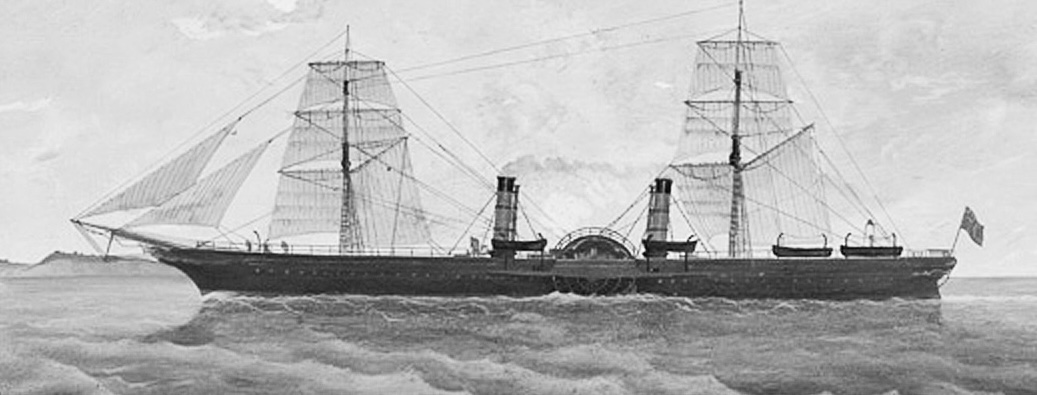
SS Arabia (1852)
Cunard Line · North Atlantic Royal Mail service · Ship Guide
Overview
SS Arabia was the last wooden-hulled liner built for Cunard. Launched by Robert Steele & Co. at Greenock on 21 June 1852, she represented the culmination of the company's first generation of large transatlantic paddle steamers.
At about 2,400 gross tons and roughly 285 feet between perpendiculars, Arabia exceeded the already substantial Asia and Africa. Her powerful side-lever engines and fine lines were intended to give Cunard a fast response to growing American competition on the North Atlantic, particularly the Collins Line.
Key Facts
The Final Wooden Cunarder
When Arabia was launched, Cunard's Atlantic fleet still depended heavily on the combination that had established the company in 1840: wooden hulls, paddle wheels, auxiliary sail, and large reciprocating engines. The design had grown dramatically in twelve years, but the basic architecture remained recognizable.
Arabia marked the end of that development path. Cunard's later major construction increasingly adopted iron hulls, and the screw propeller became progressively more important. Her significance therefore lies partly in being both an advanced ship for her type and a boundary marker between two technological eras.
Built for Speed and Competition
Contemporary launch reports described Arabia as the largest vessel then belonging to the company and emphasized her expected speed. Her machinery was supplied by Robert Napier, whose engines powered many of Cunard's early ships.
Later technical histories describe Arabia as a response to the American Collins Line, whose large express steamers had intensified competition for passengers, mail contracts, prestige, and fast passages. Although speed records attract attention, regularity and commercial economics remained equally important to Cunard.
Passenger Service
Arabia left Liverpool on her maiden voyage to New York on 1 January 1853 under Captain Charles H. E. Judkins. Contemporary and later accounts record only about sixty passengers aboard that first crossing, along with a large cargo and approximately 1,200 tons of coal.
Her accommodations were considered notably elaborate for the period. Descriptions emphasize the saloon and its decorative treatment, while later histories credit the ship with unusually developed facilities for children. Such claims are best understood within the rapidly improving standards of first-class Atlantic travel rather than through direct comparison with the much larger liners of later decades.
Crimean War Service
In 1854 Arabia was employed as a transport during the Crimean War, carrying French troops from the Mediterranean toward the Black Sea theater. The use of commercial mail steamers for wartime transport demonstrated the strategic value of large, fast ocean-going steamships.
Her wartime employment also temporarily removed expensive commercial tonnage from normal Atlantic service, illustrating how closely nineteenth-century shipping networks could become entangled with state requirements.
Operational Incidents
Arabia's service was not without mishap. In August 1856 she grounded on Blonde Rock after leaving Boston for Liverpool and sustained damage. She survived the incident and returned to service.
In 1858 she collided with the Cunarder Europa near Cape Race. Both vessels were damaged, but the episode did not end Arabia's career. These incidents are useful reminders that the apparent regularity of the mail schedules depended on ships operating in difficult waters with limited navigational aids by modern standards.
Economics and the End of Steam Service
Arabia's powerful machinery came at a price. Large paddle steamers consumed enormous quantities of coal, reducing the space available for revenue cargo and making operating economics increasingly important as newer designs appeared.
Cunard sold her in 1864. The machinery was removed and the hull was converted to sail, extending the usefulness of the vessel after her original propulsion system had ceased to make commercial sense. Sources differ on the precise date and circumstances of her final disposal, so this guide does not force a single unsupported endpoint beyond her post-Cunard sailing career.
Why Arabia Matters
Arabia provides a particularly clear snapshot of the North Atlantic at a technological turning point. She was larger, faster, and more powerful than Cunard's first steamers, yet she still relied on wooden construction and side paddle wheels.
Within only a few years, ships such as Persia would demonstrate the advantages of iron construction while preserving paddle propulsion, and later Cunarders would increasingly combine iron hulls with screw propellers. Seen in that sequence, Arabia is less an evolutionary dead end than the final expression of the technology that had made Cunard's original scheduled steam service possible.
Interpretive Notes
Dates of sale and final disposal vary: fleet lists and later summaries differ between 1864 and 1865 for her sale and give differing final dates after conversion to sail. The well-supported point is that Cunard service ended in the mid-1860s and the machinery was removed.
Speed figures are not uniform: contemporary claims, trial performance, and later average-speed figures should not be treated as interchangeable. About 13 knots is a useful service-era figure in technical histories.
“Cunard Line” is convenient shorthand: the formal contemporary company name was the British and North American Royal Mail Steam Packet Company.
Evidence-first ship guide