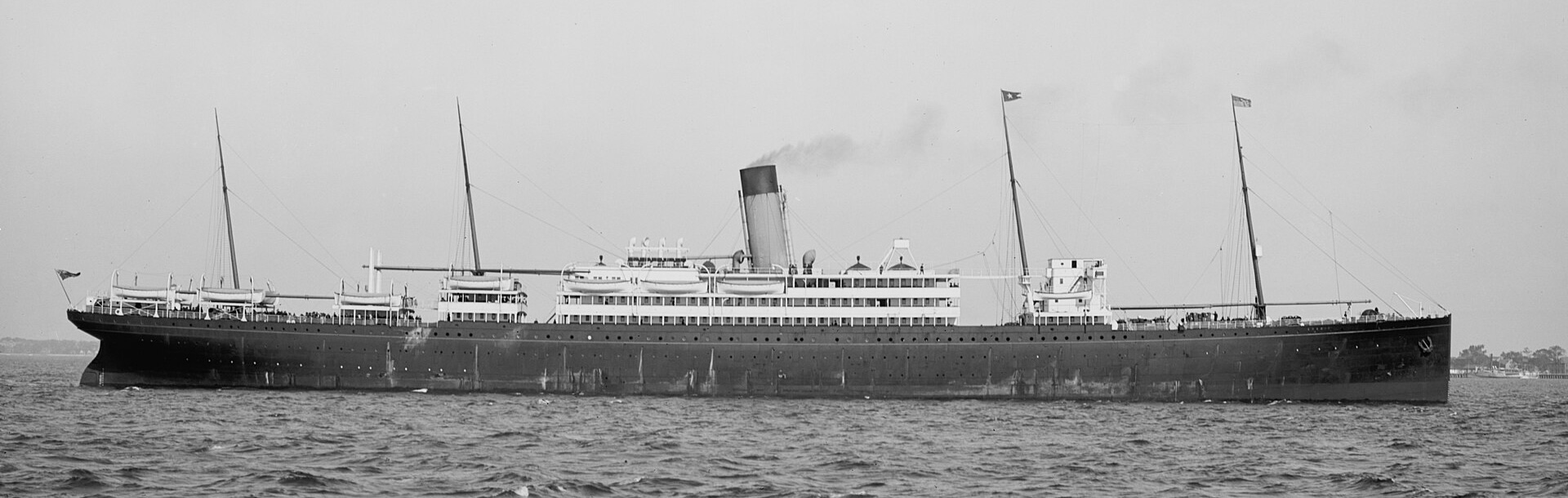
SS Arabic (1903)
White Star Line · entered service 1903 · Ship Guide
Overview
SS Arabic was a substantial White Star intermediate liner completed in 1903 after originally being intended for Atlantic Transport Line as Minnewaska. That transfer before completion places her within the broader International Mercantile Marine network rather than a simple one-line building program.
She served the Liverpool–Queenstown–New York route as a multi-class passenger liner until 19 August 1915, when U-24 torpedoed and sank her. Her loss became internationally significant because Americans were among the dead and the incident intensified diplomatic controversy over German submarine warfare.
Key Facts
Minnewaska Becomes Arabic
The ship's original intended identity as Atlantic Transport Line's Minnewaska is central to understanding her place in IMM. A design intended for one company was redirected before completion to meet White Star's needs.
Construction-era documents can therefore carry Atlantic Transport context even though the completed liner entered service under White Star. Preserving that distinction is stronger than simplifying the history into “built for White Star.”
An Intermediate Liner
Arabic was neither a small feeder ship nor a top-tier express flagship. Her size, 16-knot speed, and large third-class accommodation placed her firmly in the practical middle of White Star's Atlantic fleet.
This intermediate role is historically important. Ships like Arabic carried large numbers of ordinary passengers and generated an extensive operational record even without the fame of the line's giant liners.
Passenger Markets
The approximate 200 first-, 200 second-, and 1,000 third-class arrangement shows where the volume business lay. Third-class migration traffic was central to the economics of the ship.
Passenger lists, tickets, baggage labels, and immigration material can therefore reveal more about the ship's social history than luxury-focused descriptions alone.
Liverpool–Queenstown–New York
The regular route linked Liverpool and Queenstown with New York. Some shorter references omit Queenstown, but detailed voyage material often preserves the call.
For cataloging, the exact route printed on a contemporary object should be preserved rather than harmonized to a simplified modern route summary.
Wartime Conditions
Arabic continued civilian service after the First World War began, placing the ship within the increasingly dangerous environment of submarine warfare. Commercial liner operations and military strategy were now overlapping in ways that exposed ordinary passenger ships to wartime risk.
19 August 1915
On 19 August 1915, U-24 torpedoed Arabic south of Ireland. GG Archives records 44 deaths. The sinking became a diplomatic issue because American passengers were among those killed and because it followed earlier controversy over attacks on passenger ships.
The episode belongs to the larger history of German submarine policy and American neutrality, but it should remain grounded in the specific ship, voyage, and casualty record rather than being reduced to a generic prelude to U.S. entry into the war.
The Arabic Name Trap
This ship is the first White Star Arabic. The name was reused after the war for the former Norddeutscher Lloyd Berlin.
Date is therefore indispensable. Material dated 1921–1931 belongs to the later ship, not this 1903 liner.
Commercial Service Before the War
For more than a decade before her loss, Arabic was a working North Atlantic liner rather than a diplomatic symbol. Repeated Liverpool–Queenstown–New York voyages carried migrants, families, business travelers, mail, baggage, and freight.
This ordinary service generated a large documentary record and should remain central to the ship's history. The 1915 sinking gave the vessel international significance, but it did not create the whole story.
Diplomatic Significance of the Loss
The sinking occurred during a period of intense dispute over submarine warfare and neutral rights. American deaths aboard Arabic increased pressure on Germany and contributed to negotiations over how submarines would treat passenger ships.
That context should be stated carefully: the incident was significant in the evolving U.S.–German diplomatic crisis, but it should not be presented as a single direct cause of later American entry into the war.
The 1915 Diplomatic Crisis
The sinking of Arabic became a diplomatic issue because American citizens were among the dead and because the attack occurred during an already intense dispute over German submarine warfare. U.S. diplomatic records preserve both survivor statements and the German government's explanation of the attack.
Those records are valuable precisely because they disagree on important points. Survivors stated that no warning had been given, while the German government argued that the submarine commander believed Arabic was maneuvering to ram. The evidence should therefore be presented as competing contemporary claims rather than collapsed into a single motive narrative.
Identity Boundary: The First White Star Arabic
This ship was the former intended Minnewaska, completed for White Star in 1903 and lost in 1915. A second White Star Arabic entered service in 1921; that later ship was the former Norddeutscher Lloyd liner Berlin.
Any undated artifact labeled simply “Arabic” should therefore be checked against route, company style, and chronology before attribution.
Interpretive Notes
Arabic is best understood as an IMM-era transferred design, a working White Star intermediate liner, and later a wartime casualty of international significance.
Her history should not be reduced either to the sinking or to White Star prestige. The migration and everyday service years are just as important to the documentary record.
Evidence-first ship guide