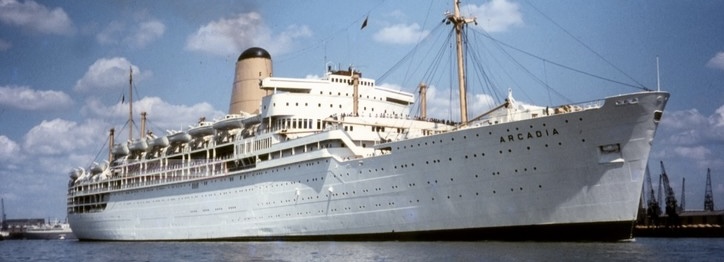
SS Arcadia (1954)
P&O · entered service 1954 · Ship Guide
Overview
SS Arcadia was one of P&O's major postwar passenger liners, built by John Brown & Company at Clydebank for the long Britain–Australia service. Laid down in 1951, launched on 14 May 1953, and completed on 20 January 1954, she began her maiden voyage from Tilbury to Australia via Suez on 22 February 1954.
Her career is especially useful for understanding how the liner and cruise trades overlapped rather than succeeding one another cleanly. P&O sent Arcadia cruising from Southampton only months after her maiden voyage, and cruising became steadily more important as jet aviation eroded the economics of long-distance scheduled sea travel. By the 1970s she had become a full-time cruise ship, ultimately based in Australia.
The earlier guide understated several principal dimensions. P&O and builder-derived references give about 29,734 gross tons and 721 ft 4 in overall, not roughly 28,700 tons and 690 ft.
Key Facts
Postwar Liner Design
Arcadia belonged to the generation with which P&O rebuilt and modernized its passenger fleet after the Second World War. Her role demanded much more than a fast crossing: she had to support weeks-long journeys through several climate zones, carry both passengers and cargo, and remain attractive to travelers choosing between sea and increasingly practical long-distance air service.
Her scale and arrangement therefore reflected route endurance and amenity rather than North Atlantic speed competition. The ship's broad postwar public spaces and extensive open-deck accommodation also made her relatively adaptable to cruising, an advantage that became increasingly important over the next quarter-century.
Service History
1954 — liner and cruise work from the beginning: Arcadia entered the Australia trade in February. P&O records show that she began cruises from Southampton in June of the same year, demonstrating that cruising was already part of her commercial program rather than a late-career afterthought.
1954 — Cervia accident: while Arcadia was moving at Tilbury on 25 October, the tug Cervia capsized and sank; her master and four crew members were lost. The accident belongs to the operational history surrounding the liner even though Arcadia herself continued in service.
1959 — major refit: a refit at Harland & Wolff in Belfast extended air-conditioning throughout the passenger accommodation. The same year she began cruising from Australian ports, an early marker of P&O's expanding Pacific cruise business.
1960s: Arcadia continued a mixture of line voyages and cruises from Britain and Australia. Her itineraries increasingly extended beyond the traditional Suez route into trans-Pacific and leisure-focused work.
1970s — full-time cruising: after further refitting, she moved decisively into one-class cruising. She spent periods on the west coast of North America, including Alaska and Mexico programs, before becoming Sydney-based in 1975.
1979: Arcadia left Sydney for the final time in January, completed her last passenger work in Asia, and was delivered to breakers at Kaohsiung. Her career had lasted twenty-five years.
Why Arcadia Matters
Arcadia complicates the familiar story that the ocean liner simply disappeared when the jet arrived. Her career instead shows a large scheduled liner being progressively repurposed within the same operating life: Australia route ship, seasonal cruiser, trans-Pacific cruise vessel, and finally full-time Australian cruise ship.
For artifact attribution, date and itinerary matter. A 1950s P&O menu from a Britain–Australia voyage and a 1970s Pacific cruise brochure can both belong authentically to Arcadia, but they represent very different phases of the same ship's commercial identity.
Interpretive Notes
Liner and cruise service overlapped: Arcadia should not be read as a simple “liner first, cruise ship later” story. Cruising appeared early in her career and expanded gradually as scheduled long-distance passenger traffic declined.
Specifications need source context: published dimensions and tonnage figures vary in secondary references; builder and P&O-derived figures are preferable when exact measurements matter.
Evidence-first ship guide