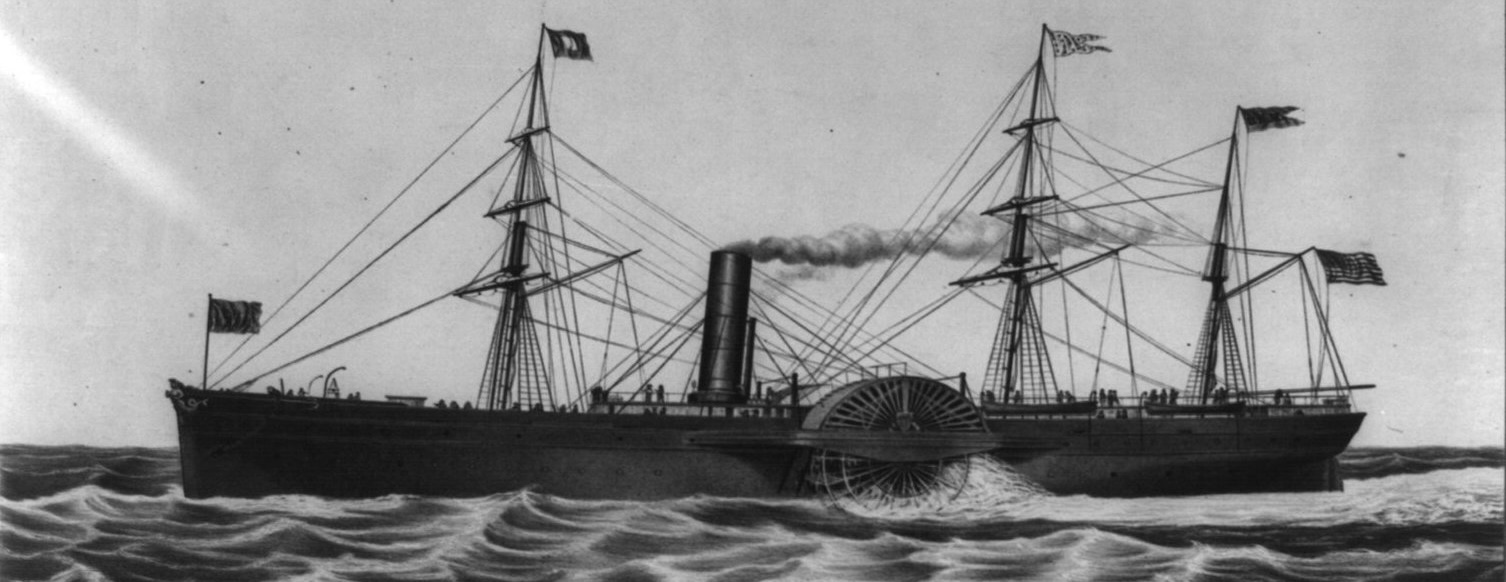
SS Arctic
Collins Line · 1850 · Ship Guide
Overview
SS Arctic was one of the best-known American transatlantic mail and passenger steamers of the early 1850s. Built for the Collins Line, she was part of the United States’ most serious commercial challenge to Cunard in the early steam-liner era and quickly became famous for both speed and luxury.
In collecting and interpretation, Arctic matters for two overlapping reasons: first, as a prestige Collins Line paddle steamer in the brief high moment of American transatlantic competition; second, as the ship lost in the famous 1854 disaster in which all women and children aboard perished. Those are related histories, but they should not be collapsed into tragedy alone.
Key Facts
Figures for people aboard and exact casualty totals vary somewhat between summaries, and 19th-century tonnage conventions do not map neatly onto later GRT-style comparisons. For museum-level cataloging, it is best to preserve the measurement system actually used by the source.
Design & Construction Context
Arctic belonged to the brief but ambitious Collins Line effort to challenge British dominance of the Atlantic steam trade. Backed by U.S. government mail subsidies, the Collins fleet was designed to offer not only competitive speed but superior comfort and display. In that context, Arctic was not simply a transport machine; she was part of an American commercial and national prestige project.
She was built of wood rather than iron and employed powerful side-lever engines driving paddle wheels. That places her firmly in the transitional early-liner age, before later iron and steel screw steamers came to define the classic ocean-liner image. Interpreting Arctic well means remembering that in 1850 she represented cutting-edge transatlantic steam travel, not an antiquated relic.
Service History (Summary)
1850–1854: Served in Collins Line’s New York–Liverpool mail and passenger operation. This is the principal collecting era for line ephemera, saloon references, voyage reports, illustrated newspaper coverage, and Collins-related promotional material.
1852: Earned special notice for a rapid winter eastbound passage to Liverpool in 9 days 17 hours, reinforcing her reputation as one of the standout Collins steamers.
1853: Ran aground on Burbo Bank in Liverpool Bay but was refloated. The incident is part of the ship’s operating history, though it is understandably overshadowed by the final disaster.
1854: Struck Black Rock off the Saltee Islands and returned to Liverpool, then later underwent engine-related modifications intended to reduce heavy fuel costs. These details matter because they reflect the financial and technical pressures affecting the Collins Line even before the loss.
Final voyage, 1854: While sailing from Liverpool to New York on September 27, 1854, Arctic collided in fog with the much smaller French steamer Vesta, about 50 miles off Newfoundland. The damage to Arctic proved fatal, and she sank after several hours.
The Collins Line Challenge to Cunard
Arctic belonged to the brief period when the Collins Line mounted the strongest American challenge to Cunard's steamship mail service. Large wooden paddle steamers such as Arctic emphasized speed, luxury, and national technological prestige as much as basic transportation.
That competitive setting matters because the ship should not be remembered only through her loss. Before 1854 she was one of the most prominent American transatlantic steamers in regular mail and passenger service.
27 September 1854
While returning from Liverpool, Arctic collided in fog with the much smaller French steamer Vesta off Newfoundland. The damage to Arctic was initially underestimated; once flooding became uncontrollable, Captain James Luce attempted to make land but the engines failed before the ship could reach safety.
Lifeboats, Discipline, and Survival
The disaster became infamous not only for its casualty total but for the collapse of orderly evacuation. Contemporary and later accounts agree that lifeboat capacity was insufficient for everyone aboard, and discipline broke down as boats were launched.
Roughly eighty-eight people survived from more than four hundred aboard, and no women or children survived. The episode became a powerful nineteenth-century example of the gap between ideals of maritime conduct and the actual realities of emergency evacuation.
Interpretive Notes
Do not interpret her only through the disaster: Arctic is famous today because of the sinking, but she was also one of the most celebrated American steamers of her decade. A period advertisement or route notice belongs to that prestige story, not only to retrospective tragedy.
Collins Line context is essential: items associated with Arctic should usually be read within the Collins–Cunard competition of the early 1850s. Without that frame, the ship’s speed, luxury, and symbolic importance are easy to flatten.
The sinking is a key women-and-children-first counterexample: later memory of the disaster often centers on the breakdown of discipline and the failure to save women and children. That interpretive angle is legitimate, but cataloging should distinguish contemporary evidence from later moralized retellings.
Measurement language should stay period-accurate: “tons burthen” and other mid-19th-century tonnage references are not interchangeable with later liner tonnage conventions. Curator practice is to preserve the original measurement language rather than modernize it too casually.
Evidence-first ship guideSources (Selected)