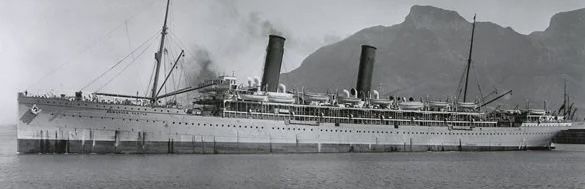
SS Armadale Castle
Union-Castle Line · 1903 · Ship Guide
Overview
SS Armadale Castle was a Union-Castle Royal Mail steamer built for the passenger and mail route between Britain and South Africa. Completed in 1903 by the Fairfield Shipbuilding and Engineering Company at Govan, she was the first new ship ordered by the recently formed Union-Castle Mail Steamship Company and represented an important early statement of the combined line’s identity.
A sister and close contemporary of Walmer Castle, she was a large twin-screw liner designed for regular Cape mail service rather than record-breaking speed. Her career included more than a decade of prewar passenger service, a substantial First World War naval career as the armed merchant cruiser HMS Armadale Castle, and nearly seventeen further years on the South African route before retirement.
Evidence-first note: sources vary in whether they style the ship as SS or RMS. “RMS” reflects her Royal Mail service, while “SS” is often used in fleet lists and modern reference works. This guide uses SS in the title while recognizing both forms.
Key Facts
Design & Construction (Context)
Armadale Castle was a development of the earlier Union liner Saxon and was closely related to Walmer Castle. Her size, twin screws, two funnels, and balanced three-class passenger plan made her a thoroughly modern Cape mail ship for the opening years of the twentieth century.
The ship was especially important symbolically. She was the first mail steamer commissioned after the Union and Castle companies combined, and her launch helped establish the naming pattern, visual identity, and operating standards of the new Union-Castle fleet.
Service History (Summary)
1903–1914: Cape mail service. Armadale Castle entered service in December 1903 under Captain J. C. Robinson and replaced the older Scot on the Cape mail route. She quickly became a popular ship and remained continuously employed in the mail service for roughly eleven years.
1904: Durban harbour milestone. On 26 June 1904, during her third South African voyage, she became the first large Royal Mail steamer to cross the newly improved Durban Bar and enter Durban Bay. The event drew considerable public attention and marked an important moment in the development of the port.
1908: Refrigerated produce traffic. Maritime records credit Armadale Castle with carrying the first shipment of citrus fruit from the Cape in 1908, connecting her passenger and mail role with the growth of refrigerated export trade.
1914–1919: HMS Armadale Castle. Requisitioned before the outbreak of war, she was fitted with eight 4.7-inch guns and commissioned as an armed merchant cruiser. Her wartime work included operations off German South West Africa, convoy escort, troop transport, blockade patrols with the 10th Cruiser Squadron, and service on North and South Atlantic routes.
1919–1935: Return to the Cape route. After reconditioning on the Clyde, she resumed commercial service in September 1919. She continued in Union-Castle employment through the interwar years, carrying passengers, mail, officials, sports teams, and commercial traffic between Britain and South Africa.
1935–1936: Withdrawal and breaking. Armadale Castle was laid up at Netley in 1935, although she was briefly reprieved for further service. She was finally sold for demolition and arrived at Blyth on 12 June 1936 to be broken up by Hughes Bolckow Ltd.
The First New Union-Castle Order
Armadale Castle was the first new ship ordered for the combined Union-Castle Mail Steamship Company after the union of the Union and Castle interests. That makes her more than simply another Cape liner: she was an early physical expression of the merged company's fleet identity.
Her design emphasized the dependable carriage of mail and passengers on the Britain–South Africa route rather than record-breaking speed, reinforcing the schedule-driven character of the Cape mail service.
Armed Merchant Cruiser Service
The Royal Navy requisitioned Armadale Castle on 2 August 1914 and commissioned her as an armed merchant cruiser. Union-Castle was heavily drawn into wartime service, and contemporary summaries specifically list Armadale Castle among the company's liners used in that role.
Her wartime documentation therefore belongs to a naval operating context distinct from her peacetime mail service. Photographs, logs, and personnel records from 1914–1918 should be interpreted against that change in command and purpose.
Return to the Cape Route
After release from wartime service, Armadale Castle returned to commercial operation and remained associated with the South African route for many years. She was finally withdrawn in the mid-1930s and scrapped in 1936.
Interpretive Notes
Armadale Castle matters because she sits at the beginning of Union-Castle’s mature corporate era. She was not merely another vessel inherited through merger; she was the first major ship specifically ordered for the combined company and therefore helped define what the new line intended its Cape mail service to be.
Her Durban arrival in 1904 also connects ocean-liner history to port engineering. A liner’s route depended not only on the ship itself but on dredging, harbour works, pilotage, and shore infrastructure. The spectacle of Armadale Castle crossing the Bar was therefore both maritime theatre and evidence of a transformed port.
For researchers and collectors, wartime material should be distinguished carefully from commercial-service material. Photographs showing guns, naval personnel, troop fittings, or camouflage belong to her HMS career, while passenger lists, menus, and stationery may document either her prewar or postwar Union-Castle service. Dates and voyage context are essential.
Evidence-first ship guideSources (Selected)
Use these as a starting index and corroborate publish-ready details with contemporary registers, Admiralty records, passenger lists, company timetables, and archival material where possible.
- Ocean Liner Curator — Sources (master bibliography)
- Clydeships — Armadale Castle builder and registry particulars
- British & Commonwealth Staff Register — Armadale Castle
- British & Commonwealth Staff Register — HMS Armadale Castle
- GG Archives — RMS Armadale Castle archival collection
- Wikipedia — SS Armadale Castle (starting index; corroborate key facts)
- 1922 Encyclopædia Britannica — Union-Castle wartime armed merchant cruiser context