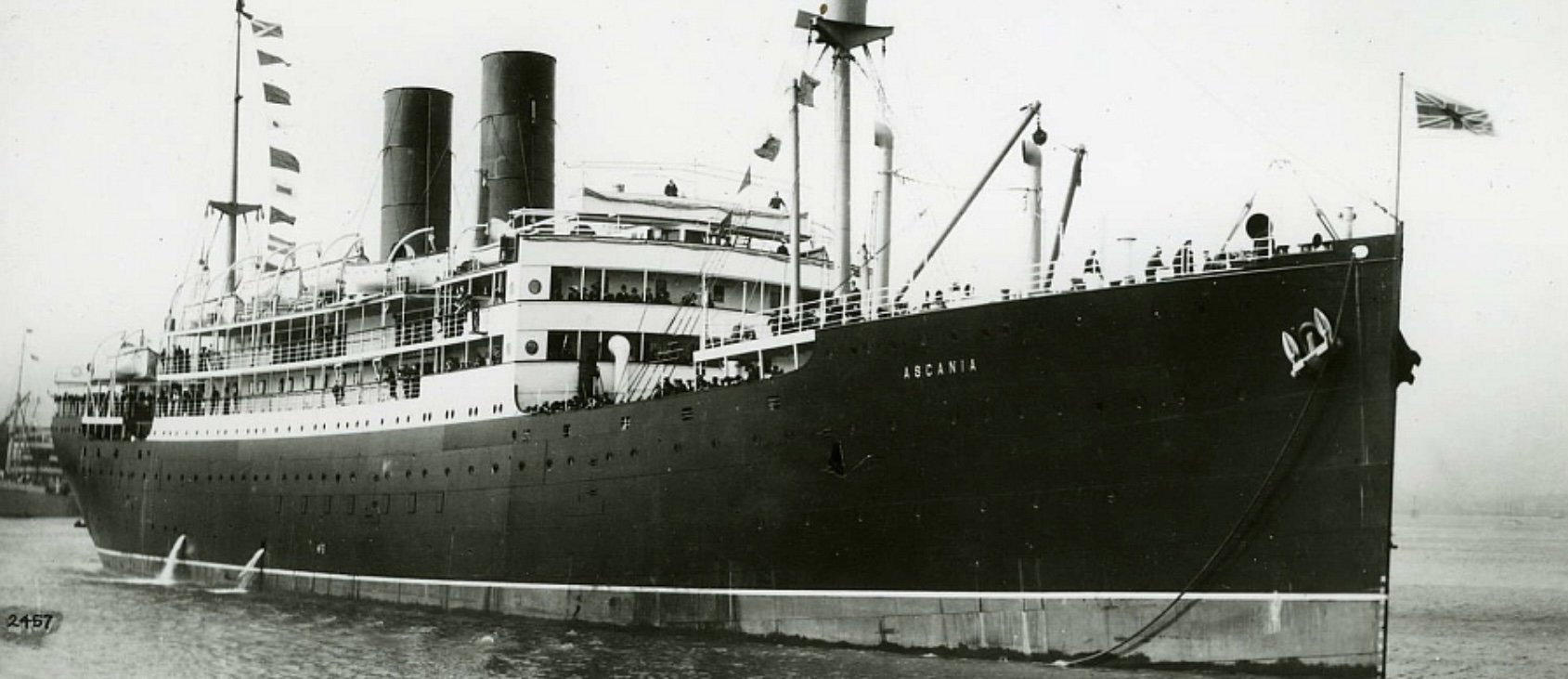
SS Ascania
Cunard Line · 1911 · Ship Guide
Overview
SS Ascania was a medium-sized Cunard passenger liner built for the Canadian route, intended for the heavy seasonal flow of emigrant and general passenger traffic rather than for the prestige express trade. Originally ordered for the Thomson Line as Gerona, she was acquired by Cunard before completion and entered service in 1911 on the London–Southampton–Quebec–Montreal run. Her career belongs to that important but less glamorous branch of North Atlantic liner history in which practical passenger and cargo service, rather than speed or luxury, defined a ship’s identity.
In collecting and interpretation, Ascania is best divided into two main phases: prewar Cunard Canadian service and wartime transport work. Passenger ephemera, troop references, and final-loss material should be treated separately, since they belong to different documentary and interpretive contexts.
Key Facts
Route summaries for Ascania are often simplified in secondary references. For cataloging purposes, it is best to preserve the exact seasonal route wording used by the original source, especially where Portland, Maine, winter substitutions, or wartime troop carriage are involved.
Design & Construction Context
Ascania belonged to the practical service side of Cunard’s fleet rather than to the company’s famous express-liner tier. Ships of this kind carried large numbers of migrants and general passengers on Canadian routes and were designed for reliable, economical service rather than for speed records or elaborate luxury.
Her transfer from Thomson Line ownership before completion is also significant. It places the ship within a wider period of fleet adjustment and route rationalization in which Cunard absorbed vessels suited to intermediate passenger service, helping strengthen its Canadian operations in the years immediately before the First World War.
Service History (Summary)
1911 construction and entry into service: Built by Swan Hunter at Wallsend, Ascania was launched on 4 March 1911, completed on 23 May, and sailed on her maiden voyage the same day from London via Southampton, Quebec, and Montreal.
Prewar Canadian service: She then served regularly on the Canadian route, with fortnightly sailings to Quebec and Montreal during the navigation season. In winter, when the St. Lawrence was closed, service patterns could shift to Portland, Maine. This is the correct interpretive setting for passenger lists, route brochures, commercial photographs, and emigrant-era ephemera.
Wartime use after 1914: At the outbreak of the First World War, Ascania continued in liner service but carried Canadian troops eastbound instead of steerage passengers. She also saw Mediterranean service during the Gallipoli campaign in 1915, demonstrating how quickly practical passenger liners could be drawn into military transport work.
Late-war service: After the United States entered the war, Ascania also carried American troops, including a detachment of the U.S. 119th Infantry from Hoboken in May 1918. By then her documentary footprint had moved well beyond ordinary civilian passenger traffic and into wartime transport history.
Final loss in 1918: On 13 June 1918, while travelling in ballast from Liverpool to Montreal, Ascania ran aground about 20 nautical miles east of Cape Ray, Newfoundland, in the Breton Strait. Her career therefore ended not through torpedoing but through a navigation casualty late in the war.
Interpretive Notes
This is a Canadian-service Cunard liner first: Ascania should be placed primarily within the Canadian and St. Lawrence branch of Cunard’s operations, not judged by the standards of the company’s express Atlantic flagships.
Her accommodation profile matters: the balance of second class and steerage helps explain the kind of material most likely to survive—migration-oriented documentation, route ephemera, and practical passenger references rather than elite luxury material.
Civilian and military references belong to different interpretive worlds: a prewar passenger list, a Canadian troop transport reference, and a Gallipoli service mention should not be merged casually, because each belongs to a different phase of the ship’s identity.
The end of her career is easy to misremember: because many Cunard losses of the period involved enemy action, it is worth noting clearly that Ascania was lost by grounding rather than by direct submarine attack.
Attribution should stay restrained: as with many intermediate liners, undated or weakly identified artifacts can be tempting to assign too confidently. Exact route, season, and service phase should be documented whenever possible.
Evidence-first ship guideSources (Selected)
- Ocean Liner Curator — Sources (master bibliography)
- SS Ascania — overview chronology, technical particulars, and service summary
- Norway Heritage — route chronology and Cunard Canadian service context
- Clydeships / shipbuilding reference — builder and construction particulars
- Wrecksite — grounding and loss summary