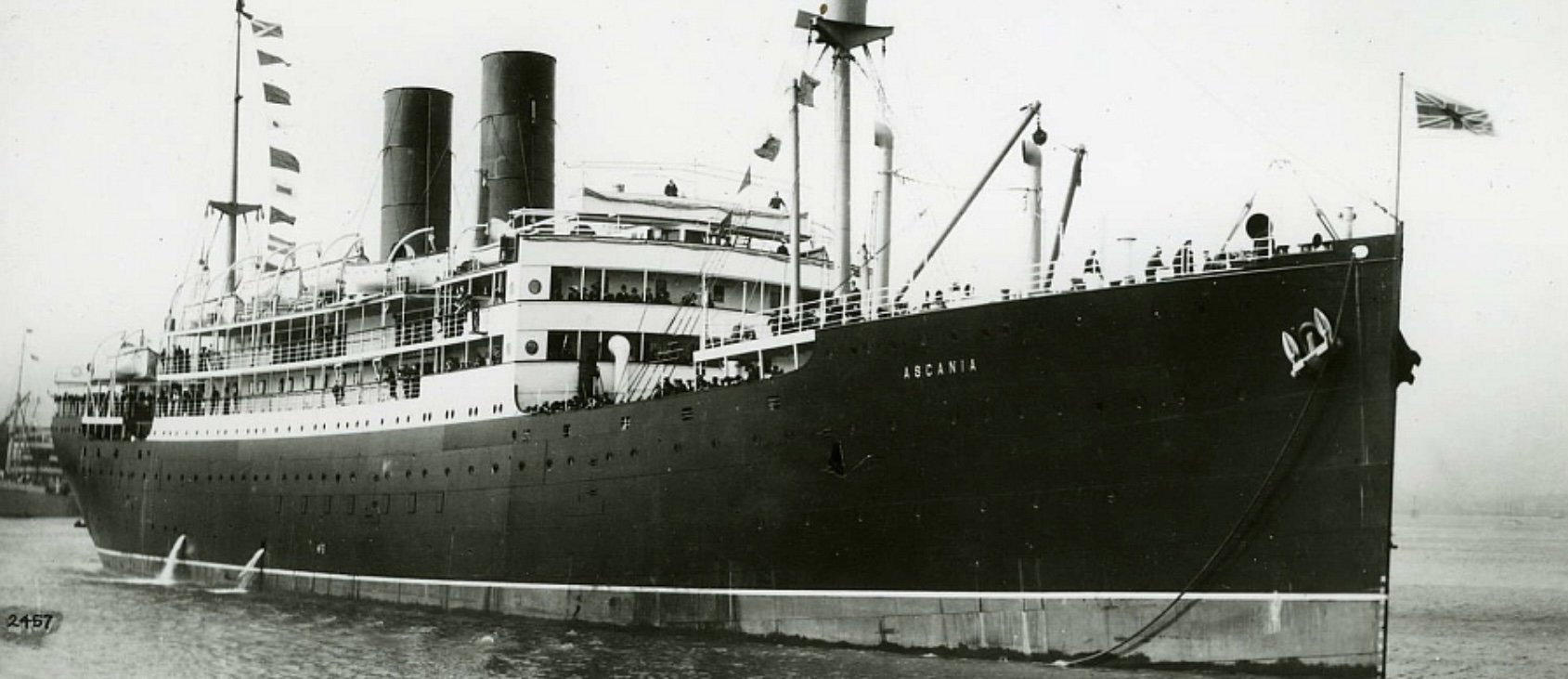
SS Ascania (1911)
Cunard Line · entered service 1911 · Ship Guide
Overview
SS Ascania was a medium-sized Cunard passenger liner built for the Canadian route and the heavy seasonal flow of emigrant and general passenger traffic. Originally ordered for Thomson Line as Gerona, she was acquired by Cunard before completion and entered service in 1911 on the London–Southampton–Quebec–Montreal run.
Her career belongs to the practical branch of liner history in which route reliability, migration, and cargo mattered more than prestige speed. The First World War then transformed that civilian role into troop transport before the ship was lost by grounding in 1918.
Key Facts
Gerona Becomes Ascania
The ship's pre-completion transfer from Thomson Line to Cunard is more than a naming curiosity. It reflects a period in which companies were consolidating routes and reallocating suitable tonnage to strengthen intermediate passenger services.
Builder or planning records may therefore use Gerona, while Cunard passenger material belongs to Ascania. Keeping that distinction clear prevents genuine construction-era evidence from being misread as documentation of a separate ship.
The Canadian Service
Ascania served London and Southampton to Quebec and Montreal during the St. Lawrence navigation season. In winter, when ice closed the river, route patterns could shift toward alternative ports such as Portland, Maine.
That seasonality is historically important. A simplified route label can make the service look more static than it really was, while dated timetables and passenger lists reveal how Cunard adapted to geography and weather.
Migration and Passenger Life
The ship's accommodation—200 second-class and roughly 1,500 steerage passengers in GG Archives' summary—shows the social purpose of the vessel clearly. Ascania was built around migration-era traffic and affordable passage rather than elite first-class prestige.
Surviving passenger lists, tickets, baggage labels, immigration papers, and route advertisements therefore sit at the center of the ship's historical record. They document ordinary transatlantic mobility rather than a luxury mythology.
War Service
After 1914, Ascania continued to operate but increasingly carried troops eastbound instead of ordinary steerage passengers. She was involved in Mediterranean transport during the Gallipoli period and later carried additional Allied personnel, including American troops after U.S. entry into the war.
This wartime use changed the documentary setting of the vessel. Military movement orders, troop references, and transport records belong to a different context from the prewar Canadian passenger trade and should be cataloged separately.
13 June 1918
On 13 June 1918, while sailing in ballast from Liverpool toward Montreal, Ascania grounded east of Cape Ray, Newfoundland. The Shipwreck Preservation Society of Newfoundland & Labrador records that the keel was broken and the vessel could not be refloated. All aboard survived.
The grounding is worth stating clearly because many Cunard losses of the First World War involved mines or submarines. Ascania was not sunk by enemy action; her career ended in a navigation casualty.
Seasonality and the St. Lawrence
The Canadian route could not be understood without winter ice. During the navigation season, Quebec and Montreal offered direct access deep into the continent; when the river closed, Cunard had to redirect traffic through other ports. That seasonal rhythm shaped schedules, ticketing, advertising, and the way passengers planned onward journeys.
For a curator, this means a route printed on an artifact is strong dating evidence. A winter Portland reference and a summer Montreal reference may both be correct for Ascania, but they describe different operating seasons rather than contradictory accounts.
Troops, Migration, and Changing Uses
The war did not erase the ship's earlier migration function so much as repurpose the same transport capacity. Space built to move large numbers of civilian passengers could be adapted to carry troops eastbound, illustrating how quickly commercial liner infrastructure became part of the Allied logistics system.
That continuity is historically revealing. The same practical qualities that made Ascania useful to migrants—capacity, reliability, and regular ocean passage—also made her useful to military planners. Civilian and wartime uses therefore belong to one physical history but to very different administrative and human contexts.
Collecting and Attribution
Because Cunard later reused the name Ascania, undated photographs and printed material deserve particular caution. Funnel arrangement, company imprint, route wording, typography, and paper style can all help separate the 1911 ship from later namesakes.
The original Gerona identity adds another layer. Construction-era documents can legitimately use a name never carried in Cunard passenger service. Rather than “correcting” such material to Ascania, a good catalog record should preserve the wording of the original source and explain the later name change.
Interpretive Notes
This is first and foremost a Canadian-service Cunard liner. Her historical meaning lies in St. Lawrence routes, migration, seasonal port changes, and wartime adaptation. Civilian and military references should not be blended casually.
The name was later reused by Cunard, so “SS Ascania (1911)” is the safest shorthand where ambiguity exists. Exact route and season are also valuable for attribution, especially when dealing with undated or weakly identified ephemera.
Evidence-first ship guide