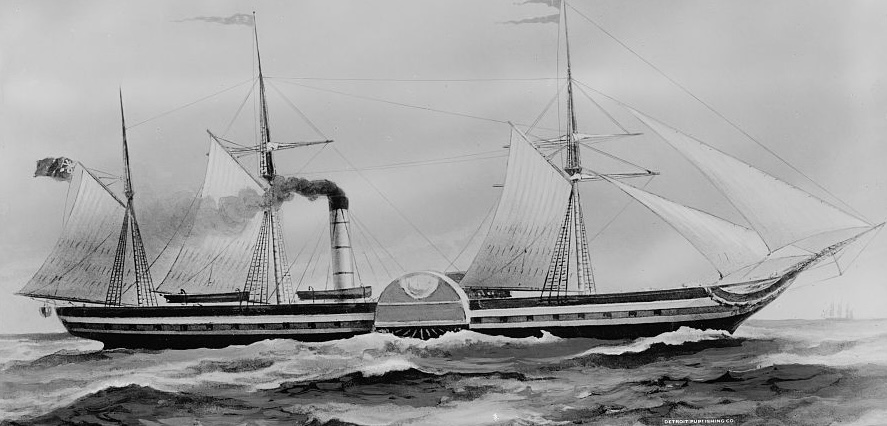
SS Asia (1850)
Cunard Line · North Atlantic Royal Mail service · Ship Guide
Overview
SS Asia was a large wooden paddle steamer built by Robert Steele & Co. at Greenock for Cunard's North Atlantic mail service. Launched on 30 January 1850, she began transatlantic service on 18 May that year and was closely matched by her sister Africa.
At roughly 2,226 gross tons and 266 feet in length, Asia was substantially larger than Cunard's original 1840 fleet. She belongs to the final and most developed phase of the company's large wooden paddle steamers before iron hulls and screw propulsion reshaped the fleet.
Key Facts
A Larger Cunarder
Asia and Africa represented another major increase in scale after ships such as Hibernia and Cambria. Their greater dimensions, power, and speed reflect how quickly regular steam navigation matured during Cunard's first decade.
The improvement was evolutionary rather than revolutionary. Asia remained a wooden, sail-assisted paddle steamer, but her machinery and size made her one of the most capable transatlantic steamships of the early 1850s.
North Atlantic Service
Asia worked Cunard's transatlantic network linking Liverpool with North American ports, including Halifax, Boston, and New York at different points in her career. Passenger and mail schedules could vary by period, so individual voyage records are preferable to assuming one unchanging itinerary across all seventeen years of Cunard service.
That long career placed her through a period of unusually rapid technical change. When she entered service, large wooden paddle steamers still occupied the front rank of Atlantic travel; by the time Cunard sold her, iron screw steamers were increasingly defining the future.
Asia and Africa
Asia and Africa were near-identical sisters built by Robert Steele & Co. in 1850. Their dimensions and machinery are commonly listed together in contemporary and later technical histories.
This pairing is particularly useful when identifying photographs or illustrations. Similarity to one sister is meaningful, but reliable attribution should still depend on dated captions, voyage context, or other documentary evidence where available.
The End of the Wooden Paddle Era
The importance of Asia becomes clearer when placed beside the ships that followed. Cunard's Arabia of 1852 was an even larger development of the wooden paddle type, while later vessels increasingly adopted iron construction and screw propulsion.
Asia therefore sits near the high-water mark of a technology that had made scheduled transatlantic steam service practical but was already approaching its limits.
After Cunard
Cunard sold Asia in 1867. Her machinery was removed and she continued as a sailing vessel, a striking reversal for a ship once regarded as an advanced steam liner.
She survived in that role until 12 December 1876, when fire destroyed her at Bombay. Her final years show how valuable a sound hull could remain even after its original propulsion and commercial role had become obsolete.
Interpretive Notes
Route descriptions vary by year: sources may summarize her service as Liverpool–Halifax–Boston or Liverpool–New York. Both can be valid for different periods; voyage-specific evidence should control.
Do not confuse tonnage with displacement: the commonly cited figure of about 2,226 tons is a registered tonnage measure, not the ship's physical weight.
“Cunard Line” is convenient shorthand: the formal contemporary company name was the British and North American Royal Mail Steam Packet Company.
Evidence-first ship guide