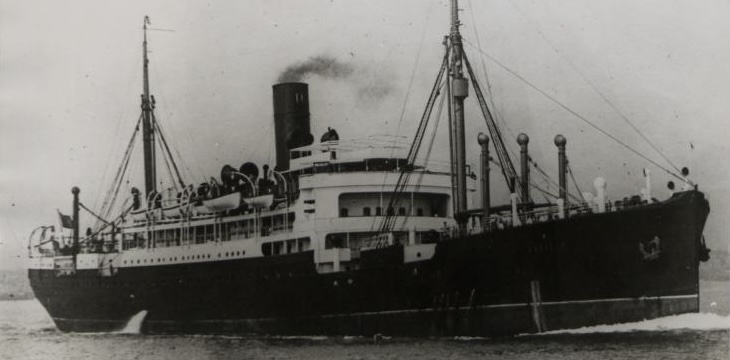
SS Assyria
Anchor Line · 1921–1929 Anchor service · Ship Guide
Overview
SS Assyria was an Anchor Line passenger steamer best understood as a postwar transfer ship: built in Germany in 1908 as Ypiranga, later entering Anchor Line service under the name Assyria in the early 1920s. She was not one of the great prestige giants of the North Atlantic, but she belongs to a very important interpretive category: practical immigrant-era and postwar passenger transport, where shipping lines, routes, names, and ownership could change as the Atlantic trade was rebuilt after World War I.
For collectors, Assyria is especially useful because surviving passenger lists, route references, and line ephemera can tie the ship to a precise Anchor Line operating context. The key is identity control: an item marked Assyria should be separated from Ypiranga material, later Colonial material, and from other similarly named vessels such as Assyrian or earlier Anchor Line ships called Assyria.
This page treats the Anchor Line Assyria as the former Ypiranga of 1908, renamed for Anchor Line service in 1921. When evidence points to a different vessel, label the material more cautiously.
Key Facts
Note on identity: Assyria is a reused and easily confused name. This guide is for the Anchor Line vessel formerly named Ypiranga, not the cargo ship Assyrian, and not every older reference to “Assyria” points to the same hull.
Design & Construction (Context)
As a German-built passenger steamer of 1908, the ship that became Anchor Line’s Assyria had already lived through one identity before entering British service. That matters for interpretation. A brochure, passenger list, photograph, or ship portrait may be perfectly authentic while still belonging to the Ypiranga phase rather than the Anchor Line Assyria phase.
Her size and speed place her in the practical middle tier of Atlantic passenger service rather than the express-liner prestige tier. That does not make her less historically useful. Ships of this scale carried much of the real human traffic of the Atlantic: families, emigrants, returning travelers, and ordinary passengers whose records survive in manifests and sailing lists rather than luxury advertising campaigns.
Service History (Summary)
The ship was built in 1908 as Ypiranga and later came into Anchor Line service after the disruptions and transfers that followed World War I. Under the name Assyria, she is documented in Glasgow–New York service beginning in 1921, with passenger-list material showing the ship operating in the regular Anchor Line pattern of the early 1920s.
By 1929, the vessel left Anchor Line ownership and was sold to Portuguese interests, taking the name Colonial. This later phase belongs to a different collecting and research context. Unless an item is date-locked or line-marked, it is safer to identify it by period—Ypiranga, Assyria, or Colonial—rather than treating the ship’s whole career as one undifferentiated story.
Route Context
Anchor Line’s Glasgow–New York service linked Scotland and the North Atlantic migration world. Passenger material for Assyria may therefore show Glasgow, New York, Moville, Londonderry, or related route language depending on the document and sailing. These details are not decorative; they can help verify whether a paper item belongs to the correct ship, line, and operating period.
Name Confusion & Attribution
The most important caution with Assyria is the name itself. A seller may use “Anchor Line Assyria” correctly, but may also collapse separate vessels into one listing. Look for date anchors. A 1922 Anchor Line passenger list for Assyria belongs naturally to the former Ypiranga. A pre-World War I “Assyria” reference may require a different identification. A reference to Assyrian is not automatically a typo; it may be another ship entirely.
For object records, the cleanest wording is often: “SS Assyria (Anchor Line; ex-Ypiranga), [date if known].” If the date is missing, avoid forcing certainty. Use “attributed to” until the item’s line marks, route, typography, or provenance can support the claim.
Collecting Profile (What Tends to Survive)
Likely surviving material includes passenger lists, sailing cards, ship portraits, postcards, baggage or route ephemera, and immigration-related records. Unlike a major prestige liner, Assyria may not appear as often in high-style promotional material, so ordinary documents can be especially valuable as evidence of service.
The best examples are dated and route-specific. A passenger list naming the ship, line, sailing date, route, and captain is far stronger than an undated photograph captioned later by a seller. In this case, the ordinary paperwork may be the strongest artifact category.
From Ypiranga to Assyria
The ship's Anchor Line career makes more sense when treated as a continuation of her German life rather than as a separate vessel. Built in 1908 as Ypiranga for Hamburg America Line, she entered a postwar market in which older but serviceable tonnage was repeatedly transferred between companies and national registries.
Renamed Assyria in 1921, she entered Anchor Line's Glasgow–New York service. Norway Heritage's fleet records identify the vessel as the third Anchor ship to bear the name Assyria, which is why date, builder, dimensions, and former name are essential whenever a document or photograph is being attributed.
Anchor Line and Postwar Migration
The 1920s Anchor Line fleet linked Glasgow with New York and carried a passenger market very different from the prewar express-liner world. Assyria's moderate speed and mixed accommodation suited ordinary transatlantic travel, including migrants, returning residents, and family traffic.
Her importance is therefore documentary rather than spectacular. Passenger lists and sailing records can often establish a precise voyage, route, and passenger community more securely than general ship histories can.
Colonial and the End of the Career
In 1929 the ship left Anchor Line service and was sold to Portuguese interests, receiving the name Colonial. That later identity extended the useful life of a vessel already more than twenty years old and carried the same hull into another national and commercial setting.
Interpretive Notes (What to Avoid)
Avoid treating Assyria as a generic “Anchor Line liner” without identifying which Assyria is meant. Avoid importing details from Ypiranga into the Anchor period unless the object clearly belongs to that earlier phase. Also avoid assuming that a vessel’s later Colonial career proves anything about an Anchor Line object unless there is a clear chain of evidence.
The strongest interpretation is modest but precise: this was a postwar Anchor Line passenger steamer, formerly German-built, operating in Glasgow–New York service during the 1920s. That framing is historically meaningful without overclaiming prestige or rarity.
Evidence-first ship guideSources (Selected)
This list is intentionally conservative.
- Ocean Liner Curator — Sources (master bibliography)
- Norway Heritage — S/S Assyria (3), Anchor Line
- GG Archives — SS Assyria Passenger Lists and Ship Summary
- GG Archives — SS Assyria Passenger List, 26 August 1922
- TheShipsList — Anchor Line fleet context
- Clydeships — earlier Anchor Line Assyria identity caution
- Norway Heritage — Ypiranga / Assyria chronology and particulars
- Norway Heritage — Anchor Line fleet list