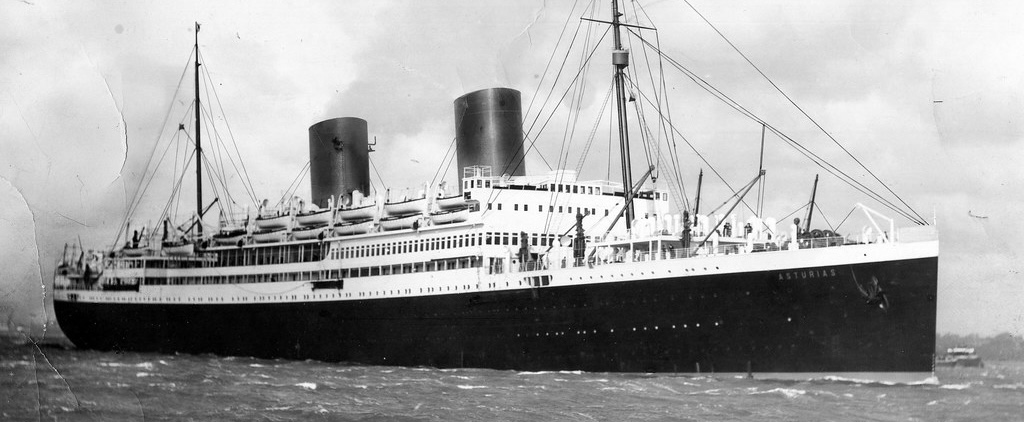
RMS Asturias (1925)
Royal Mail Steam Packet Company / Royal Mail Lines · entered service 1926 · Ship Guide
Overview
SS Asturias was one of the important interwar Royal Mail liners on the Britain–South America run, built at Belfast for the Royal Mail Steam Packet Company’s South American passenger and mail services. Together with her sister Alcantara, she represented a significant modernization of the route, combining large scale with then-advanced diesel propulsion. Her later career became even more layered: rebuilt for greater speed with steam turbines, converted during the Second World War into an armed merchant cruiser, then returned after the war to civilian emigrant and troop transport service.
In collecting and interpretation, Asturias should be approached in at least four distinct phases: pre-1934 diesel liner service, post-1934 rebuilt liner service, wartime AMC service as HMS Asturias, and postwar emigrant/troopship service. Artifacts from those phases can differ meaningfully in appearance, route language, and institutional context.
Key Facts
Some figures vary slightly depending on whether a source is describing the ship as built, after her 1934 machinery conversion, or in a wartime/postwar role. For cataloging purposes, preserve the exact phase and wording used by the source being cited.
Design & Construction Context
Asturias was part of Royal Mail’s interwar re-investment in the South American route after the losses and disruptions of the First World War. She was conceived not for Atlantic speed rivalry in the Cunard–White Star sense, but for long-haul British imperial and commercial passenger service to South America. That helps place her properly: she was a prestige route liner, but one shaped by the geography and economics of the South Atlantic rather than the North Atlantic express race.
As built, she was especially notable for her diesel machinery. At the time, she and her sister were among the largest motor ships in the world. That makes early Asturias particularly interesting in technological terms, even though the diesel arrangement was eventually abandoned in favor of turbines when Royal Mail sought greater speed and stronger competition on the South American run.
Service History (Summary)
1925–1926: Built by Harland & Wolff at Belfast, launched in July 1925, and completed in February 1926. She entered Royal Mail South American service from Southampton later that month.
Late 1920s–early 1930s: In early service, Asturias operated as a large motor liner on the Britain–South America route. This phase belongs to her original diesel identity and is the correct context for early promotional and passenger material.
1934 rebuild: In response to competitive pressures, Asturias was rebuilt at Belfast with steam turbines, revised propellers, streamlined rudders, and taller funnels. This materially changed both her performance and appearance, and post-1934 imagery should not be casually conflated with her original configuration.
1939–1943 wartime service: Requisitioned just before the outbreak of the Second World War, she was converted into the armed merchant cruiser HMS Asturias. In this role she served on escort and patrol duties, including time on the South Atlantic Station.
25 July 1943: While towing a floating dock toward Freetown, she was torpedoed on the port side by the Italian submarine Cagni. Although she survived and reached safety, the damage was severe enough for her to be treated as a constructive total loss for wartime purposes.
1945–1948: After temporary repairs and the end of the war, she was taken in hand for permanent repair and conversion back to civilian use. She returned to service in 1948.
Postwar career: In her final civil phase she served as an emigrant ship and later as a troop ship, helping carry postwar migrant traffic and government-sponsored passengers in a very different world from the one for which she had originally been built.
1957: Withdrawn and sold for scrapping. During demolition, one side of the ship was temporarily used in the filming of A Night to Remember, after which breaking up was completed.
Interpretive Notes
This is a South America liner first: Asturias belongs to the Royal Mail South Atlantic / River Plate world, not the standard North Atlantic prestige-liner framework.
The 1934 rebuild matters a great deal: because her machinery and profile changed significantly, pre-1934 and post-1934 images or specifications should be separated carefully in catalogs and captions.
Wartime and peacetime identities are fundamentally different: HMS Asturias material belongs to a naval auxiliary context, not a passenger-liner context, even though it is the same hull.
Postwar emigrant material should not be read as interwar luxury material: the ship’s final civilian phase reflects migration, state transport priorities, and a changed passenger economy rather than the original Royal Mail service ideal of the 1920s.
Evidence-first ship guide