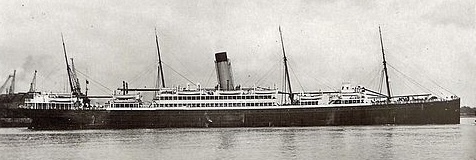
SS Athenic
White Star Line · 1902 · Ship Guide
Overview
SS Athenic was a White Star Line passenger and cargo liner built for the company’s London–New Zealand service rather than the North Atlantic express route. She was the first of the three ships usually grouped as the Athenic class, followed by Corinthic and Ionic, and was designed to carry a mixed traffic of passengers, cargo, and emigrants on the long imperial route linking Britain with New Zealand. In service, she also called at intermediate ports including Plymouth, Cape Town, Hobart, and Wellington, reflecting the broad commercial logic of the route.
In collecting and interpretation, Athenic is important because she represents White Star’s New Zealand service world rather than its more famous Liverpool–New York identity. Material connected with the ship often illuminates migration, imperial-route logistics, and dominion commerce more clearly than prestige Atlantic-liner ephemera.
Key Facts
Capacity figures vary slightly across quick-reference sources, especially where early and later accommodation totals are summarized differently. For cataloging purposes, preserve the wording and figures used by the specific source or artifact being cited.
Design & Construction Context
Athenic was part of White Star’s commercial expansion into the New Zealand route, a service that required ships with mixed passenger accommodation and solid cargo capability rather than speed-driven prestige design. The line had already demonstrated its ability to operate large and comfortable Atlantic liners, but the dominion service demanded a somewhat different balance: practical long-range utility, respectable passenger comfort, emigrant capacity, and dependable freight carriage over a much longer voyage pattern.
As the first of the Athenic-class trio, she helped define the character of this service. In that sense, she belongs to the same broad family of White Star “working liners” as ships on the Australian route, even though her New Zealand context gave her a distinct route identity and collecting profile.
Service History (Summary)
1901–1902: Built at Belfast, launched in August 1901, completed in January 1902, and placed into White Star service the following month. The maiden departure is reported as 13 February by Norway Heritage and 14 February by the National Library of New Zealand; both place the voyage from London toward Cape Town and Wellington.
Early service: Operated on the London–New Zealand route, calling at Plymouth and then proceeding south by way of Cape Town, across the Indian Ocean, and onward via Hobart to Wellington. This routing reflects the larger imperial-service geography within which the ship should be understood.
1900s–1920s: Continued in White Star service as part of the regular dominion trade pattern. She served a passenger and cargo world shaped by migration, colonial commerce, and dependable inter-imperial transport rather than the publicity-rich express-liner competition of the North Atlantic.
1928: Sold out of White Star service and renamed Pelagos, then converted for use as a whaling factory ship. This marked a major change in the vessel’s identity and function, though the White Star phase remains the central one for liner-history interpretation.
Later career: Continued a long second life outside liner service, including wartime capture and eventual postwar survival, before final scrapping in Hamburg in 1962.
Wartime Requisition and Return
Between 1917 and 1919, Athenic operated under the British Liner Requisition Scheme. Norway Heritage records her return to commercial service on 10 January 1920, thereafter using the Panama route to New Zealand.
The 1920 Munamar Rescue
On 3 May 1920, Athenic rescued the crew and 80 passengers of the Munson liner Munamar, which had grounded near San Salvador, and carried them to Newport News. The episode adds a well-documented rescue chapter to an otherwise route-centered service history.
Pelagos and the Wartime Second Life
Sold in May 1928 and renamed Pelagos, the former liner was converted into a whaling factory ship. German auxiliary cruiser Pinguin captured her on 15 January 1941. She was later used under German control, sunk at Kirkenes on 24 October 1944, raised by the Norwegians in 1945, returned to service, and finally scrapped at Hamburg in 1962.
Why Athenic Matters
Athenic matters because one hull connects White Star’s New Zealand passenger-cargo system with an industrial whaling afterlife lasting decades beyond the liner era. The correct historical label therefore depends heavily on date: White Star Athenic before 1928, Norwegian/German/Norwegian Pelagos afterward.
Interpretive Notes
White Star’s dominion routes deserve separate treatment: Athenic should not be interpreted through the same lens as the company’s North Atlantic express liners. Her identity is rooted in the New Zealand service, mixed passenger traffic, and cargo-emigration function.
The ship’s later industrial career should not erase the liner phase: because Athenic later became Pelagos, some summaries place heavy weight on the whaling-factory-ship era. For Ocean Liner Curator purposes, the White Star passenger-cargo phase remains the interpretive center of gravity.
Route context matters in cataloging: objects associated with Athenic may reference London rather than Liverpool, and New Zealand or dominion destinations rather than New York. That detail is not incidental; it is one of the clearest signals of the ship’s service world.
Evidence-first ship guideSources (Selected)
- Ocean Liner Curator — Sources (master bibliography)
- Norway Heritage — SS Athenic particulars and service summary
- SS Athenic — overview chronology, specifications, and later career
- Athenic-class ocean liner — class and route context
- Norway Heritage — White Star Line fleet and service context
- White Star Line — company background and broader route context