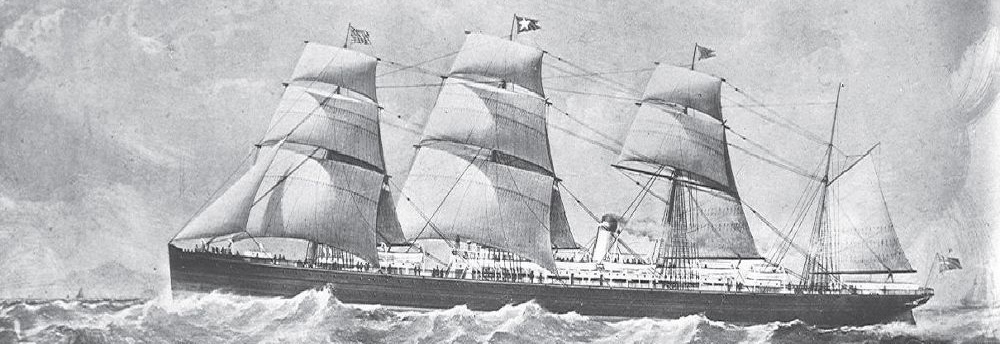
SS Atlantic (1873)
White Star Line · 1871–1873 · Ship Guide
Overview
SS Atlantic was an early White Star Line (Oceanic Steam Navigation Co.) transatlantic liner of the Oceanic-class, built in Belfast by Harland & Wolff and placed on the Liverpool–New York run in 1871. She belongs to the formative moment when White Star was establishing its modern identity: large hulls, auxiliary sail rig, and a strong emphasis on comfort and routine service rather than record-chasing speed.
Today Atlantic is remembered primarily for her loss on 1 April 1873 off Nova Scotia, near Halifax, after diverting toward the port in rough weather. The wreck became one of the deadliest civilian maritime disasters of the era and the White Star Line’s greatest loss before Titanic.
Evidence-first note: “SS Atlantic” is a reused ship name across different eras and operators. This page covers the White Star liner launched in 1870, wrecked in 1873 near Lower Prospect, Nova Scotia.
Key Facts
Design & Construction (Context)
Atlantic was built at the point where steam was dominant for schedule-keeping, but auxiliary sail still mattered operationally and economically. Like her sisters, she combined a single-screw steam plant with a full barque rig. In collecting terms, this “steam-and-sail” identity often shows up in period engravings and lithographs: tall masts, a low single funnel, and a hull built for regular service rather than theatrical speed competitions.
White Star’s early marketing stressed comfort and organization. Surviving ephemera can include cabin-class dining material, steerage regulations, baggage labels, and agency-issued sailing notices. These pieces are historically important, but attribution should be handled conservatively: many period items refer to “White Star Line” without specifying ship, and some are reprints or later commemoratives.
Service History (Summary)
1871–1873: Liverpool–New York service. Atlantic entered service in June 1871 and completed a series of Atlantic crossings. Her final voyage (the 19th in many reconstructions) departed Liverpool in March 1873 for New York.
March–April 1873: Diversion toward Halifax and wreck. In heavy weather and with concern about coal reserves, the ship diverted toward Halifax, Nova Scotia. In the early hours of 1 April 1873, Atlantic struck rocks near Lower Prospect, west of Halifax, and became a catastrophic wreck. Local coastal communities participated in rescue efforts in difficult conditions, and the disaster became a defining maritime tragedy for the region.
The Halifax Diversion
Atlantic left Liverpool for New York on 20 March 1873. Eleven days later, with concern about the ship's coal supply, Captain James A. Williams decided to divert toward Halifax rather than continue directly to New York.
Nova Scotia Archives records that the ship went ashore at Mars Head near Lower Prospect in the early hours of 1 April. The disaster killed 565 passengers and crew and was regarded at the time as the world's worst known merchant-ship wreck.
Navigation, Darkness, and the Shore
The loss was not an open-ocean foundering. Atlantic reached the Nova Scotia coast in darkness and rough conditions, then struck close to shore during the approach toward Halifax. That geography shaped both the disaster and the rescue, as survivors who reached rocks and nearby land had a chance unavailable in many deep-water sinkings.
For interpretation, the wreck should therefore be understood as a chain involving fuel planning, diversion, coastal navigation, weather, and nighttime position uncertainty rather than as a single isolated mistake.
Why Atlantic Matters
Atlantic demonstrates how quickly White Star's new service model could encounter the hard limits of nineteenth-century navigation and emergency response. She was one of the company's modern early liners, yet her loss exposed the consequences of navigational uncertainty before radio, electronic position finding, or modern lifesaving regulation.
Interpretive Notes
For collectors, Atlantic material tends to fall into four buckets: (1) ordinary White Star operational ephemera from the early 1870s, (2) items tied to the 1873 disaster (newspaper coverage, memorial services, fundraising, cemeteries), (3) later commemoratives and heritage interpretation material, and (4) “general White Star” items mis-sold as ship-specific.
Practical checks:
1) Ship-named print beats brand-only: “White Star Line” alone is not the same as “SS Atlantic.” Prefer pieces with the ship name printed.
2) Date anchors: 1871–1873 is the operational window. Later dates suggest commemoration or reinterpretation unless explicitly a reprint.
3) Disaster claims require documentation: a captioned contemporary newspaper, an identified memorial service program, or cemetery documentation is stronger than seller narrative.
4) Beware modern ‘antique-style’ reproductions: lithographs and “period” posters are commonly reprinted—look for print method, paper, and provenance.
Sources (Selected)
Use these as a starting index; for technical particulars and casualty figures, corroborate across registers, contemporary newspapers, and local archival sources.
- Ocean Liner Curator — Sources (master bibliography)
- Wikipedia — SS Atlantic (1870) (starting index; verify against primary sources)
- SS Atlantic Heritage Interpretation Park — History (local heritage summary; cross-check)
- Norway-Heritage — The S/S Atlantic disaster (compiled narrative; cross-check)
- Titanicandco — White Star “Oceanic class” context (compiled; cross-check)
- Nova Scotia Archives — “The Wreck of the Atlantic,” 1873