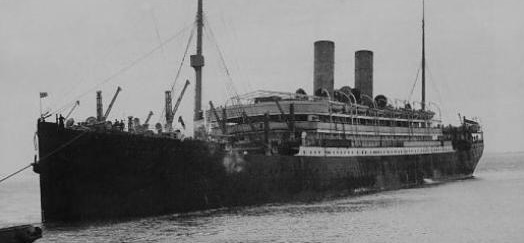
SS Barbarossa
Norddeutscher Lloyd · built 1896 · Ship Guide
Overview
SS Barbarossa was a large German passenger and cargo liner built for Norddeutscher Lloyd by Blohm & Voss at Hamburg. Launched in 1896 and entering service in 1897, she became the namesake of the Barbarossa class: a group of substantial twin-screw steamships designed to combine extensive freight capacity with accommodations for passengers in three classes.
Unlike the four-funnel express liners that soon dominated Norddeutscher Lloyd publicity, Barbarossa was intended for flexible, dependable work. She served in both the North Atlantic trade and the German mail route to Australia, carrying migrants, travelers, mail, and cargo over a long peacetime career.
This page treats Barbarossa as the Norddeutscher Lloyd liner built by Blohm & Voss and later commissioned by the United States Navy as USS Mercury. The name also appears in other historical and maritime contexts, so builder, date, operator, and later name should always be checked before attributing material.
Key Facts
Design & Construction Context
The Barbarossa class represented a deliberate effort to create large combination liners that could carry both substantial freight and large numbers of passengers without allowing cargo requirements to dominate the cabin spaces. Contemporary descriptions emphasized the concentration of cabin accommodation within a long amidships superstructure, separating passenger areas from the principal freight spaces.
This arrangement reflected a commercial strategy different from the pursuit of maximum speed. The ship needed to earn revenue from several sources and remain useful across multiple routes. Her twin-screw machinery offered a practical combination of power and redundancy, while her two-funnel profile distinguished her from Norddeutscher Lloyd’s later prestige express ships.
North Atlantic Service
On the North Atlantic, Barbarossa participated in a dense system of scheduled passenger and migration traffic connecting Germany with American ports. She was not the fastest vessel in the fleet, but her large third-class capacity made her well suited to the movement of emigrants during the peak decades of European migration.
Passenger manifests, port notices, and contemporary advertisements can document individual voyages more precisely than general fleet histories. Such records should be read with attention to departure port, arrival port, sailing date, master, and route because Norddeutscher Lloyd frequently shifted ships among services according to seasonal and commercial requirements.
Australian Mail Service
Barbarossa also served on the route between Germany and Australia. This was a long imperial mail and passenger service calling at a sequence of European, Mediterranean, Asian, and Australian ports. Her employment there demonstrates the geographic flexibility built into the class and places her within a global rather than exclusively transatlantic history.
For Australian researchers, shipping intelligence, arrival notices, passenger lists, and government records may offer a richer voyage-level picture than retrospective ship summaries. Artifacts connected to this service should ideally preserve a dated port or voyage association, since a generic Norddeutscher Lloyd item cannot establish a direct connection to Barbarossa.
Immigration Evidence
The ship’s high steerage capacity makes migration history central to her interpretation. Thousands of passengers experienced Barbarossa not as a celebrated work of naval architecture but as the physical setting for emigration, family separation, uncertainty, and arrival in a new country.
Passenger lists can preserve names, ages, occupations, last residences, destinations, and family relationships. These records transform the liner from an abstract technical subject into a documented system of human movement. When a family history identifies the ship, the manifest should still be checked against the original name, date, and route rather than relying only on later transcriptions.
Internment at Hoboken
When the First World War began in 1914, Barbarossa was unable to return safely to Germany and took refuge at Hoboken, New Jersey. She remained there under internment while the United States was neutral. Her commercial career under the German flag effectively ended at that point.
After the United States entered the war on April 6, 1917, the federal government seized the vessel. As occurred aboard several interned German ships, machinery damage inflicted before seizure had to be repaired before the ship could be placed in American service.
USS Mercury
The former Barbarossa was commissioned by the United States Navy on August 3, 1917 and renamed USS Mercury. Converted for transport work, she began transatlantic troop-carrying operations in January 1918. Before the Armistice, she completed seven voyages to France and carried more than 18,000 passengers, principally military personnel.
After the fighting ended, her task reversed. USS Mercury made eight additional crossings to return more than 20,000 troops to the United States. This wartime and repatriation record forms a major second identity for the ship and is documented extensively in U.S. naval records and photographs.
Postwar Years & Disposal
USS Mercury was decommissioned in September 1919 and transferred to the United States Army Transport Service. She later passed to the United States Shipping Board. A proposed charter for service between New York and Danzig did not develop into a lasting commercial career, and the aging liner was eventually laid up.
She was sold for scrapping in 1924. Her disposal closed a career that had encompassed German mail and passenger routes, mass migration, wartime internment, American troop transport, and postwar repatriation.
Collecting Profile
Surviving material may appear under either Barbarossa or Mercury. German-period items can include postcards, passenger lists, menus, sailing schedules, advertisements, and migration documents. American-period material may include naval photographs, troop transport records, embarkation papers, unit histories, and personal accounts.
The two identities should not be collapsed without explanation. A photograph of USS Mercury is evidence of the same hull, but it belongs to a different institutional, visual, and operational phase. Catalog records should preserve the name in use at the time an object or document was created.
Interpretive Notes
Barbarossa demonstrates that an ocean liner’s significance need not depend on speed records or elite luxury. Her importance lies in versatility: she connected continents, carried migrants in large numbers, survived the abrupt end of German commercial service, and became part of the American military transport system.
She also illustrates how political events can overwrite a ship’s original identity. The transition from Barbarossa to USS Mercury was not merely a change of name; it changed the vessel’s flag, purpose, personnel, records, and historical memory. Evidence-first interpretation should preserve both careers while distinguishing clearly between them.
A migration liner with a wider geography: Barbarossa belongs not only to the North Atlantic but also to the German passenger network serving Australia and other long-distance markets. That broader route history helps explain why surviving schedules and passenger material may fall outside the familiar Bremen–New York frame.
Her U.S. wartime identity as USS Mercury creates a hard documentary boundary. Civilian NDL material and American transport records should be cataloged under the contemporary operator and service status rather than blended into one generic career summary.
Evidence-first ship guide