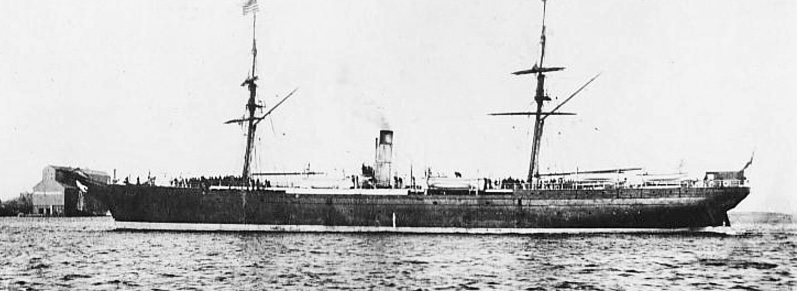
SS Batavia
Hamburg America Line · 1898 · Ship Guide
Overview
SS Batavia was a large Hamburg America Line passenger-cargo steamer built by Blohm & Voss at Hamburg. Launched on 11 March 1899 and completed in May, she was one of HAPAG’s high-capacity “B” steamers and a close sister of Bulgaria. Like the other ships of the group, she was intended principally for emigrant and freight traffic rather than for the company’s prestigious express service.
Her career extended well beyond ordinary North Atlantic work. Batavia carried German troops to China in 1900, helped rescue passengers from the wrecked Cunard liner Slavonia in 1909, briefly sailed as the Austro-Hungarian Polonia in 1913, and served as a German military transport during the First World War. She was surrendered to France after the war and ultimately broken up in the 1920s.
Evidence-first note: published tonnage and disposal dates vary. Contemporary and later references record approximately 10,178 GRT when new, about 11,464 GRT after remeasurement, and scrapping in either 1923 or 1924. This guide retains those differences rather than presenting uncertain precision.
Key Facts
Design & Construction (Context)
Batavia was built for volume, cargo capacity, and economical operation. Her hull and machinery followed the same broad emigrant-liner concept represented by Bulgaria: a moderate service speed, extensive lower-cost passenger accommodation, and holds capable of carrying commercially important freight on both eastbound and westbound passages.
Blohm & Voss equipped the ship with twin screws driven by quadruple-expansion engines. Her single funnel and two-masted profile were restrained when compared with the multi-funnel express liners of the period. That appearance reflected function: Batavia was a working migration and cargo ship rather than a floating symbol of speed.
Service History (Summary)
1899: Entry into service. Batavia began her maiden voyage from Hamburg to Baltimore on 30 May 1899. She entered HAPAG’s North Atlantic network carrying emigrants, general passengers, mail, and cargo between Germany and the United States.
1900: Transport to China. On 27 July 1900 the ship departed Bremerhaven carrying more than 2,300 German troops and their equipment for service in China during the Boxer conflict. Kaiser Wilhelm II delivered his notorious “Hun speech” at the departure ceremony, making Batavia part of a politically charged episode extending far beyond ordinary commercial shipping.
1906: Remeasurement or rebuilding. Fleet references record an increase in her registered tonnage to approximately 11,464 GRT. The change helps explain why later specifications differ from the original 1899 figures.
10–11 June 1909: Rescue of Slavonia. After the Cunard liner Slavonia stranded near Flores in the Azores, distress signals brought assistance from Batavia and Norddeutscher Lloyd’s Prinzess Irene. Together they removed the stranded liner’s passengers without loss of life; Batavia is generally credited with taking roughly 300 people.
1913: Brief career as Polonia. The ship passed to Unione Austriaca and was renamed Polonia for service from Trieste to Quebec and Montreal. The venture was short-lived, and she returned to HAPAG and resumed the name Batavia.
1914–1918: Wartime employment. At the outbreak of the First World War, Batavia remained in German waters. She was employed as a military transport and in 1917 participated in German operations connected with the Baltic landing on Ösel. After the fighting she was also used in prisoner-transport work.
1919–1920: Surrender to France. In February 1919 the ship was handed over to France under the postwar settlement. She subsequently entered the control of Messageries Maritimes, although her French career was brief.
1920s: Disposal. Aging, slow, and economically outdated in the postwar passenger market, the former HAPAG liner was withdrawn and dismantled. Sources disagree whether final breaking occurred in 1923 or 1924.
China Expedition and Route Flexibility
Batavia was built for emigrant and freight work, but HAPAG used the large "B" steamers flexibly. In 1900 she carried German troops connected with the China expedition, demonstrating how a commercial passenger-cargo liner could be diverted quickly into state transport service. In ordinary years she appeared on North Atlantic and Mediterranean schedules, including Hamburg, Baltimore, New York, and southern European ports.
Surviving HAPAG schedules also show how her passenger role evolved. By 1910 company material advertised Batavia as carrying second-cabin and steerage passengers, a useful reminder that the social history of these ships lies as much in mass migration and intermediate-class travel as in prestige accommodation.
Slavonia Rescue and the Polonia Interlude
On 11 June 1909, after Cunard's Slavonia grounded in the Azores, Batavia participated in the rescue and took aboard roughly 300 people from the stricken liner. The episode places her within the informal rescue network of scheduled liners operating across the Atlantic before dedicated long-range rescue services existed.
In 1913 she passed briefly to Unione Austriaca and became Polonia, serving from Trieste on Mediterranean and Canadian routes before returning to HAPAG and reverting to Batavia. After wartime transport use, she was surrendered to France and passed to Messageries Maritimes; sources differ between 1923 and 1924 for the final scrapping date, so this guide retains that uncertainty rather than forcing false precision.
Interpretive Notes
Batavia demonstrates the versatility expected of large emigrant steamers. The same ship could carry thousands of civilian migrants, military formations, disaster survivors, and prisoners, depending upon the demands placed on the merchant fleet.
The rescue of Slavonia is especially significant because it occurred during the transition from older distress practices to wireless emergency communication. The episode is often associated with one of the earliest widely reported uses of the SOS signal, and it showed how nearby liners could function as an improvised rescue network in remote waters.
Her 1913 transfer also links her directly with sister ship Bulgaria. As Polonia and Canada, respectively, the two vessels briefly tested a Trieste-to-Canada route before both returned to HAPAG. Their parallel careers make the pair useful for understanding how shipping companies experimented with routes and redeployed large, specialized vessels when traffic failed to develop.
Evidence-first ship guideSources (Selected)
Use these as a starting index and corroborate publish-ready details with German registers, HAPAG schedules, passenger manifests, military transport records, and contemporary reporting on the Slavonia rescue and the 1900 China expedition.
- Ocean Liner Curator — Sources (master bibliography)
- Norway Heritage — SS Batavia
- GG Archives — SS Batavia Archival Collection
- GG Archives — SS Batavia Passenger Lists
- Archives maritimes — Batavia and the rescue of Slavonia
- German-language fleet summary — HAPAG “B” steamers (starting index; corroborate key facts)