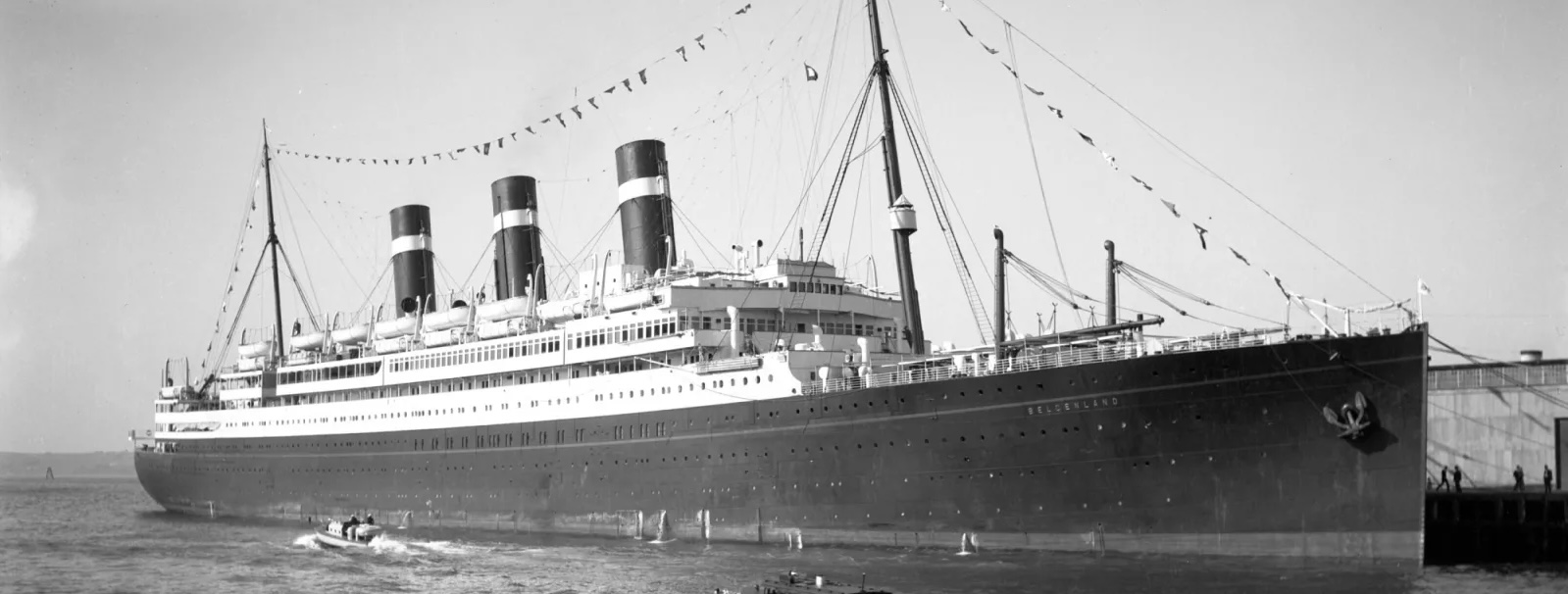
SS Belgenland
Red Star Line · passenger service from 1923 · Ship Guide
Overview
SS Belgenland was the largest and most ambitious ship operated by Red Star Line—conceived before the First World War, finished in a wartime configuration under a different name, then rebuilt into the passenger liner that collectors recognize today. Launched in Belfast in late 1914, she was completed in June 1917 as Belgic (for White Star Line) with altered fittings suited to war service. Only in 1923 did she finally emerge as the lavishly rebuilt Belgenland—three-funnel profile restored, passenger spaces completed, and Red Star’s flagship status made real.
In the 1920s and early 1930s, Belgenland became a true “paper trail ship”: transatlantic crossings plus headline-making round-the-world cruises that produced a heavy record of menus, passenger lists, brochures, postcards, baggage labels, and onboard stationery—often dated and port-specific in a way that rewards careful cataloging.
Evidence-first note: Belgenland has a built-in identity trap because her name changes map onto different physical states of the same hull: prewar “Belgenland” plans, wartime Belgic completion, postwar rebuild as Belgenland, and late-career rename to Columbia (1935). When attributing images or ephemera, anchor to a date range and the name used at that time.
Key Facts
Design & Construction (Context)
Belgenland is a textbook example of how global events can “fork” a ship’s design history. She was ordered as a prestige liner, but wartime priorities forced a practical completion: altered superstructure, changed cargo-handling needs, and an interim identity as Belgic. The postwar rebuild (completed for passenger service in 1923) restored the ship’s intended public face—most visibly in her three-funnel profile and multi-deck passenger superstructure.
Collector takeaway: when an interior photograph, menu, or letterhead “looks too grand” (or too plain) to match the date claimed, your instinct is probably right. For this ship, “as built,” “as completed,” and “as rebuilt” are materially different physical realities.
Service History (Summary)
1914–1919: Launch and wartime completion. Launched at the end of 1914, the ship’s completion was delayed and reshaped by war. She was finished in 1917 as Belgic, initially without the fully realized passenger configuration that collectors associate with the later Red Star flagship.
1923: Return to Red Star and full passenger rebuild. In 1923 the ship emerged as Belgenland—a rebuilt liner and the largest vessel Red Star ever operated. This is the “collectible era” baseline: the dining rooms, cabin categories, and branded Red Star printed matter that show up in the market overwhelmingly trace to this post-rebuild state.
1924–1931: Cruises and publicity. Belgenland became widely associated with long cruises—including round-the-world itineraries departing New York in winter and returning in spring. This period produced rich documentation: cruise brochures, port programs, passenger list booklets, souvenir postcards, and menus often printed for named legs of an itinerary.
1930–1931: Communications as a modernity signal. The ship is frequently noted in connection with long-range radiotelephone experiments, reflecting how shipping companies marketed not just comfort but connectivity—an early “ship as network node” story.
1931–1934: Depression-era repositioning. Like many liners, Belgenland shifted toward shorter cruises as the Great Depression reshaped demand. This is a common point where ephemera becomes easy to mis-date: materials labeled “cruise” may be Bermuda/Caribbean short cruises rather than world travel.
1935–1936: Columbia and the end. Renamed Columbia in 1935 under Panama Pacific Line management, she briefly operated cruises out of New York before being laid up and sold for scrap. In 1936 she crossed the Atlantic for the final time and was broken up at Bo’ness on the Firth of Forth.
Interpretive Notes
Belgenland is a “label discipline” ship. Many items are legitimately from her—but sellers often compress her entire life into a single identity. Strong catalog records use the trio: (1) name used at the time, (2) date band, and (3) route context. A postcard that simply says “Belgenland” should be treated as a starting clue, not a conclusion.
A second caution is the Columbia rename. Items from 1935–36 may be branded Panama Pacific Line or U.S.-registered and still depict the same hull. If you publish or sell an object, name the ship as it appears on the item and then clarify (in a note) the continuity of identity.
Why the rebuild matters: Belgenland is unusual because launch date alone does not describe the passenger liner familiar from Red Star material. The wartime Belgic configuration and the 1923 passenger reconstruction belong to different physical and documentary states. That distinction is especially important when dating photographs, deck plans, brochures, and interior views.
The world-cruise phase also changes how surviving material should be read. A Red Star item tied to a winter circumnavigation documents leisure travel, itinerary marketing, and port-by-port consumption rather than the ordinary migration and scheduled-crossing economy of the North Atlantic. Cruise material therefore deserves its own route and date context rather than being folded into generic “Belgenland service.”
Evidence-first ship guide