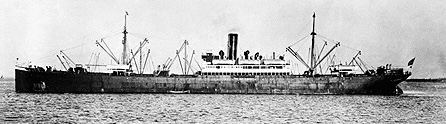
SS Belgravia
Hamburg America Line · 1898 · Ship Guide
Overview
SS Belgravia was a large Hamburg America Line passenger-cargo steamer built by Blohm & Voss at Hamburg. Launched on 10 May 1899 and entering service that August, she formed part of HAPAG’s substantial fleet of high-capacity emigrant steamers intended to move passengers and freight between continental Europe and North America.
Her commercial North Atlantic career was comparatively brief. In 1905 she passed to the Imperial Russian Navy and was renamed Riga. After the Russian Revolution she continued under Soviet control, receiving the name Transbalt in 1920. Remarkably, the 1899-built ship remained in service into the closing weeks of the Second World War, when she was torpedoed and sunk in error by the American submarine USS Spadefish in La Pérouse Strait on 13 June 1945.
Identification note: an earlier Anchor Line vessel also bore the name Belgravia. This guide concerns the Hamburg America Line ship launched at Hamburg in 1899, later known as Riga and Transbalt.
Key Facts
Design & Construction (Context)
Belgravia belonged to HAPAG’s group of large, moderately powered passenger-cargo steamers designed around capacity rather than express speed. Her long steel hull, one-funnel profile, and twin-screw machinery closely reflected the practical requirements of the emigrant trade: large accommodation spaces, substantial cargo volume, and dependable economy over prestige.
Contemporary descriptions place her among the company’s steerage-oriented steamers. In 1903, reporting on emigration through Hamburg specifically grouped Belgravia with Batavia and Bulgaria as regular HAPAG ships carrying steerage passengers. Her recorded gross tonnage changed after rebuilding and later remeasurement, which explains the differing figures found in ship lists and naval-era sources.
Service History (Summary)
1899: Entry into HAPAG service. Belgravia was launched at Hamburg on 10 May 1899 and began her maiden voyage from Hamburg to Baltimore on 16 August. She entered service as a mixed passenger and cargo liner serving the migration traffic between Europe and the United States.
1900: Rebuilding and remeasurement. The ship was rebuilt or altered soon after entering service, and her gross register tonnage was subsequently recorded at approximately 10,982 tons. Later references commonly list a still higher figure of about 11,439 tons, illustrating the need to identify the date and measurement basis behind any quoted specification.
North Atlantic emigrant service. During her HAPAG career, Belgravia operated principally as a capacity carrier rather than a prestige liner. Passenger lists document voyages from Hamburg and Mediterranean ports to the United States, while company sailing notices placed her alongside other large emigrant steamers on HAPAG’s North Atlantic network.
1905: Transfer to Russia. In 1905 the vessel left HAPAG ownership and entered the Imperial Russian Navy under the name Riga. This ended her short career as a German transatlantic liner and began four decades of Russian and Soviet use.
1920: Renamed Transbalt. Following revolution and civil war, the former Belgravia remained under Soviet control and was renamed Transbalt. She continued as a merchant passenger-cargo and transport vessel, surviving long beyond the normal commercial life expected of an emigrant steamer built in the 1890s.
13 June 1945: Sunk in error. Near the end of the Pacific War, USS Spadefish encountered Transbalt in La Pérouse Strait. The American submarine identified and attacked her as an enemy target, unaware that she was Soviet. The ship was torpedoed and sunk; published accounts record five crew fatalities. The loss occurred less than two months before Japan’s surrender.
Beyond the Hamburg America Line
Belgravia's HAPAG career was comparatively brief, but the ship survived for decades after leaving German commercial service. Sold to Russia in 1905 and renamed Riga, she became part of a very different maritime system from the emigrant-oriented North Atlantic network for which she had been built.
After the Russian Revolution the vessel was renamed Transbalt. Her long second life is especially valuable for interpretation because it shows how a late-nineteenth-century German passenger-cargo liner could be repurposed repeatedly as ownership, state structures, and trading patterns changed.
Final Wartime Loss
The former Belgravia survived into the Second World War. Sailing as the Soviet Transbalt, she was torpedoed and sunk in La Pérouse Strait in 1945 by the American submarine USS Spadefish, which attacked her in error. That ending, almost half a century after launch, makes her career unusually long for a HAPAG emigrant steamer of the 1890s.
For curatorial purposes, material from her German, Russian, and Soviet identities should be treated as one continuous ship biography rather than as unrelated vessels. Name changes can otherwise obscure how much of the same physical ship persisted across three political eras and two world wars.
Interpretive Notes
Belgravia is significant because her career links three very different maritime systems. She began as an instrument of mass migration, became an Imperial Russian naval auxiliary, and finally served Soviet transport needs through two world wars.
Her longevity is especially striking. By 1945, the ship’s one-funnel, quadruple-expansion design belonged visibly to another era, yet the hull remained useful enough to continue operating nearly forty-six years after launch.
The circumstances of her loss also illustrate the limits of wartime identification. The sinking was not the result of hostility between the United States and Soviet Union, but of an operational misidentification in waters where shipping movements, route restrictions, and incomplete intelligence could turn an allied merchant vessel into a target.
Evidence-first ship guideSources (Selected)
Use these as a starting index and corroborate publish-ready details with HAPAG registers, Blohm & Voss construction records, Russian and Soviet naval documentation, passenger manifests, and USS Spadefish patrol reports.
- Ocean Liner Curator — Sources (master bibliography)
- Norway Heritage — SS Belgravia
- GG Archives — SS Belgravia Archival Collection
- Naval History and Heritage Command — SS Transbalt photograph and identification
- Maritime Timetable Images — Hamburg America Line sailing schedules
- GG Archives — Emigration to the United States via Hamburg (1903)