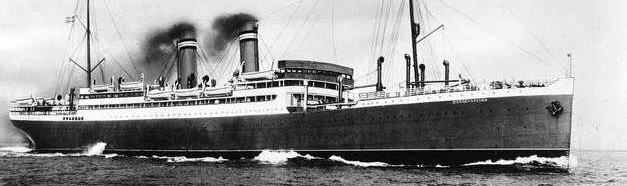
SS Bergensfjord
Norwegian America Line · entered service 1913 · Ship Guide
Overview
SS Bergensfjord was one of the foundational liners of the Norwegian America Line, built for direct service between Norway and New York at a time when most Scandinavian emigrants still reached the Atlantic through continental transfer ports. Together with her near-sister Kristianiafjord, she helped define a specifically Norwegian transatlantic liner identity: modern, efficient, nationally branded, and closely tied to emigration, return travel, and later cruising. Her long career also makes her unusual among pre-First World War liners, since she survived both world wars, served as a troopship, and continued under later names long after her original Norwegian America Line life had ended.
In collecting and interpretation, Bergensfjord is best divided into several clearly separate phases: prewar Norwegian America Line emigrant and passenger service, interwar liner and cruise service, wartime troopship service under British control, and postwar service under later names. Those phases should not be merged casually, because the ship’s identity, ownership, and documentary character changed substantially over time.
Key Facts
Published particulars differ slightly in some secondary sources, especially where later conversions and postwar service are summarized. For cataloging purposes, it is best to preserve the precise wording and measurement system used by the original source behind a given artifact or description.
Design & Construction Context
Bergensfjord was built for a distinctively Norwegian purpose: direct transatlantic service from Norwegian ports to New York without the intermediate continental connections that had long shaped emigrant travel. In that sense, she was not just another medium-sized Atlantic liner, but part of a national transport project that materially shortened and simplified the voyage from Norway to the United States.
Her design combined respectable first- and second-class accommodation with a much larger third-class capacity, which reflects the practical realities of Scandinavian emigrant and family travel before the First World War. She also helped establish the visual and commercial identity of the Norwegian America Line in its formative years, making her important well beyond her raw dimensions.
Service History (Summary)
1913 construction and entry into service: Built by Cammell Laird at Birkenhead, Bergensfjord was launched on 8 April 1913 and entered service in September of the same year. She began her maiden voyage on 25 September 1913 from Kristiania to New York via Kristiansand, Stavanger, and Bergen.
Prewar Norwegian America Line service: Her early career belongs to the direct Norway–New York emigrant and passenger route that defined the Norwegian America Line. This is the proper interpretive frame for passenger lists, route brochures, deck plans, postcards, and commercial photographs tied to her original service identity.
Interwar service and cruises: After the First World War, Bergensfjord resumed liner service and also participated in cruise work. This broadened her documentary footprint beyond strict emigrant travel, making later material more varied in tone and audience than her earliest service records.
Second World War troopship phase: During the Second World War she was requisitioned and used as a troopship under British wartime management. At that stage her identity shifted decisively from commercial passenger liner to military transport vessel, and records from this phase belong to a different historical category from peacetime line material.
Postwar career under new names: After the war she returned briefly to Norwegian ownership, then passed into South American and later Israeli service, sailing as Argentina, then Jerusalem, and finally Aliya. This unusually long afterlife means that not all material bearing the hull’s later image or silhouette should be interpreted as Norwegian America Line material.
End of career: After a long and multi-identity life extending into the 1950s, the ship was scrapped at La Spezia in 1959. Few liners launched in 1913 had careers that stretched so far beyond their original emigrant-era context.
Interpretive Notes
This is a Norwegian national-route liner first: Bergensfjord should be understood primarily through the Norwegian America Line’s direct service model, not through the British or German express-liner frame that dominates much ocean-liner popular history.
Third-class and emigrant context matter deeply: the ship’s passenger balance helps explain the kinds of surviving material most often associated with her original service—emigrant documentation, family travel, route ephemera, and nationally framed advertising.
Her long career creates attribution risks: because the same hull later sailed under different owners and names, collectors should be careful not to assign later images, menus, or publicity material automatically to the Norwegian America Line phase.
Wartime service belongs to a separate interpretive world: troopship references, Ministry of War Transport records, and wartime photography should not be blended casually with prewar emigrant-line material, even when they concern the same vessel.
She matters beyond size or luxury: Bergensfjord is historically important not because she was among the largest Atlantic liners, but because she helped make direct Norwegian transatlantic sailings a durable and recognizable reality.
Evidence-first ship guideSources (Selected)
- Ocean Liner Curator — Sources (master bibliography)
- SS Bergensfjord — overview chronology, technical particulars, and later-name history
- Norway Heritage — vessel particulars, passenger capacity, and Norwegian America Line service context
- Norway Heritage — image and narrative context for Bergensfjord
- Warsailors — wartime context and photographic material for Bergensfjord